
[IBM Research] PRISM: Why Mid-Training is the Secret Sauce for LLM Reasoning
PRISM: Demystifying Retention and Interaction in Mid-Training
The paper introduces PRISM, a systematic study of mid-training design for Large Language Models (LLMs). It demonstrates that a mid-training phase of ~27B high-quality tokens consistently boosts math (+15-40 pts), code (+5-12 pts), and science (+6-13 pts) performance across seven model families (3B-24B) while preserving general capabilities.
The trajectory of LLM development has shifted from a simple "Pre-train → Align" duo to a more nuanced "Pre-train → Mid-train → Align" trio. While pre-training provides knowledge and RL provides style/safety, a new paper from IBM Research and MIT-IBM Watson AI Lab, titled PRISM, argues that mid-training is where "reasoning" is actually born.
TL;DR
PRISM (Demystifying Retention and Interaction in Mid-Training) is an exhaustive empirical study across 7 model families (Granite, LLaMA, Mistral, Nemotron-H) and scales (3B to 24B). The core finding: Mid-training is not just a minor tune-up; it is a fundamental architectural restructuring. By spending ~27B tokens on high-quality reasoning data, models gain up to 40 points in math and unlock the ability for RL to actually work on hard tasks like AIME.
The Problem: The "Base Model" Wall
Most researchers have noticed a frustrating trend: applying RL (like PPO or GRPO) directly to a base model often results in "AIME scores near zero." The model lacks the "Chain-of-Thought" (CoT) intuition needed to even begin exploring the solution space. Prior mid-training attempts often solved this but caused "Generalization Regression"—the model became a math calculator but forgot how to speak normally.
Methodology: The Anatomy of a Reasoning Pipeline
PRISM decomposes mid-training into three critical axis: Retention, Domain Interaction, and RL-Compatibility.
1. Data Composition is King
The authors found that performance is highly sensitive to the mix. A balanced diet of General Web Data (DCLM-EDU), Math, Code, and Science reasoning traces is required.
2. The Mechanics: Dense vs. Sparse
This is the paper's most profound insight. By analyzing weight divergence (), the authors found:
- Mid-training is DENSE: It restructures >90% of the model's weights. It is effectively "re-wiring" the brain for logic.
- RL is SPARSE: It refines only ~5% of the weights.
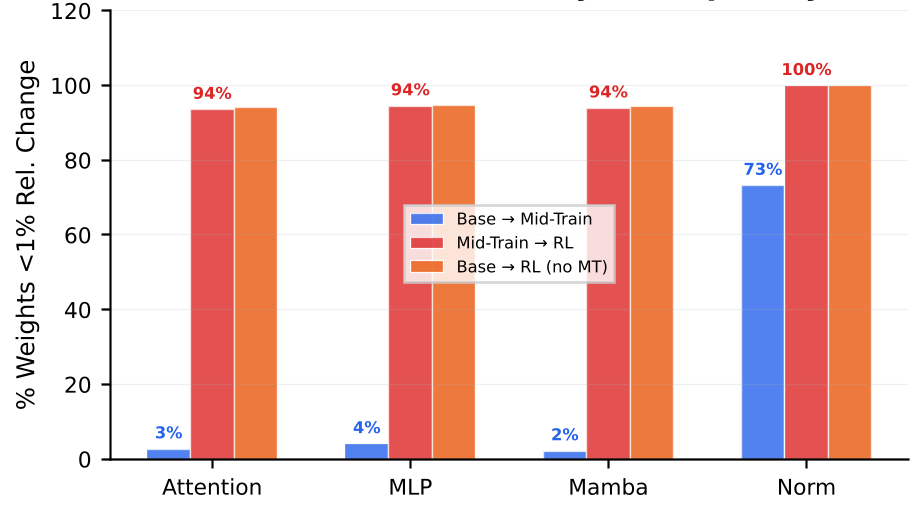 Figure: Difference in weight divergence between Mid-training (Blue) and RL (Red).
Key Results: Unlocking the RL Frontier
The results across benchmarks are staggering. The "Full Pipeline" (Base → PRISM → RL) improves the macro-average of six reasoning benchmarks by 3-4×.
- Math (MATH500): LLaMA-3.1 8B jumped from 6.51 to 73.47.
- The "Science Unlock": Including science data in mid-training is the only way to get high GPQA scores after RL. Even if you don't use science data in RL, the mid-training stage creates the "representational geometry" required to solve PhD-level science.
 Table: The PRISM→RL hierarchy across LLaMA, Granite, and Mistral.
Deep Insight: Representational Preservation
Using Centered Kernel Alignment (CKA), the authors proved that RL almost perfectly preserves the representational geometry established by mid-training ().
The takeaway for researchers? If your model's representations aren't "reasoning-ready" after mid-training, no amount of RL will save it. RL targets the same sub-components (mostly Value and Output projections) regardless of where the model starts, but it only "clicks" if mid-training has already set the stage.
Critical Analysis & Conclusion
PRISM provides a rare, high-scale look under the hood of "hidden" training stages used by industry leaders. It clarifies that mid-training is the stage that teaches the model to produce extended reasoning chains (shifting median response length from ~150 to >2,000 tokens).
Limitations:
- The study peaks at 24B parameters; whether these dynamics hold at 70B+ or 405B remains a "scaling law" question.
- RL prompt selection was model-agnostic; model-specific filtering would likely push these SOTA numbers even higher.
In conclusion, PRISM proves that mid-training is the "Heavy Lifting" phase of modern AI. It is the bridge that transforms a knowledge-rich base model into a logic-driven reasoning agent.