
Strengthening Weak Secrets: Leveraging Social Topology for Privacy Amplification
Privacy Amplification with Social Networks
The paper introduces a decentralized privacy amplification mechanism that leverages social network topologies to strengthen weak pre-shared secrets. By utilizing Markovian random walks to identify common acquaintances (intersecting nodes), the protocol extracts additional entropy from the network to establish a computationally secure key.
TL;DR
Common cryptographic practices often suffer from a "chicken and egg" problem: how do two parties establish a strong key if they only share a weak password or distrust the central infrastructure? This paper proposes a decentralized solution using Social Network Topologies. By performing random walks across a graph of acquaintances, users can "harvest" entropy from the network structure itself, turning a 6-character password into a cryptographically robust key in just about 7 hops.
Problem: The "God-Adversary" and Weak Passwords
Most secret key agreement protocols assume either a trusted third party or a source of common randomness (like a satellite). However, if the adversary is a nation-state that controls the satellite, the security collapses. On the other hand, users often default to low-entropy, memorable passwords that are easily cracked.
The author, Shishir Nagaraja, identifies two primary gaps:
- Centralization Risk: Dependence on external random sources that an adversary can monitor.
- Human Factor: The inherent weakness of human-generated secrets.
The Insight: Social Networks as Entropy Sources
The core intuition is the Small-World Phenomenon. We are all connected by a short chain of acquaintances. If Alice and Bob share a weak secret, they can use it to "steer" a random walk through their social graph. Because social networks have specific "mixing properties," these walks quickly explore the network and find common, reliable nodes to provide "entropy tokens."
The Keyed Random Walk Mechanism
Instead of a simple random walk, the author suggests a Keyed Random Walk.
- Alice uses her weak key to decide which edges to follow at each node.
- The walk moves from neighbor to neighbor, collecting "tokens" (hashes of secrets and node-specific random strings).
- Bob does the same. If the network "mixes" well, their walks will naturally intersect at specific nodes.
- The final strong key is a hash of the original weak key and all the collected tokens from the intersection.

Why It Works: Mixing and Convergence
The paper dives deep into graph theory, specifically looking at Conductance (). Conductance measures how easily a random walk can escape a subset of nodes.
- In Scale-Free networks (like the internet or large social groups), the conductance is high and constant, meaning the walk doesn't get "stuck."
- Convergence: The authors prove that the number of steps needed to reach a "stationary distribution" (where any node is equally likely to be visited) is only .
Practical Results
The simulations compared different network models:
- Erdős-Rényi (Random): Takes ~7 hops.
- Barabási-Albert (Scale-Free): Takes ~6 hops.
- Watts-Strogatz (Small-World): Converges quickly (6-7 hops) if there are enough "long-range" links.
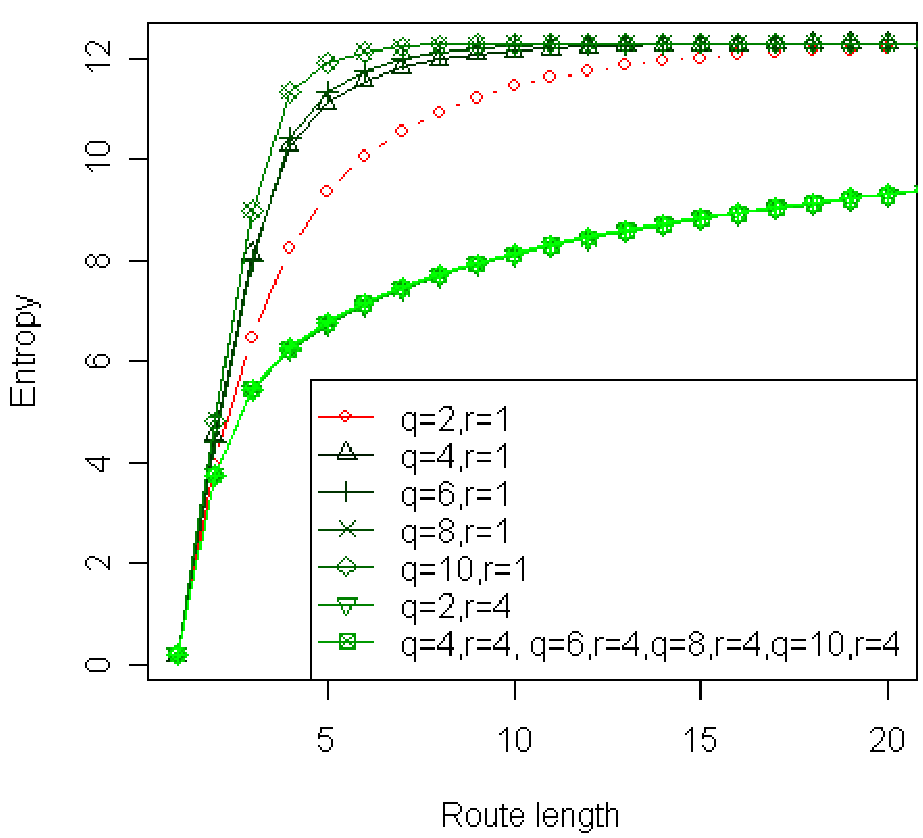 Figure 5: Normalised entropy vs. walk length. Notice how Scale-Free networks reach maximum entropy (1.0) significantly faster than others.
Security against Sybil Attacks
One of the most elegant aspects of this method is its resistance to Sybil Attacks (where an attacker creates thousands of fake identities). Because Sybil nodes are usually "loosely connected" to the real social graph through only a few bridge nodes, a random walk is statistically unlikely to stay within a Sybil region. It will naturally "flow" back into the well-connected, honest part of the network.
Conclusion & Critical Analysis
Takeaway: This work turns the "social" into "security." It proves that the structure of human relationships is mathematically sufficient to amplify cryptographic strength.
Limitations:
- Local Knowledge: The protocol assumes nodes are willing to share their neighbor lists, which might be a privacy concern in itself.
- Churn: Social networks are dynamic; if "friends" go offline, the walk might fail.
Future Outlook: This approach is highly relevant for today's decentralized web (Web3) and encrypted messaging apps. Using the "Introduction Graph" to secure the communication channel provides a layer of security that even the most powerful central authority cannot easily break without subverting the social fabric itself.
Main Reference: Nagaraja, S. "Privacy Amplification with Social Networks." University of Cambridge.