
Digital Onboarding: The Hidden Privacy Risks of OSN Registration
Privacy-aware Data Assessment of Online Social Network Registration Processes
This paper presents a privacy-aware assessment of registration processes across 11 popular Online Social Networks (OSNs), including Facebook, LinkedIn, and Twitter. Using business process modeling (BPMN), the authors identify minimum data requirements and map these attributes to potential attack vectors like profile cloning and social phishing.
TL;DR
While we obsess over privacy settings after joining a social network, we often ignore the initial registration door. This research analyzes 11 major OSNs (Facebook, Xing, etc.) to show that even "minimal" registration data provides enough fuel for sophisticated phishing and profile cloning attacks. The authors propose a standardized model to visualize these risks and advocate for more privacy-centric registration designs.
The "Initial Contact" Problem
Most privacy research focuses on what happens once you are "inside" a network—who can see your posts or how your data is sold. However, the Registration Process is the first moment of data exchange.
The core problem identified is a lack of awareness regarding the Inductive Bias of registration forms. By asking for "optional" data like birthdays or phone numbers during sign-up, OSNs create a "digital dossier" before a user has even interacted with a single person. This data is the primary fuel for:
- Same-site/Cross-site Profile Cloning: Copying your identity to a new platform to scam your existing friends.
- Social Phishing: Using personal details to make fraudulent emails four times more effective.
Methodology: The Avatar Approach
To analyze how different domains (Business, Leisure, Research) handle data, the authors created standardized "avatars" to navigate the sign-up flows of 11 platforms.
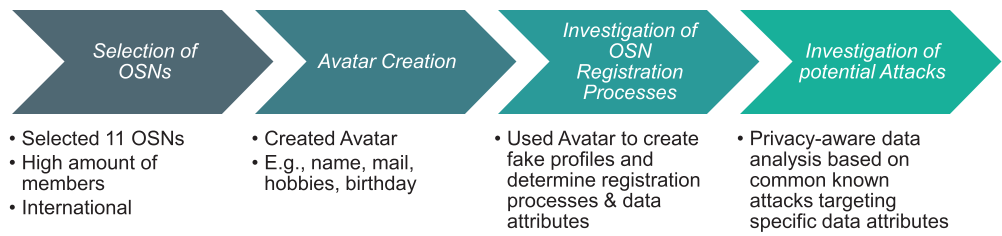
They used Business Process Model and Notation (BPMN) to formalize the registration steps, moving beyond simple checklists to see how data flows through the system.
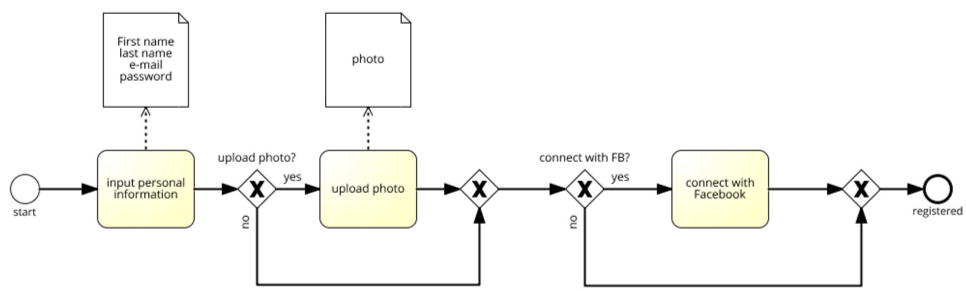
The Reference Registration Model
The authors found a surprising "smallest common denominator." If you only look at what is strictly required by every single OSN, it is just an Email and Password.
However, to create a functional "Reference Process Model," they looked at attributes requested by at least 50% of platforms. This revealed that First Name, Last Name, and often Gender/Birthday are standard requirements that users provide almost reflexively.
Mapping Data to Danger
The most impactful part of the study is the mapping of data attributes to specific attack scenarios. The table below illustrates how seemingly innocuous fields like "Birthday" or "Friendlist" are utilized by attackers.
| Data Attribute | Phishing | Profile Cloning | Fake Profiles | Face Recognition |
|---|---|---|---|---|
| Public Profile | ✓ | ✓ | ✓ | |
| ✓ | ||||
| Birthday | ✓ | |||
| Photographs | ✓ | |||
| Friendlist | ✓ | ✓ |
The researchers note that while much of this information is "optional," the design of the UI often nudges users to fill it in, leading to Information Leaks and the potential for De-anonymization.
Critical Insight: The Future of Privacy-Aware Registration
The paper concludes that current commercial OSNs are unlikely to minimize data collection voluntarily because personal information is the "gold" of digital marketing.
The Takeaway for Developers and Researchers:
- Attribute-Based Encryption (ABE): We should move toward systems where users define access policies via cryptographic keys rather than trusting a central server.
- Minimalism by Design: Registration should strictly adhere to the "minimal data" requirement (Email/Password) and phase in other attributes only when functionality requires them.
- User Agency: There is a desperate need for tools that simulate the "attack surface" of a registration form before the user hits "Submit."
Conclusion
This study serves as a forensic look at the "birth" of a digital identity. By standardizing the registration process into a BPMN model, the authors provide a framework for future researchers to audit new platforms and protect users from the moment they first log in.