
Acoustic Privacy: Recognizing Human Activity Without Eavesdropping
Privacy-aware environmental sound classification for indoor human activity recognition
The paper presents a privacy-aware indoor human activity recognition system using Environmental Sound Classification (ESC). By stripping human voice bands (300Hz - 3kHz) at the source, the authors achieve an 85%+ classification accuracy across five activity classes using a combined feature set and an SVM classifier.
TL;DR
Researchers from the University of Twente have developed a system that identifies indoor human activities (walking, door slamming, etc.) using sound while intentionally "deafening" the sensor to human speech. By stripping the 300Hz-3kHz voice band, they protect privacy at the device layer while maintaining over 85% recognition accuracy using optimized machine learning features.
Context: The Smart Building Dilemma
In the quest for "Smart Buildings," understanding occupant behavior is essential for optimizing HVAC and lighting. However, common sensors are flawed: cameras are intrusive, PIR sensors are too simple (detecting only motion), and wearables are cumbersome. Microphones offer a rich middle ground but bring a "Big Brother" anxiety—nobody wants their private conversations recorded.
The authors' insight is simple yet profound: Human speech is narrow-band, but environmental sounds are wide-band. By filtering out the frequencies where human conversation lives, we can retain the "physics" of the room's activity without the "content" of the speech.
Methodology: Privacy by Subtraction
The core innovation lies in Voice Band Stripping. Using a band-stop filter, the system removes the 300Hz to 3kHz range.

Feature Engineering for "Muted" Audio
When you remove the core frequency of speech, traditional features like MFCC (Mel Frequency Cepstral Coefficients)—which are modeled after human hearing—lose their effectiveness.
- The Hero: LPCC. Unlike MFCC, Linear Predictive Cepstral Coefficients (LPCC) provide a smoothed spectral envelope across the entire range without prioritizing speech-heavy frequencies.
- Feature Fusion: The authors used a greedy search to find the optimal cocktail: LPCC + Spectral Flux + Short Time Energy (STE) + Temporal Entropy. This combination captures both the static "fingerprint" of the sound and its dynamic change over time.
Experiments and Results
The team tested the system against five classes: Speech, Crowd/Chatting, Walking, Door Slamming, and Chair Moving.
Key Findings:
- Robustness to Filtering: While MFCC accuracy plummeted from 82% to 77% after stripping voice bands, LPCC remained consistent, proving it is the superior choice for privacy-aware systems.
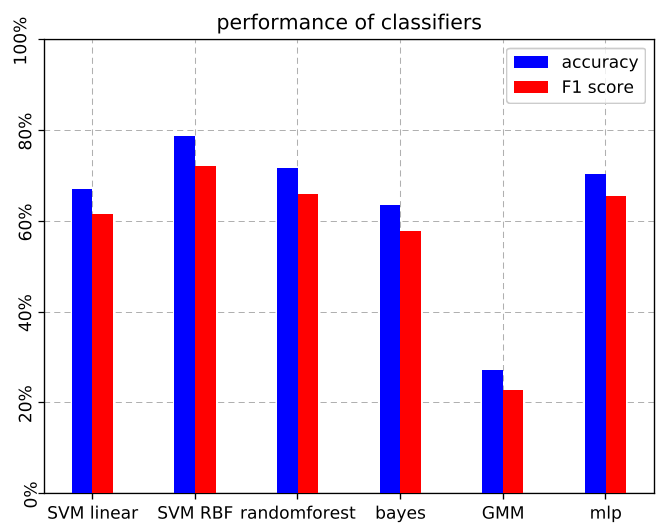
- Model Performance: SVM with an RBF kernel outperformed Neural Networks, likely due to the limited dataset size (150 samples per class).
- Confidence Filtering: By applying Platt Scaling, the system assigns a probability to each guess. If the system only acts on its top 50% "most confident" guesses, accuracy jumps to over 90%.
Critical Insight: The "Door vs. Footstep" Challenge
The confusion matrix revealed that "Door Slamming" and "Walking (Footsteps)" are the most easily confused. This occurs when a single footstep is mistaken for a sharp door click. However, the authors argue that in a real-world deployment, Spatial Context (e.g., sound localization) would resolve this—since a door location is fixed and a human is mobile.
Conclusion
This work fills a vital gap in the IoT ecosystem. It proves that we do not need to choose between data-driven intelligence and personal privacy. By intentionally limiting the "vision" (or rather, "hearing") of our sensors to non-human frequencies, we can build smarter, more ethical environments.
Takeaway: For future IoT developers, the lesson is clear—sometimes, what you choose NOT to sense is just as important as what you do.