
Policy-Driven Decentralization: Solving the Privacy-Availability Paradox in DOSNs
A Privacy-Aware Framework for Decentralized Online Social Networks
The paper introduces a privacy-aware framework for Decentralized Online Social Networks (DOSNs) that leverages XACML-based policies for both access control and data allocation. The core method, validated using real Facebook trace simulations, ensures data availability when users are offline by replicating profiles only to nodes that satisfy the owner's privacy criteria, significantly reducing the need for heavy encryption.
TL;DR
Current social media platforms force a trade-off between convenience and privacy. Decentralized Online Social Networks (DOSNs) aim to return control to users, but they face a major hurdle: How do you keep data online when the owner is offline without handing it to strangers? This paper proposes a framework that uses XACML privacy policies to decide exactly where to store data replicas, ensuring your profile only lives on nodes you already trust, thereby bypassing the overhead of constant encryption.
The Core Problem: The Delegation Dilemma
In a centralized network (like Facebook), you delegate your data to a provider. In a decentralized network, your data disappears when you go offline unless it is replicated.
Prior works typically solve this by:
- Encrypted Replication: Storing encrypted chunks on random peers. Issue: High overhead, key management complexity.
- Simple ACLs: Basic "Public/Private" settings. Issue: Too blunt for real-world social nuances like "close friends" vs "acquaintances."
The authors argue that the infrastructure needs to be "Privacy-Aware." If your friend Bob is already allowed to see your photos, why not store your backup on Bob's node in clear text?
Methodology: Privacy as an Infrastructure Layer
The framework splits the DOSN into two layers: the Service Layer (user interaction) and the Infrastructure Layer (storage/overlay). The "Magic" happens in the Authorization System.
1. XACML Integration
Instead of hardcoding rules, the authors use the eXtensible Access Control Markup Language (XACML). This allow policies based on:
- Tie Strength: Frequency of interaction.
- Common Friends: Mutual connection thresholds.
- Social Context: E.g., "Allow friends of Alice, unless they are also friends with Bob."
2. Smart Allocation Logic
When a user disconnects, the system triggers an "Election Procedure":
- Identify online neighbors.
- Run the privacy policy against these neighbors.
- Rank neighbors: Those who have Access Rights get the profile in clear text.
- Only if no "trusted" nodes are found does the system revert to traditional encryption.
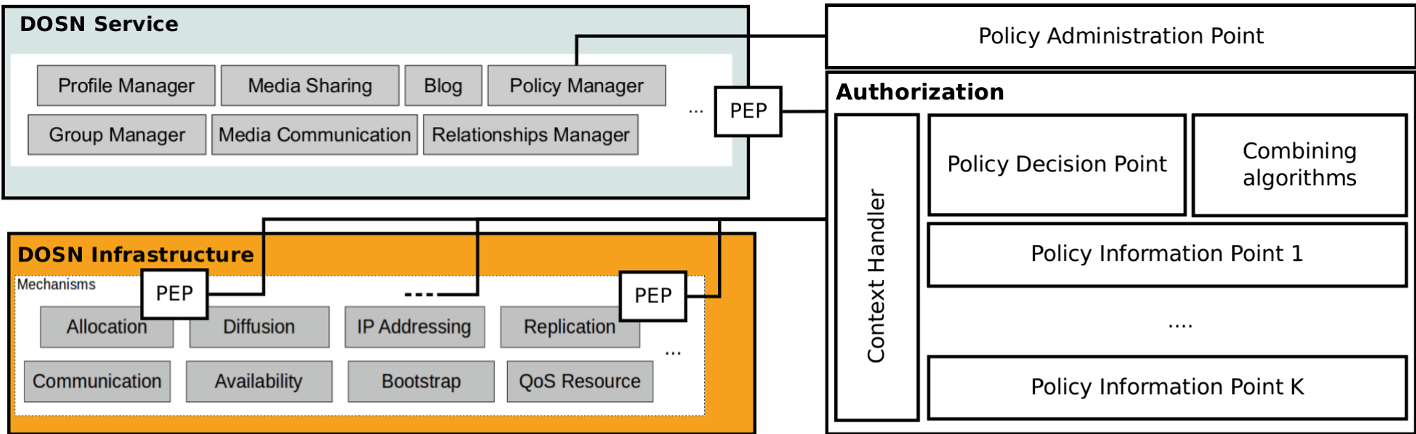 Figure 1: The dual-layer architecture showing how the Authorization System bridges social services and underlying data storage.
Experimental Validation: Real-World Traces
The authors didn't just test this in a vacuum; they used SocialCircles!, a Facebook app, to gather data from 144,481 users. They tracked online/offline status every 8 minutes for 10 days to see how often "elections" (data migrations) would occur.
Key Performance Metrics:
- Efficiency: Evaluating a policy for all neighbors takes between 2ms and 195ms.
- The "Common Friend" Bottleneck: Calculating mutual friends is the most expensive operation (80% of execution time for complex policies) but still remains well within acceptable limits for a background process.
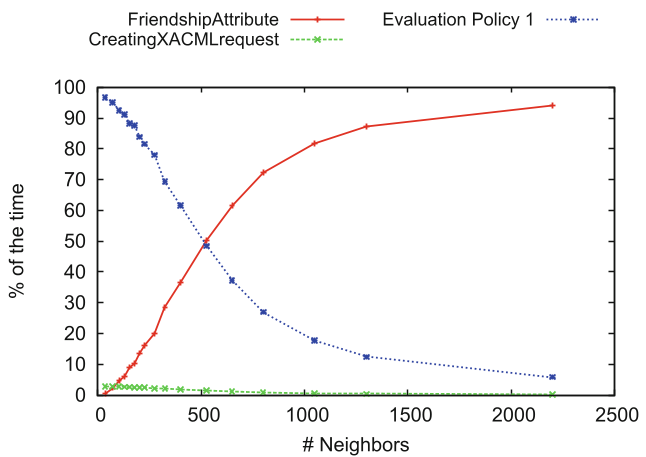 Figure 2: Breakdown of evaluation times. While attribute computation (PIP) scales with the number of neighbors, it remains feasible for real-time operation.
Critical Analysis & Takeaways
Why this is a SOTA shift:
Most DOSN research focuses either on distributed hash tables (DHTs) for speed or cryptography for privacy. This paper bridges the gap by treating Privacy as Metadata that informs the network topology. It reduces the computational cost of the network by using social trust as a substitute for cryptographic gates.
Limitations:
- Integrity: The paper acknowledges but does not solve the problem of data tampering. If Bob hosts Alice's data, what stops Bob from modifying it?
- Dynamic Policies: If Alice changes her policy while offline, the existing replicas might suddenly become "illegal" based on the new rules.
Conclusion:
This framework proves that decentralized social networks can be both private and highly available without suffering from the "encryption tax." By making the infrastructure layer smarter and context-aware, we can move closer to a social web where the user truly owns their digital footprint.
Senior Editor's Note: This work is a significant milestone in the "Socially-Informed Computing" space. It treats the social graph not just as a feature, but as a routing and storage optimization tool.