
Social Music without the Surveillance: Privacy-Aware Group Playlists
Privacy-aware social music playlist generation
The paper presents a privacy-aware architecture for the automated generation of social music playlists during group gatherings. By leveraging smartphone-based context data collection and a distributed server-client model, it enables dynamic playlist updates based on the collective musical tastes of attendees currently present at a location.
TL;DR
Imagine walking into a party and having the music automatically shift towards a mix that reflects your taste—without hand-delivering your entire listening history to a Big Tech server. This paper introduces a system that automates group music recommendation by combining background smartphone sensing with a privacy-preserving distributed architecture, maintaining data control for the user while minimizing battery drain.
Context is King: The Motivation
Most music recommendation engines treat the user as an isolated island. However, music is inherently social. Current solutions (like Spotify Jam) often require manual coordination or broad data sharing permissions. The authors identified a gap: we need a system that is automatic (using sensors like accelerometers and GPS), social (consolidating group tastes), and private (letting users decide what to share).
The Architecture: Distributed and Decoupled
The system splits the heavy lifting between the mobile client and a temporary "Meeting Host" server.
1. Data Collection Engine (The Client)
The smartphone unobtrusively tracks:
- Music Data: Artist, track, and album.
- Physical Context: Activity (walking, running, sedentary) via the accelerometer.
- Temporal/Spatial Context: Time of day and precise location.
2. The Meeting Host (The Server)
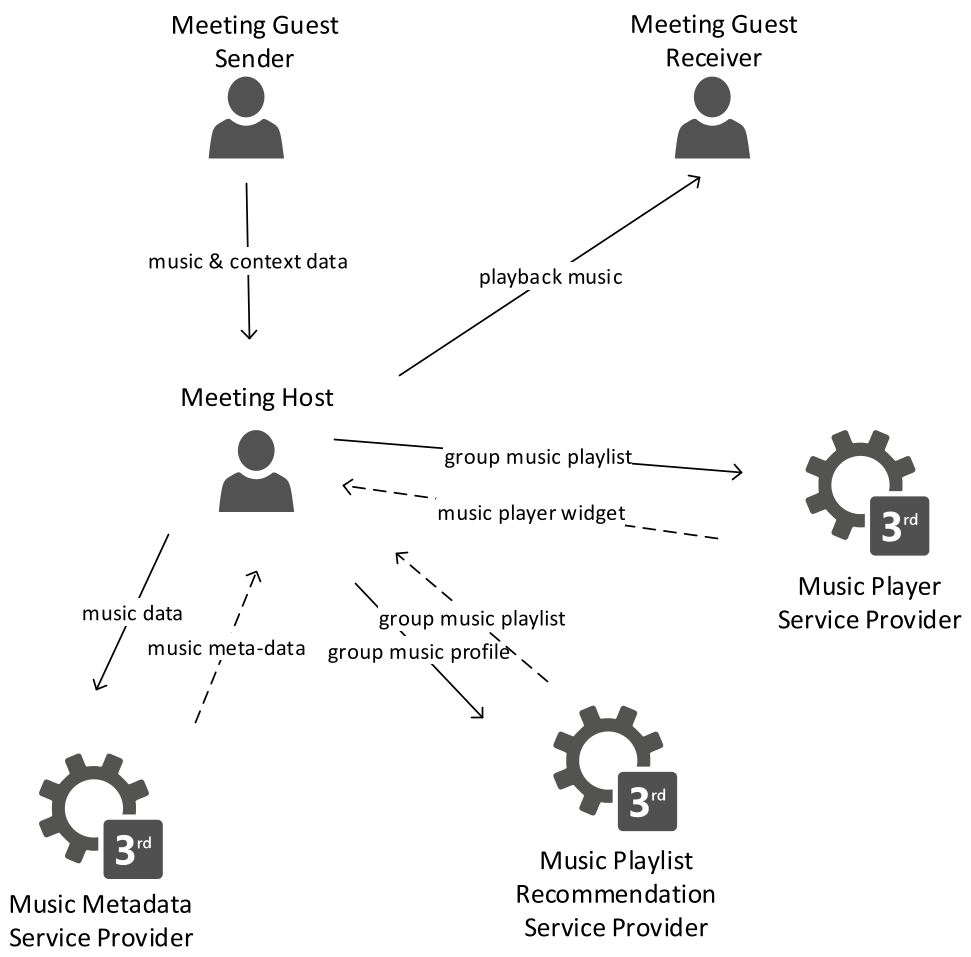
Unlike a giant centralized service, the host can be a local server at the venue. It follows a strict workflow to protect privacy:
- Geofencing: Data is only sent when the user physically enters the venue's virtual boundary.
- Profile Consolidation: Instead of processing individuals separately, the server builds a single "Group Profile." This means the external Music Recommendation Provider (like Echo Nest) never sees who is at the party—only the collective vibe.
How it Works: The BPMN Process
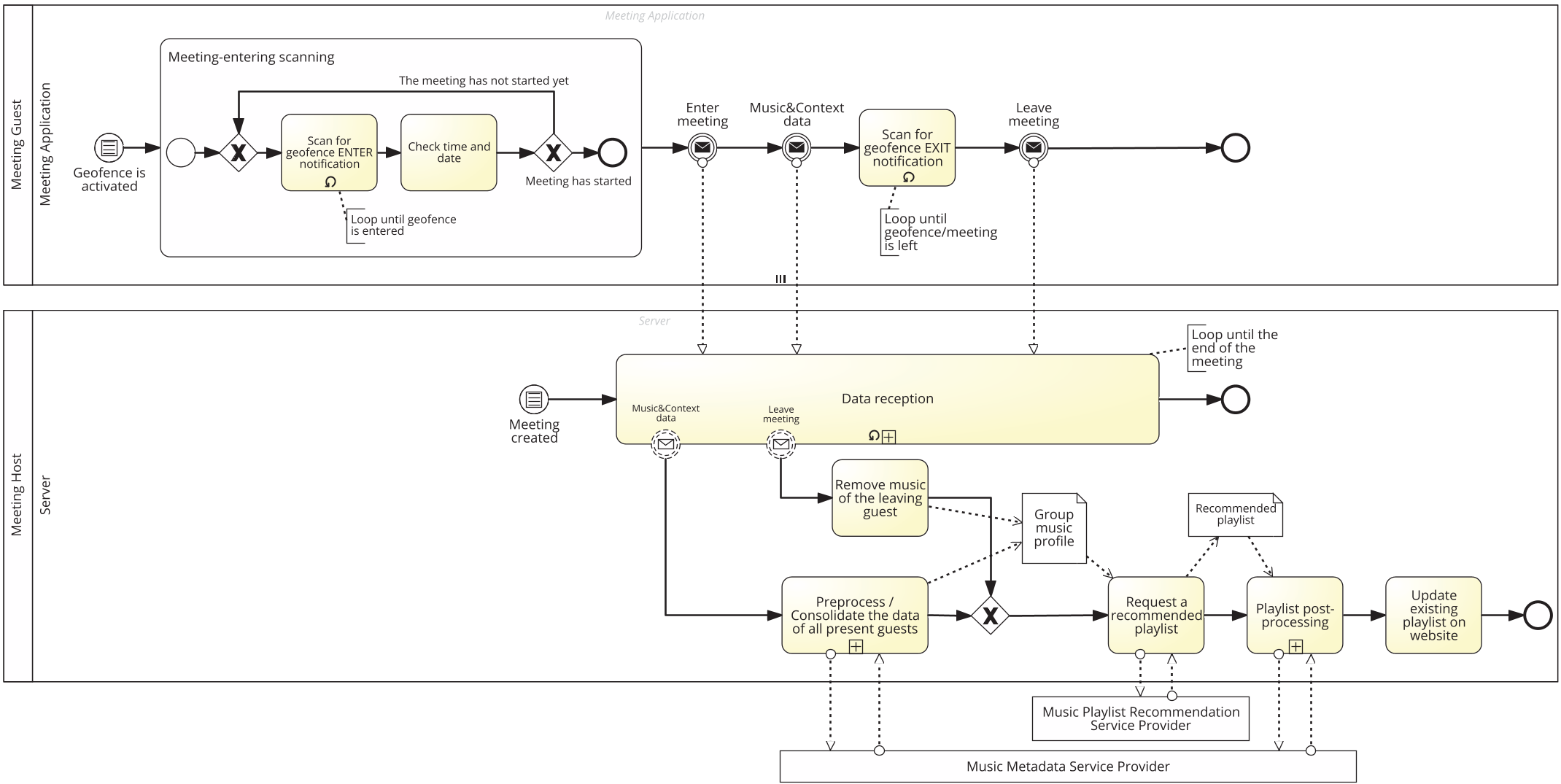
The beauty of this system lies in its automation. The process follows a structured lifecycle:
- Registration: Guest scans a QR code and sets their privacy filters.
- Detection: Geofencing detects entry; the phone uploads the filtered data.
- Active Update: As people come and go, the host triggers a non-interrupting process to refresh the playlist synchronously with the current crowd dynamics.
Experimental Validation
A common critique of background sensing is battery "hemorrhaging." The authors tested this on an LG Nexus 5:
- Standard Playback: 19.5 hours.
- Playback + Context Tracking: 19.3 hours.
The result? A negligible 1% increase in battery drain. This proves that the computational overhead of logging music metadata and low-frequency sensor data is dwarfed by the power required for audio playback and screen usage.
Critical Insight: The Privacy Trade-off
The paper introduces a "Data/Role Matrix" that highlights a crucial design choice: The Host is the high-trust point. While external providers (MMSP, MPRSP) only see anonymized or aggregated data, the local host still sees the filtered individual music data.
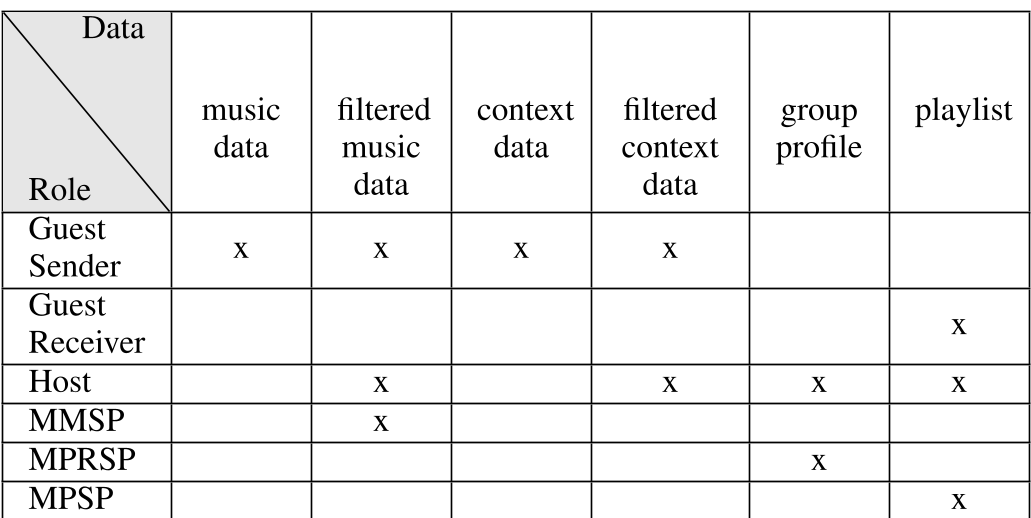
The Takeaway: To reach "True Privacy," future iterations could move the preprocessing (profile building) entirely to the smartphone, so the host only ever sees an abstract mathematical representation of taste, rather than a list of tracks.
Conclusion
This work provides a solid blueprint for the "Internet of Shared Experiences." It moves beyond the "all-or-nothing" privacy models of current social apps, showing that with smart pre-filtering and geofencing, we can enjoy the benefits of ubiquitous sensing without becoming a permanent entry in a corporate database.