
PTFS: Harmonizing Privacy, Traceability, and Efficiency in Healthcare IIoT
A Privacy-Aware and Traceable Fine-Grained Data Delivery System in Cloud-Assisted Healthcare IIoT
This paper proposes PTFS, a Privacy-aware and Traceable Fine-grained Data Delivery System for HealthIIoT. It combines Ciphertext-Policy Attribute-Based Encryption (CP-ABE) with keyword search, featuring online/offline encryption and lightweight decryption to accommodate resource-constrained medical IoT devices.
TL;DR
The Privacy-aware and Traceable Fine-grained System (PTFS) addresses the "security-efficiency-accountability" trilemma in medical IoT. By optimizing vector-based attribute encryption and introducing a split online/offline computational model, it enables secure keyword-based medical data retrieval and identifies malicious insiders who leak secret keys—all while maintaining a lightweight footprint for wearable sensors.
Background & Motivation: The Paradox of Secure Healthcare IoT
The Healthcare Industrial Internet of Things (HealthIIoT) promises real-time patient monitoring, but it creates a massive attack surface. While Ciphertext-Policy Attribute-Based Encryption (CP-ABE) is the standard for fine-grained access, its vanilla implementation has three fatal flaws:
- Computationally Intensive: Encryption and decryption costs scale linearly with the number of attributes, overwhelming battery-powered wearables.
- Access Policy Privacy: Conventional policies (e.g., "[Doctor] AND [Psychologist]") reveal the patient's condition just by looking at the encrypted header.
- The "Shadow" User Problem: If a doctor sells their secret key to an insurance company, standard ABE cannot identify the leaker because keys are tied to attributes, not specific identities.
Methodology: The PTFS Architecture
The core innovation of PTFS lies in its dual-layer optimization strategy.
1. Optimized Vector Generation (Algorithm 1)
Instead of standard policy trees, the authors use Inner Product Encryption (IPE). They developed a unique approach to transform access structures and attribute sets into vectors of significantly reduced length. This ensures that the mathematical "match" (the inner product reaching zero) happens with minimal operations.
2. The Online/Offline Computational Split
Encryption is broken down into:
- Offline Phase: Pre-calculates the heavy modular exponentiations when the device is idle or charging.
- Online Phase: Swiftly performs a few multiplications to bind the specific data and keyword to the ciphertext when the health event occurs.
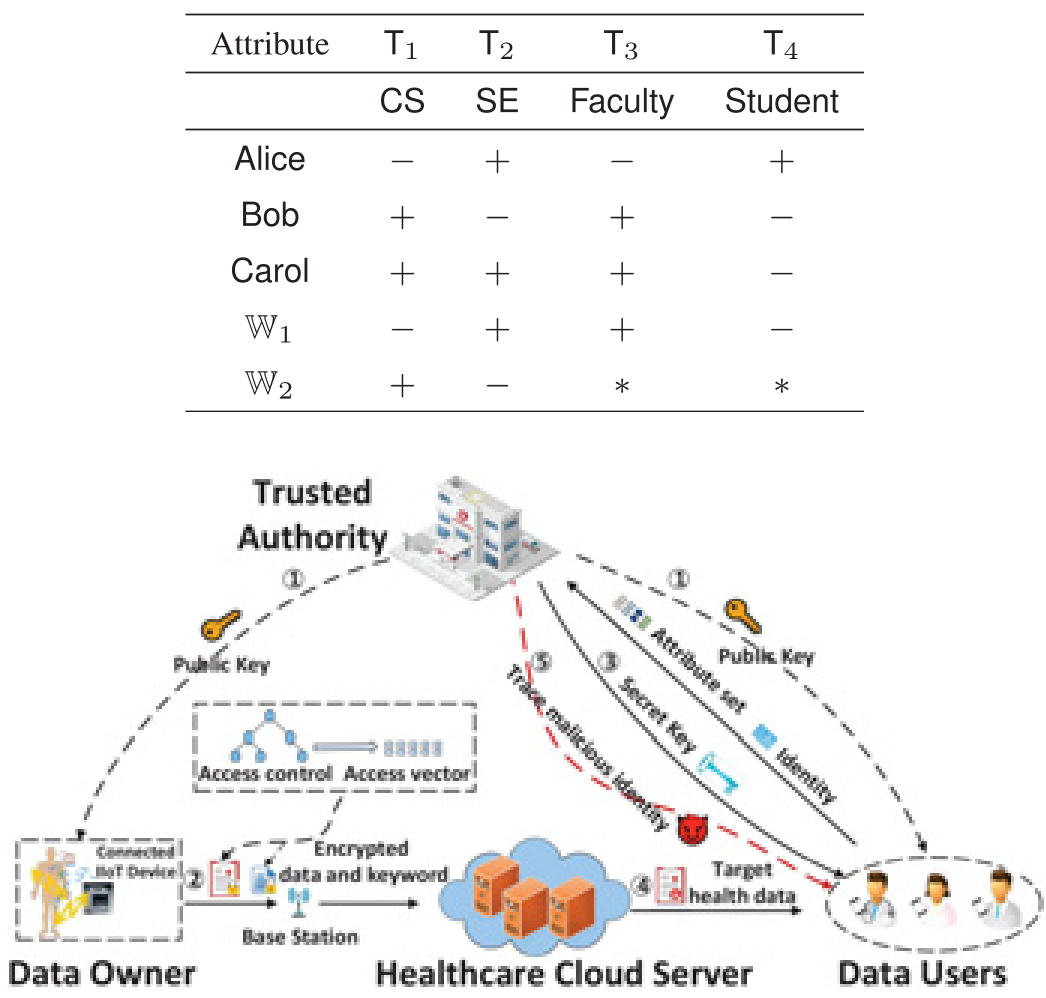 Figure 1: The PTFS interaction model involving the Trusted Authority, Patient (Owner), Cloud, and Healthcare Practitioner (User).
3. Traceability via Signature Integration
By embedding a Boneh-Boyen signature into the user’s secret key, the system ensures that any functional key contains the user's encoded identity. If a "pirate" key is discovered, the Trace algorithm can extract the original owner's ID using a constant-size identity table.
Performance Benchmarks
PTFS was tested against several SOTA schemes (e.g., LS, SXD+, MLC+).
- Decryption Efficiency: By shifting heavy pairing operations to the Cloud Server (Outsourced Decryption), the user's phone or device performs only constant-time operations.
- Storage Savvy: Despite adding traceability, the secret key size remains competitive.
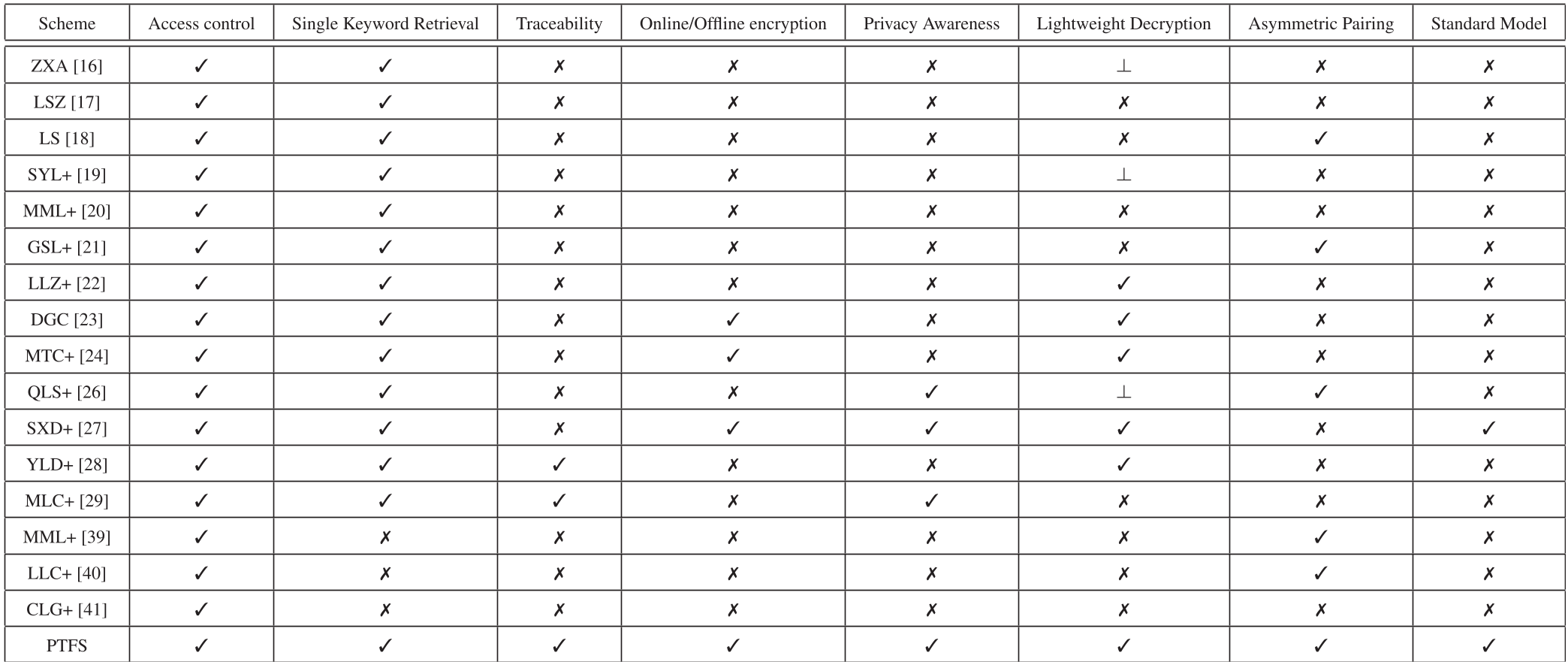 Table 1: Functional Comparison. Notice PTFS is the only scheme supporting all features (Traceability, Privacy Awareness, Standard Model) simultaneously.
Critical Insight & Conclusion
The true value of PTFS isn't just "faster encryption." It is the shift towards Accountable Privacy. Most privacy systems assume users are honest; PTFS assumes users might be malicious and provides the "forensic" tools to deter key leakage.
Limitations: While the online phase is extremely fast, the offline phase still consumes energy. Future work could look into energy-harvesting-aware scheduling for these pre-calculations.
Final Takeaway: For HealthIIoT to scale, security must be invisible to the user but formidable to the adversary. PTFS moves us one step closer to that reality.