
Privacy by Design: The Balancing Act Between Data Acquisition and User Control
Privacy by Design: Examining Two Key Aspects of Social Applications
This paper presents a behavioral study on how social application design influences user adoption through the lens of Information Privacy. By applying the Justice Framework and Privacy Calculus, the authors evaluate two key design dimensions: Information Acquisition (local vs. global) and Exposure Control (selective vs. compulsory), identifying how they collectively shape perceived risk and application value to determine usage intention.
TL;DR
As social applications move from simple tools to complex ecosystems, they often "over-collect" data from our friends and networks. This paper explores the psychological mechanisms behind user acceptance, proving that compulsory data exposure combined with global network tracking is the "red line" for users. Conversely, giving users granular control can significantly mitigate the perceived risks of data collection.
Problem & Motivation: The "Friend Information" Dilemma
In the early days of social apps, privacy was about your data. Today, it’s about your network’s data. When you install an app that asks for your friends' birthdays or profile photos, you aren't just making a choice for yourself—you are making a choice for your entire circle.
The authors identify a gap in existing literature: we know users are worried, but we don't know exactly which design levers (Information Acquisition vs. Exposure Control) cause the most friction, or how they work together to kill or encourage usage intention.
Methodology: The Justice Framework meets Privacy Calculus
The researchers built their study on two pillars:
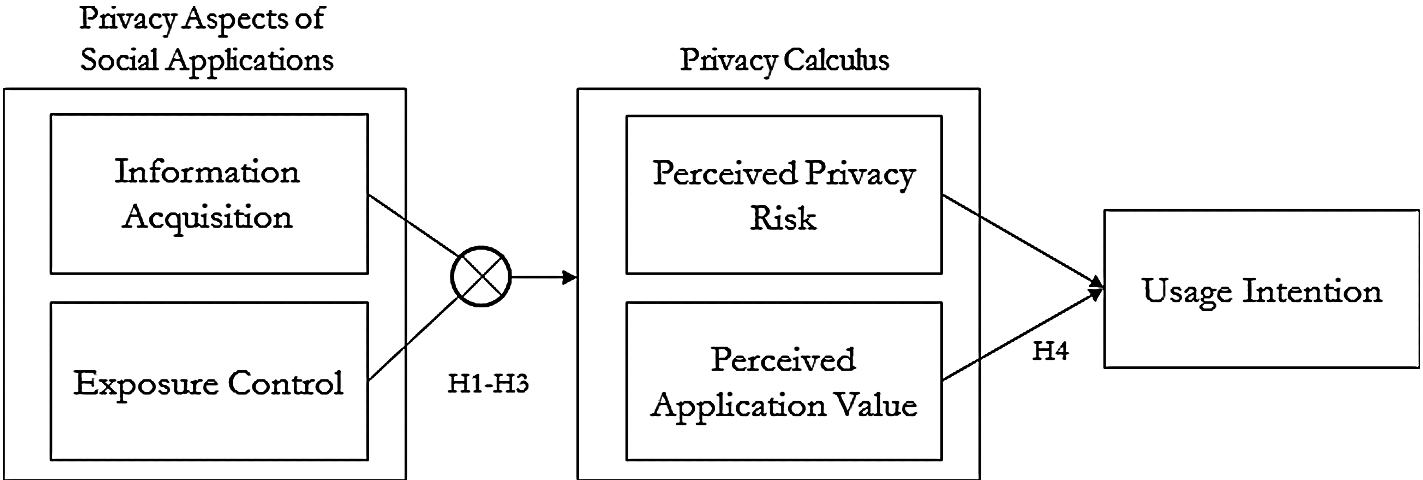
- The Justice Framework: Distributive Justice (is the data-to-value exchange fair?) and Procedural Justice (do I have a say in how it's handled?).
- Privacy Calculus: The mental "math" where users subtract Perceived Privacy Risk from Perceived Application Value to decide if they should click "Install."
Key Experimental Variables:
- Information Acquisition: Local (just your data) vs. Global (your data + your friends' data).
- Exposure Control: Selective (you choose what to share) vs. Compulsory (it's all or nothing).
Core Insights: It's Not Just What You Take, It's How You Take It
The study’s most profound finding is the Interaction Effect between acquisition and control.
- The "Control" Buffer: When users have selective control, the difference in perceived risk between local and global data collection becomes statistically insignificant. In other words, users are willing to tolerate wider data collection if they feel they are in the driver's seat.
- The "Compulsory" Penalty: When exposure is compulsory, global data collection triggers an explosive increase in perceived risk. Users view the lack of choice as a violation of procedural justice, leading them to devalue the app entirely.
Critical Analysis & Conclusion
While the study provides a robust framework for "Privacy by Design," there are inherent limitations:
- Student Sample: The 18-24 demographic is naturally more "digitally native" and might have different privacy thresholds than older users or corporate clients.
- Hypothetical Scenarios: Laboratory settings can sometimes mask the "impulse" behavior seen in real-world app stores where users might skip reading permissions altogether.
Final Takeaway for Developers:
Don't just minimize data collection; maximize user agency. By shifting from "Compulsory" to "Selective" exposure, you can increase your app's perceived value and lower its perceived risk, even if your functionality requires extensive network data. Privacy is not just a legal hurdle—it is a core component of the user experience.