
Foursquare's Invisible Leak: Why "Private" Check-ins Aren't Enough to Hide Where You Live
We know where you live: privacy characterization of foursquare behavior
The paper characterizes location-based privacy risks on Foursquare by analyzing publicly available user traits like mayorships, tips, and "dones." It proposes a majority-voting inference model to predict users' home locations, achieving state-of-the-art identification of home cities for nearly 80% of users.
TL;DR
Even if you hide your Foursquare check-ins from the public, your mayorships, tips, and "done" lists act as a GPS beacon for your home address. Researchers from UFMG and IIIT Delhi analyzed 13 million users and discovered that a simple voting algorithm can pinpoint the home city of 78% of users within 50km, purely using publicly accessible "gamification" data.
The Privacy Illusion: Beyond the Check-in
In the world of Location-Based Social Networks (LBSNs), we’ve been trained to think that "Private" means "Invisible." On Foursquare, users often keep their check-ins limited to friends. However, the system’s competitive and social layers—becoming a "Mayor" of a Starbucks or leaving a "Tip" about a burger joint—are public by default.
The core problem is Semantic Leakage. While a check-in is a point in time, a mayorship is a statement of habit (frequent visits), and a tip is a statement of preference. This paper investigates whether these public "digital breadcrumbs" are enough to reconstruct a user's private home location, even when the user intentionally leaves their profile location blank or fake.
Methodology: Mining the Foursquare Metadata
The researchers conducted a massive crawl, capturing a snapshot of the Foursquare ecosystem (roughly 13M users). To clean the data, they utilized the Yahoo! PlaceFinder API to standardize messy, open-text location fields into geocoded coordinates.
The Inference Models
The study tested seven different models based on "Majority Voting." If you have 10 mayorships in New York and 1 in London, the model predicts you live in New York.
- Single-Feature Models: Mayorship only, Tip only, or Done only.
- Hybrid Models: Combining pairs (e.g., Mayorship + Tip).
- The "All" Model: Synthesizing all public interaction data.
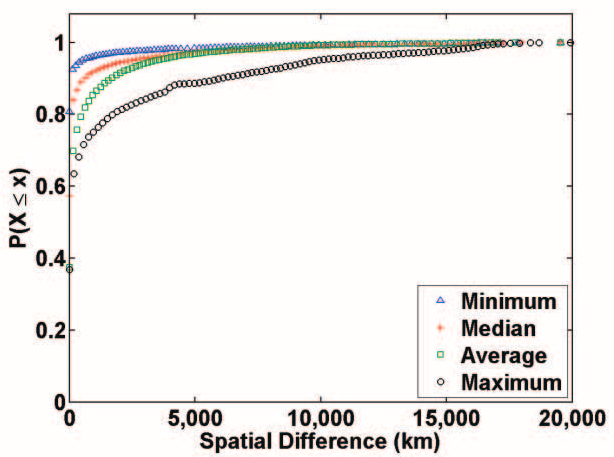 Figure: The global spread of public interactions (Mayorships, Tips, Dones) shows high density in the US, Europe, and SE Asia, mirroring the platform's primary user base.
Key Insights: Habit vs. Exploration
The study's spatial analysis revealed a fascinating distinction in user behavior:
- Locality of Tips/Dones: Most users (70%) have a median displacement of less than 150km between consecutive activities. This suggests that even "recommendation" behavior is hyper-local.
- The Power of Mayorships: Because obtaining a mayorship requires being the most frequent visitor in a 60-day window, it is the most robust indicator of a user's "anchor point" (home or work).
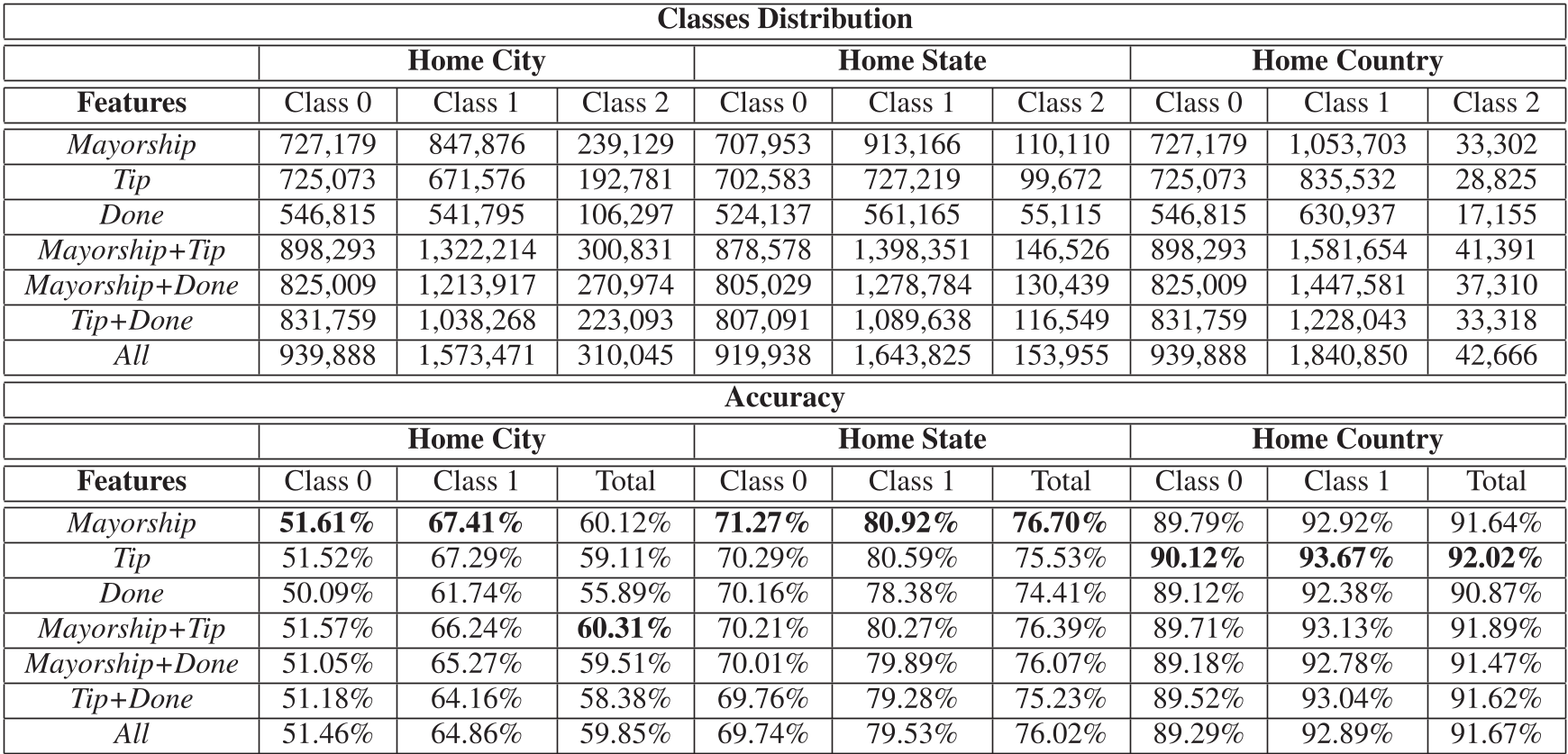 Table: Accuracy levels across different granularities. Note that predicting the correct country (Home Country) is nearly trivial, with >91% accuracy.
Experimental Results: Where Accuracy Meets Reality
The results are sobering for privacy advocates:
- City-Level Accuracy: The "All" model achieved ~60% direct city matches. However, when expanding the radius to 50km (accounting for neighboring suburbs in a metropolitan area), the accuracy jumps to 78%.
- The "Context" Buff: Tips and Dones, while individually noisier than Mayorships, are crucial for "Class 2" users (those with ties in their location data). Adding these features increases the coverage of the attack—making more users vulnerable to inference.
Critical Analysis & Conclusion
The industry value of this research lies in its exposure of secondary data vulnerabilities.
Takeaway
For developers, the lesson is clear: Privacy is a holistic property. You cannot secure a user's location by merely encrypting their "current" coordinates if their "historical" interactions remain public.
Limitations & Future Work
The study uses a simple majority-vote approach. A more sophisticated attacker could use probabilistic weighting (e.g., a mayorship at a "Residential" venue category should weigh more than a tip at an "Airport"). Additionally, as Foursquare shifted toward the "Swarm" and "CityGuide" split post-2014, the dynamics of these public features evolved, but the underlying risk of historical data inference remains a foundational challenge in modern LBSN design.
Final Thought: Next time you compete for that neighborhood coffee shop mayorship, remember: you aren't just winning a digital badge; you're confirming your home address to the world.