
The Usability Gap: Why Facebook's Privacy Controls Fail Children and Teenagers
Privacy for Children and Teenagers on Social Networks from a Usability Perspective: A Case Study on Facebook
This paper presents a comprehensive case study evaluating the usability of privacy controls on Facebook specifically for children and teenagers in Brazil. Using Heuristic Evaluation (HE) and user surveys, the authors identify critical design flaws that hinder young users from effectively managing their personal data exposure.
TL;DR
Even though the majority of children and teenagers express concern about their online safety, their actual protection is severely compromised by poor interface design. This study analyzes Facebook's privacy mechanisms, revealing that usability barriers—not just user indifference—are the primary reason young users are exposed to hacking and harassment. By triangulating expert inspections with user surveys, the authors demonstrate that if a privacy setting is hard to find or understand, it effectively doesn't exist for the most vulnerable users.
The "Invisible" Danger: Motivation and Insight
Prior research has long noted a "privacy paradox" where users say they care about privacy but don't act on it. The authors of this study argue that for children (ages 6-17), this isn't just a behavioral choice—it's a usability failure. Existing Online Social Networks (OSNs) like Facebook use complex terminology and hidden menus that violate basic human-computer interaction (HCI) principles. The insight here is that privacy is a functional requirement that must be accessible to the intellect and usage patterns of young people, rather than a legal checkbox.
Methodology: A Multi-Dimensional Approach
To bridge the gap between technical settings and user behavior, the researchers employed a rigorous three-phase approach:
- Expert Inspection: HCI experts and an Occupational Therapist evaluated 12 interaction scenarios (like blocking users or managing tags) against Nielsen’s 10 Heuristics.
- User Characterization: A survey of 142 Brazilian minors (a top-3 global market for Facebook) to map their daily habits and privacy experiences.
- Triangulation: Linking the identified UI flaws to the specific types of privacy violations reported by the kids.
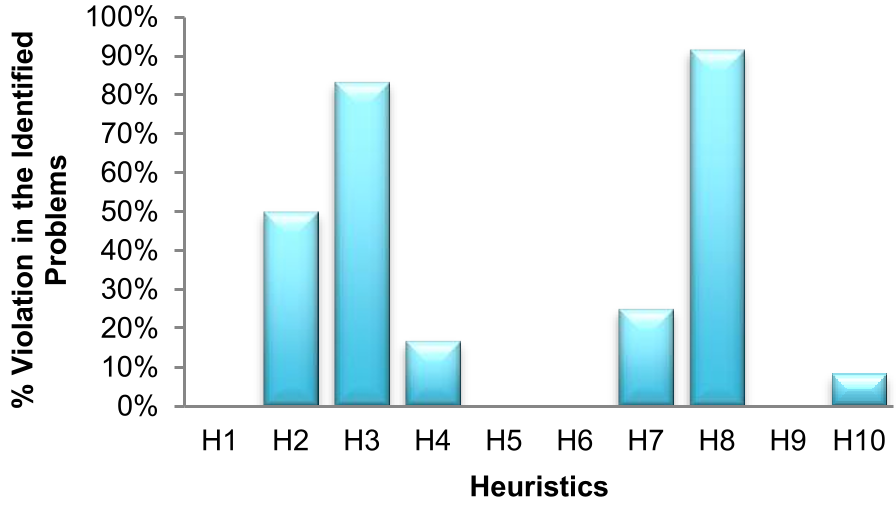 Figure 1: The analysis shows that 'User Control and Freedom' (H3) and 'Flexibility/Efficiency' (H8) are the most frequently violated principles.
Key Findings: The Cost of Complexity
The results are a stark warning for designers and parents alike:
- Catastrophic Usability: 91% of the identified problems were rated as "Big" or "Catastrophic." For instance, Facebook limits visibility changes to future posts by default, making it nearly impossible for a child to quickly hide their past history without manual, post-by-post editing.
- The Exposure Reality: 67% of participants have over 500 "friends," yet 92% admit they don't know all of them personally.
- Consequences: 50% of the children surveyed had already experienced a privacy violation. There was a direct correlation between having a "Public" profile and suffering from hacking or cyberbullying.
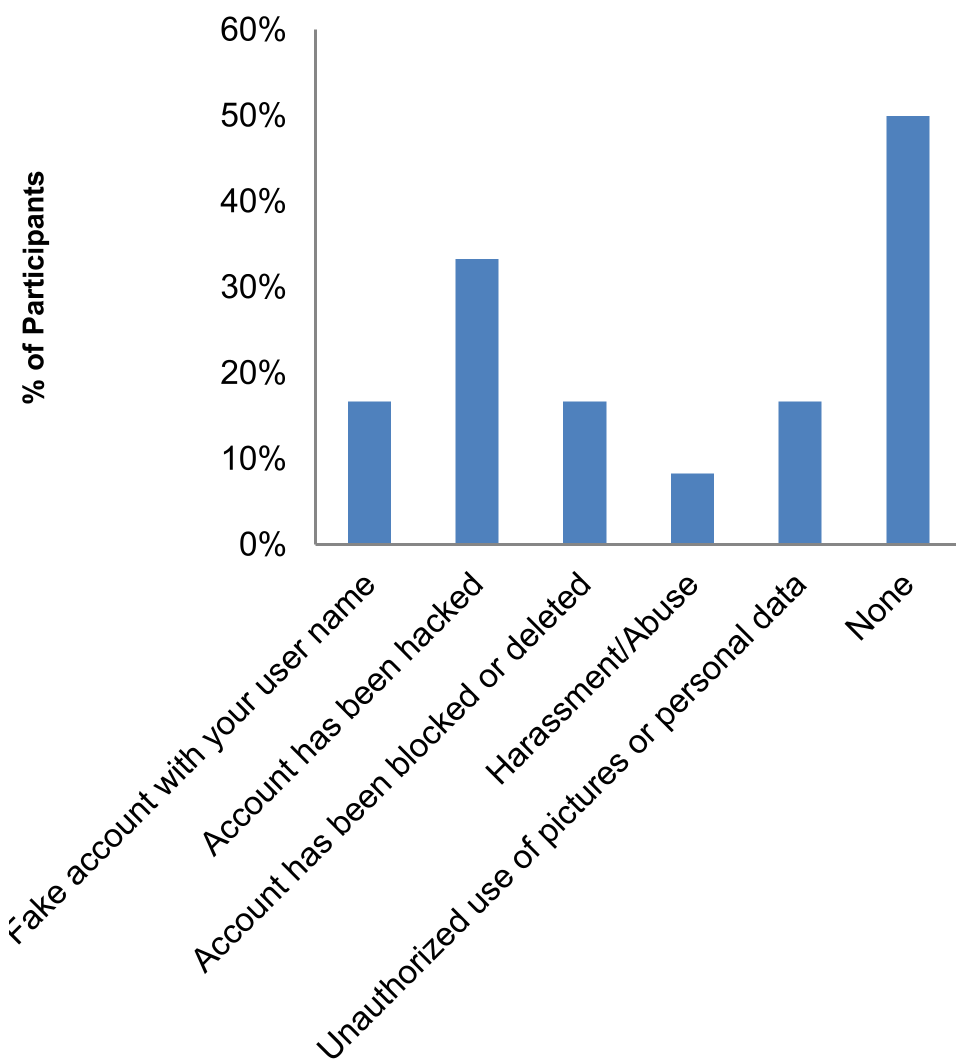 Figure 2: Distribution of privacy violations suffered by the participants, highlighting that 33% had accounts hacked.
Critical Insight: Why Does This Resilience Gap Exist?
The study highlights that Heuristic H2 (Match between system and the real world) is a major failure point. Facebook uses technical jargon and abstract concepts that don't resonate with a teenager's mental model. When users encounter these barriers, they become "shortsighted" and "frustrated," leading them to abandon the settings altogether.
The authors conclude that the current OSN landscape places an unfair "cognitive tax" on minors. To fix this, we need:
- Simplified Language: Removing jargon like "Activity Log" or "Tag Review" in favor of intuitive terms.
- Proactive Assistance: Implementing "Privacy Wizards" that guide users based on their age group.
- Consistent Standards: Ensuring that privacy controls aren't buried three levels deep in a profile menu.
Final Takeaway
Privacy is not merely a legal right; in the digital age, it is a usability challenge. This research serves as a call to action for platform developers to move beyond compliance and start designing for the safety of the next generation through intuitive, age-appropriate interfaces.