
Voyage: Navigating the Tension Between Social Sharing and Privacy in Corporate Travel
Privacy Concerns in Enterprise Social Travel: Attitudes and Actions
This paper investigates privacy attitudes and sharing behaviors within "Voyage," an enterprise social travel application. It combines qualitative and quantitative methods to explore how employees manage personal business travel data, concluding that while sharing is valued, significant gaps exist between theoretical willingness and actual practice.
TL;DR
Enterprises are increasingly adopting "socialized" business processes, but travel remains a sensitive frontier. This study introduces Voyage, a social travel tool, to reveal a stark "Privacy Paradox": employees value the collective intelligence of their colleagues' plans but are far more hesitant to share their own in real-time. The key insight? Privacy is time-sensitive—sharing where you were is perceived as much safer than sharing where you will be.
The Problem: The Corporate Privacy Paradox
In the age of TripAdvisor and Yelp, sharing travel experiences is second nature. However, when applied to a corporate environment, the stakes change. While the "Wisdom of Crowds" can help an employee pick the safest hotel or the most efficient flight path, sharing a specific itinerary exposes professional secrets (which client are you visiting?) and personal security (is your house empty while you are away?).
Existing research acknowledges that people share more within the "safe" confines of an enterprise than on public sites, but the authors suspected a gap existed between what people say they will do and what they actually do when clicking the "Save Reservation" button.
Methodology: Triangulating Intent vs. Action
The researchers didn't just rely on a survey; they built a prototype called Voyage and tracked real user behavior.
- Phase 1 (Attitude): A survey of 1,431 employees to gauge theoretical willingness.
- Phase 2 (Experience): Qualitative interviews (13 employees) to understand the "Why."
- Phase 3 (Action): Analysis of system logs from 92 active users to see actual privacy toggles.
The Voyage Architecture
The tool integrated social cues (ratings, comments, booking percentages) directly into the reservation flow, encouraging a collaborative feedback loop.
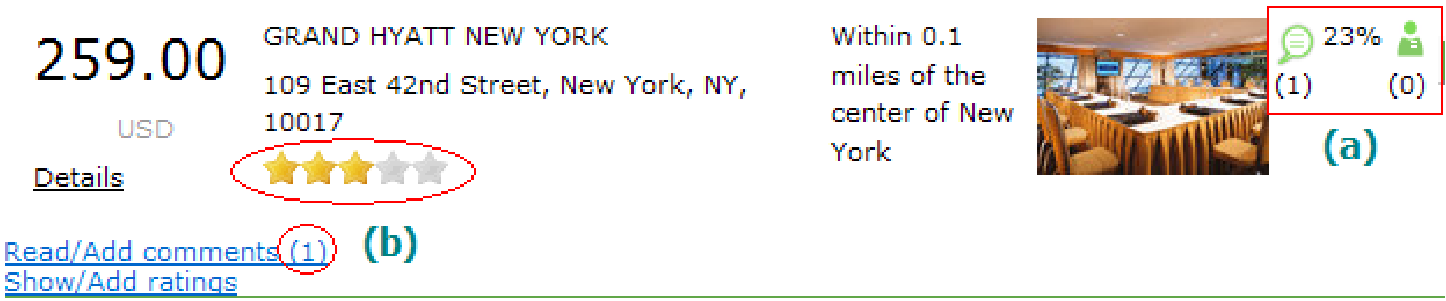 Figure 1: Social cues in Voyage showing hotel popularity and colleague ratings.
Key Insights: Why "Where I'm Going" is Different from "Where I Was"
1. The Real-World Friction
While 95% of survey respondents claimed they would share their travel details with someone, the actual logs told a different story. 38% of real trips were marked as Private, compared to the 5% predicted by the survey.
2. Temporal Privacy (The "After-the-Fact" Effect)
The study discovered a fascinating trend: employees are much more comfortable sharing "Past Travels" than "Future Plans."
- Future Sharing (Public): ~32%
- Past Sharing (Public): ~47% (A statistically significant jump, p < 0.01)
The logic is intuitive: once a trip is over, the security risk of someone knowing you are away from home or tracking your real-time movement vanishes.
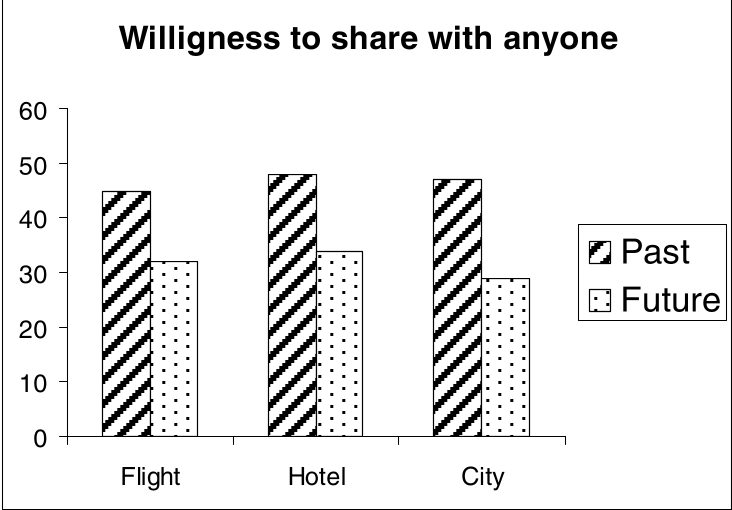 Figure 2: The marked difference in willingness to share past vs. future data.
3. Resource Sharing vs. Information Sharing
Interestingly, employees are more reluctant to share physical resources (like carpools) than information. 20% refused to share cars/taxis entirely. The reason? The physical "burden of coordination" and the social discomfort of being in a confined space with a stranger outweigh the cost-saving benefits.
Strategic Recommendations for Developers
Based on the findings, the authors suggest two major shifts in how we design enterprise social tools:
- Privacy Relaxation Protocols: Applications should detect when a travel event has concluded and prompt the user: "Your trip to New York is over. Would you like to make this itinerary public to help colleagues planning future trips?" This maximizes data utility without compromising real-time safety.
- Item-Level Granularity: Currently, many tools use an "All-or-Nothing" approach. Users need the ability to share their Hotel (to coordinate with colleagues) while keeping their Flight or Client Meeting location private.
Conclusion
The Voyage study highlights that in the enterprise, privacy is not a static preference but a dynamic decision influenced by time, safety, and professional context. To build successful social business tools, we must move away from rigid defaults and toward systems that understand the lifecycle of information sensitivity.
Takeaway: If you want users to share more, don't ask them to share their future; ask them to contribute their history.