
Beyond the Screen: How Culture Dictates Your Digital Privacy and Social Habits
From Privacy Concern to Uses of Social Network Sites: A Cultural Comparison via User Survey
This study investigates how cultural dimensions influence privacy concerns, trust, and usage behaviors on Social Network Sites (SNS), specifically Facebook. Using Hofstede’s cultural framework, the researchers conducted a comparative survey between users in Hong Kong and France, revealing that cultural values significantly predict how individuals perceive privacy and utilize social platforms.
TL;DR
Is your Facebook behavior a personal choice or a cultural byproduct? This study dives into the diametrically opposed SNS habits of users in Hong Kong and France. It reveals that cultural traits like "Uncertainty Avoidance" and "Individualism" aren't just academic terms—they are the primary architects of how much we trust social platforms, what we post, and even how many friends we make.
The "Why" Behind the Click: Culture as the Hidden Variable
Most tech giants design platforms with a Western-centric "universal user" in mind. However, this paper argues that a user in Paris perceives a "Post" button very differently than a user in Hong Kong.
The authors lean on Hofstede’s Cultural Dimensions to explain the friction:
- France (High IND/UAI): Individualistic and risk-averse. French users view ambiguous situations as a threat.
- Hong Kong (Low IND/UAI): Collectivist and comfortable with ambiguity. HK users prioritize group membership and social interdependence.
The core question: How do these deep-seated values translate into digital privacy concerns and actual usage?
Methodology: Mapping the Psyche of the SNS User
The researchers built a path-analysis model to track the flow from cultural values to behavioral outcomes. They measured "Privacy Factors" (Comfort, Control, and Protection) and how they filtered through "Trust" and "Motives" to produce "Actual Uses."
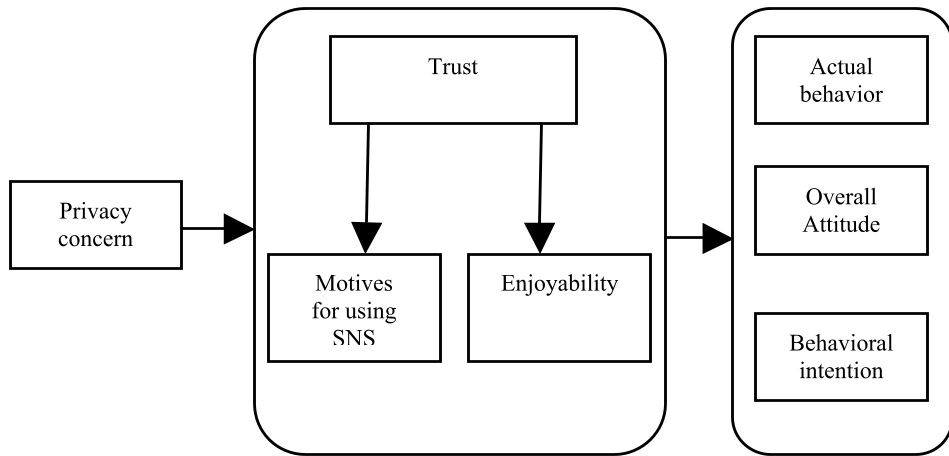 Above: The hypothesized relations between privacy, trust, and behavior.
Key Findings: The Great Cultural Divide
1. The Comfort Gap
The data shows a striking disparity in how users perceive safety on the same platform (Facebook):
- Privacy Protection: Hong Kong users felt significantly more protected by the site than their French counterparts (M=2.78 vs 2.07).
- Information Disclosure: HK users are "Open Books" regarding contact info like emails (85%) and messengers (36.7%). French users, fearing reputational risk (High IND), are much more guarded, often sticking to news and general events rather than personal life.
2. Predictors of Use
One of the most profound insights is that what drives usage differs by culture:
- For the French: High privacy concern is a "gatekeeper." If they don't feel in control or protected, their motivation to share information or join groups collapses.
- For Hong Kongers: They essentially "ignore" general privacy protection concerns; the only factor that truly moves the needle for them is Privacy Control (the ability to update profiles).
3. The Result: Engagement and Joy
Because HK users are less hindered by privacy anxieties, they report much higher Enjoyability and see the site as a vital stress-release channel. French users, staying at arm's length, derive less emotional value from the platform.
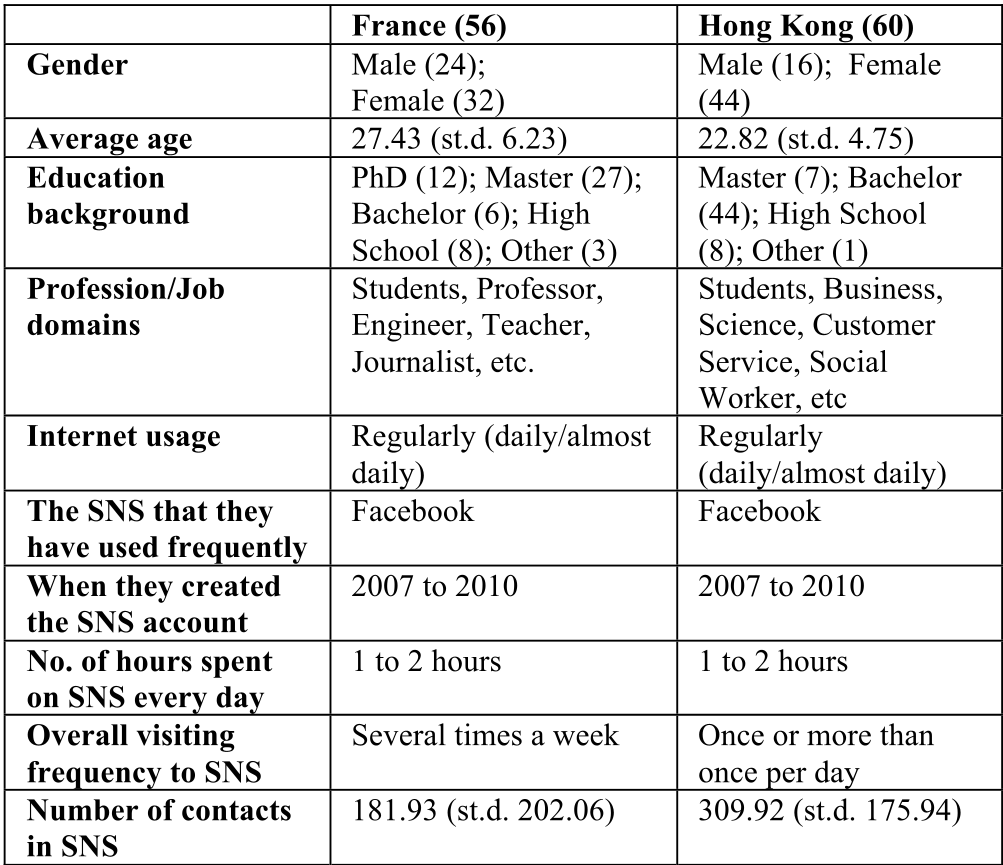 A snapshot of the demographic and behavioral differences discovered between the two groups.
Academic Insight: The "Uncertainty" Factor
The paper's "Aha!" moment lies in the explanation of French behavior. In high Uncertainty Avoidance cultures, users are "risk-averse" and prefer "the tried and tested." The digital void of an SNS—where info can spread uncontrollably—is a source of cultural stress for a French user. Conversely, the low IND/UAI of Hong Kong creates an "Inductive Bias" toward building social capital and meeting new people, leading to an average of 309 friends vs. France's 181.
Conclusion & Future Outlook
This work serves as a wake-up call for SNS practitioners. As platforms like Facebook, TikTok, and LinkedIn expand, they cannot rely on a global average.
- Localization should go beyond language translation; it must address "Privacy Calculus" differences.
- In high-UAI markets, platforms should emphasize legal assurances and robust control mechanisms to mimic the "tested" environments these users prefer.
Limitations: While the sample size was relatively small (N=116), the statistical significance (p < .001) in MANCOVA tests suggests these cultural signals are robust and demand further exploration across a broader spectrum of "Eastern vs. Western" contexts.
Main Contribution: This study bridges the gap between sociology and computer science, proving that the zeros and ones of social media are ultimately filtered through centuries of cultural conditioning.