
Towards Privacy Conventions: Automating Consensus in Social Networks
Emergence of privacy conventions in online social networks
The paper proposes an agent-based framework to establish "Privacy Conventions" in Online Social Networks (OSNs). It utilizes Evolutionary Game Theory and complex network dynamics to help users reach a consensus on application privacy settings, thereby reducing the burden of manual fine-grained access control.
TL;DR
Establishment of privacy "rules" in social networks is currently a chaotic tug-of-war between intrusive apps and over-burdened users. This paper proposes a Multi-Agent System (MAS) framework that uses Evolutionary Game Theory and Network Dynamics to help users' software agents automatically converge on a set of "Privacy Conventions"—shared, optimal settings that balance functionality with security.
Background: The Privacy Paradox
Online Social Networks (OSNs) are fertile ground for third-party applications, but these apps often act as "Trojan Horses" for identity thieves and marketing data-miners. Modern OSNs typically offer an "all-or-nothing" permission model. While fine-grained controls exist in theory, they fail in practice because:
- User Cognitive Load: Most users are not privacy experts and ignore complex settings.
- Developer Friction: Developers cannot realistically optimize apps for millions of unique, fragmented privacy preferences.
The author argues that the solution lies in Consensus. If a community can agree on a few "Privacy Conventions," developers can target those standards, and users can adopt them with a single click.
Methodology: Agents, Games, and Topology
The core of the proposal is a shift from manual configuration to Agent-Based Reasoning.
1. The Interaction Model
Each user recruits a software agent. These agents participate in an iterated game (similar to the Prisoner's Dilemma) where the "payoff" is a function of:
- Utility: The benefit derived from using the app.
- Privacy Cost: The risk of data exposure.
- Coordination Multiplier: The benefit of aligning with neighbors to form a stable social norm.
2. Leveraging Network Dynamics
A major hurdle in decentralized systems is the Frontier Effect (FE)—where different clusters of the network settle on different, incompatible rules (sub-conventions). To break these barriers, the author suggests using the physical properties of the social graph:
- Assortativity: Understanding how similar users connect.
- Degree Heterogeneity: Using "hubs" (highly connected nodes) to spread a convention faster.
- Coupled Learning: Agents don't just learn from their own history; they use node coupling strength to weigh the influence of their neighbors.
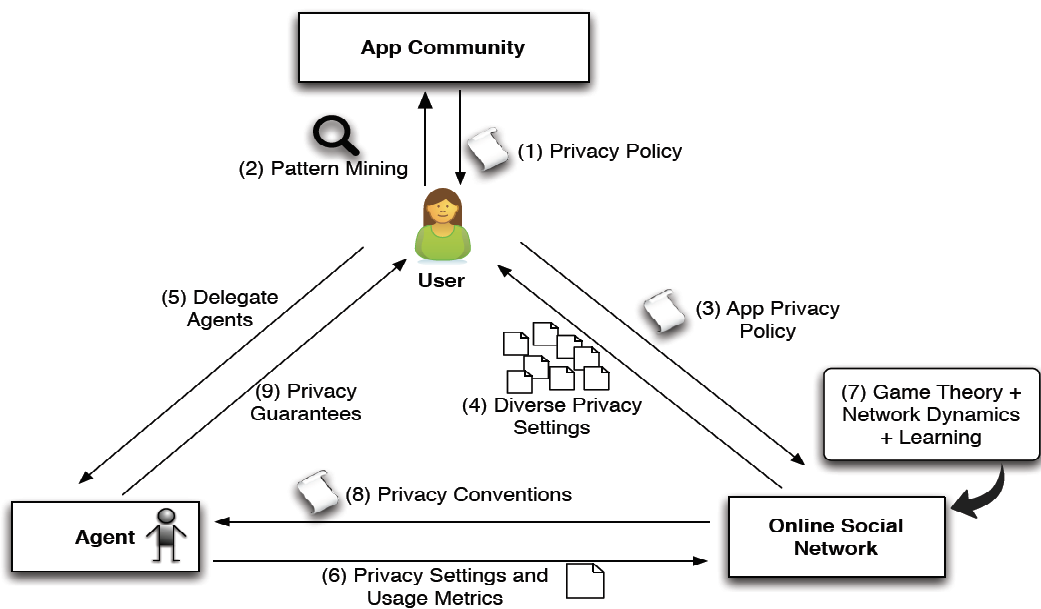 Above: The conceptual loop where agents interact via game theory, influenced by the underlying OSN dynamics to reach a stable state.
Preliminary Results & Evidence
Experimental simulations were conducted on scale-free networks (the mathematical model most representative of real-world social networks like Facebook or Twitter).
Key findings include:
- Heterogeneity is a Catalyst: The presence of "influencer" nodes (hubs) significantly speeds up the time it takes for a single privacy convention to govern the entire network.
- Clustering Benefits: Higher clustering coefficients (triadic closures) provide the "social pressure" needed to sustain a coalition against "defectors" or malicious apps.
 Note: The research demonstrates that topological insights, when embedded in the agents' partner selection strategy, outperform standard reinforcement learning in reaching a global consensus.
Critical Analysis & Future Outlook
The Takeaway
This research shifts "privacy" from a UI problem to a Distributed Coordination problem. By treating privacy settings as a convention to be evolved rather than a checkbox to be ticked, it opens the door for autonomous systems that protect users without requiring constant intervention.
Limitations
- Incentive Alignment: The model assumes users (and their agents) are rational actors seeking long-term stability. In reality, malicious actors might purposefully disrupt conventions.
- Evolutionary Speed: In stagnant networks, convergence might be too slow to keep up with the rapid release cycle of new "trending" apps.
Future Work
The next frontier involves integrating Multi-Agent Reinforcement Learning (MARL) and exploring more complex network features like link weights and assortativity to make the convergence "fraud-proof."