
Decoding the Privacy Dichotomy: How Your Twitter Circle Reveals Your Secrets
Understanding Privacy Dichotomy in Twier
This paper investigates the "privacy dichotomy" on Twitter, proposing an unsupervised collaborative filtering approach to detect user privacy preferences based on social footprints. By analyzing 23,320 users, the authors demonstrate that privacy preferences are homophilous, allowing for the characterization of "privacy-concerned" users even when their accounts are nominally public.
TL;DR
Researchers have discovered that your privacy preferences aren't just a personal choice—they are contagious. This study demonstrates that Privacy Homophily exists on Twitter: public users surrounded by "protected" (private) accounts often behave like private users themselves, sharing more sensitive, personal, and emotional content. By calculating a Privacy Ratio, the authors can predict whether a public user is actually "privacy-concerned" but simply "privacy-unaware."
The "I'm Public, But Not Really" Problem
Most social media users suffer from a Privacy Dichotomy. We claim to value our privacy, yet we stick to default public settings because managing permissions is tedious. This creates a goldmine for marketers but a nightmare for user trust.
The core insight of this paper is that we can't trust a user's "Public" toggle. Instead, we should look at their neighborhood. If your friends have locked their profiles, there is a high statistical probability that you also value privacy, even if your account is wide open.
Methodology: The Privacy Ratio and Latent Features
The authors built a social footprint detector using an unsupervised approach. They focused on reciprocated relations (mutual follows) to filter out celebrity "information networks" and isolate real "social networks."
The Core Metric: Privacy Ratio
The researchers defined the Privacy Ratio as:
Mapping Latent Intent
They transformed the network into a bipartite graph of users and features. By associating users' privacy ratios with the words, hashtags, and topics they use, they identified "latent attributes" of privacy-concerned individuals.
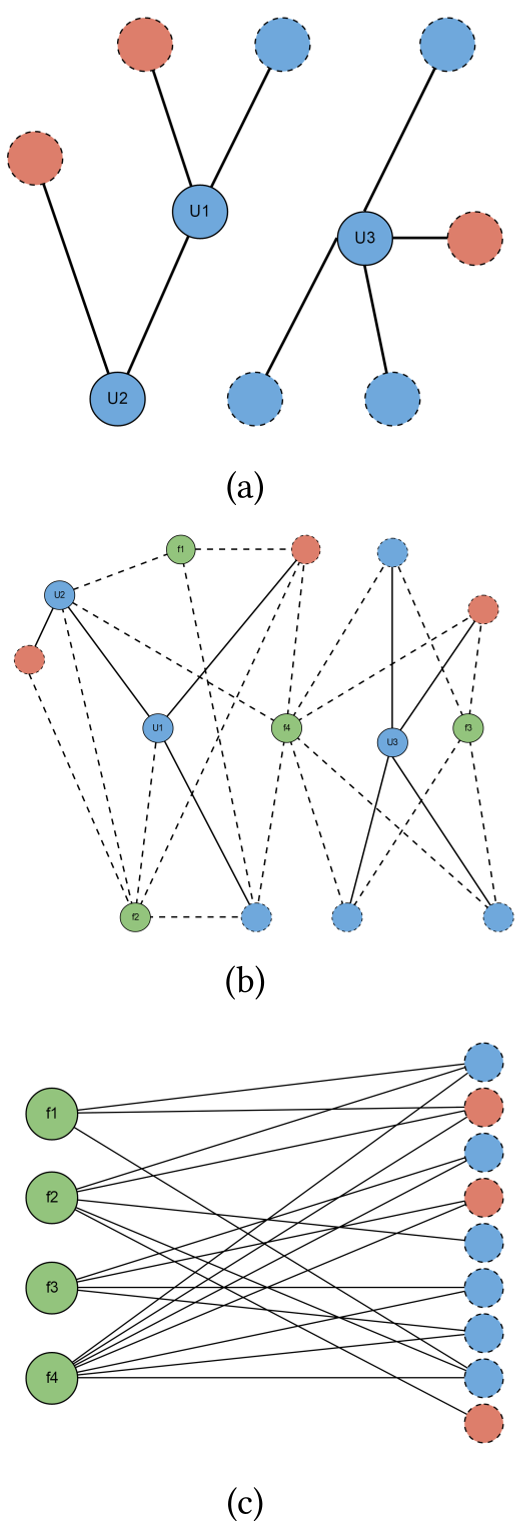 Figure 1: The process of propagating privacy ratios from users to specific content features.
Key Findings: The Language of the Private
The study utilized LIWC (Linguistic Inquiry and Word Count) to analyze the psychological state of users. The results were striking:
- High Privacy Ratio Users (those in private circles) use more: Swear words (+0.40), Anger (+0.35), and Negative Emotions (+0.34).
- Low Privacy Ratio Users (public circles) use more: Analytical thinking (-0.26) and Formal language.
This suggests that people in private neighborhoods feel "safer" and are more "authentic"—ironically making them more vulnerable because they disclose highly sensitive information (health, sexual topics, personal grievances) in what they perceive to be a safe space, despite their profile being public.
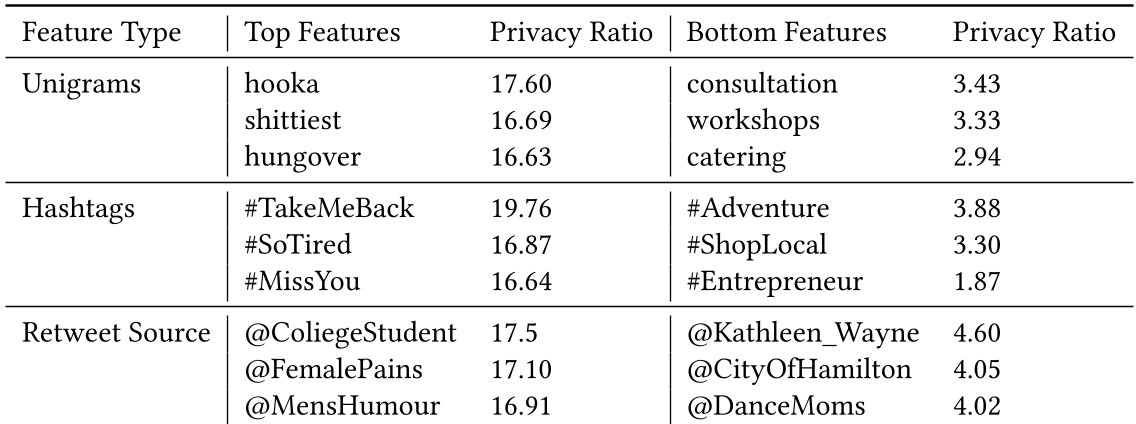 Table 1: Features at the extreme ends of the Privacy spectrum. Note how "Entrepreneur" and "Workshops" signal public intent, while "MissYou" and "SoTired" signal personal/private intent.
Critical Insight: Why This Matters
The distinction identified here is between being Privacy-Concerned and Privacy-Aware.
- Status Homophily: We hang out with people of similar age/education who share our privacy values.
- The Red Flag: If a company sees a public user with a high privacy ratio using "authentic" and "emotional" language, they should recognize this as a "Red Flag." This user is statistically likely to feel violated if their data is exploited for targeted ads, even though it is technically "public."
Conclusion and Future Outlook
This work moves us away from binary "Public vs. Private" thinking. It suggests that our digital identity is defined by our social context. While the study is limited to English-speaking Twitter users, the framework of Neighborhood-based Inference is a powerful tool for building "Privacy-Enhanced Personalization" systems that respect user intent over mechanical settings.
Limitations: The study relies on binary Twitter settings. Future research should look into "Self-Censorship" as a strategy for those who are public by necessity (e.g., freelancers) but private by choice.