
Beyond Anonymity: Protecting Trajectories in Vehicular Crowdsourcing
Privacy-friendly spatial crowdsourcing in vehicular networks
The paper proposes a novel Privacy-friendly Spatial Crowdsourcing (PFSC) scheme for vehicular networks (Internet of Vehicles). It introduces a composite privacy metric and an anonymous communication protocol to enable Smart Vehicles to perform tasks and receive rewards without compromising their location privacy.
TL;DR
As vehicles evolve into mobile sensors in the Internet of Vehicles (IoV), spatial crowdsourcing has become a powerful tool. However, even if you hide your name, your path can give you away. This paper introduces a Privacy-friendly Spatial Crowdsourcing scheme that uses a composite metric to prevent attackers from linking multiple tasks to a single vehicle's trajectory, ensuring Anonymity, Untraceability, and Unlinkability.
The Hidden Trap in Masked Locations
Traditional privacy in crowdsourcing often focuses on the "What" and specific "Where" by adding noise (Differential Privacy). However, the authors identify a critical flaw: Trajectory Linkability.
Because vehicles travel on constrained road networks, a sequence of tasks—even with masked locations—forms a pattern. By analyzing the spatial-temporal distribution of these tasks, a malicious server can reconstruct a vehicle's path with high accuracy, effectively deanonymizing the "anonymous" worker.
Methodology: The Three Pillars of Privacy
The core innovation lies in shifting from simple data masking to a Composite Privacy Metric. This allows a vehicle (Worker) to evaluate a task before accepting it, based on how much it would expose their route.
- Pseudonym Frequency (): Logic dictates that changing identities frequently helps, but it has overhead. The system allows users to define a -limit.
- Degree of Task Distribution (): Uses an extension of Pollard’s test to measure "Complete Spatial Randomness" (CSR). Are the tasks too clustered? If so, they create a traceable hot-spot.
- Degree of Task Similarity (): Uses Hausdorff and Frechet distances to calculate how similar a new trajectory looks compared to previous ones under different pseudonyms. If they are too similar, the pseudonyms can be linked.
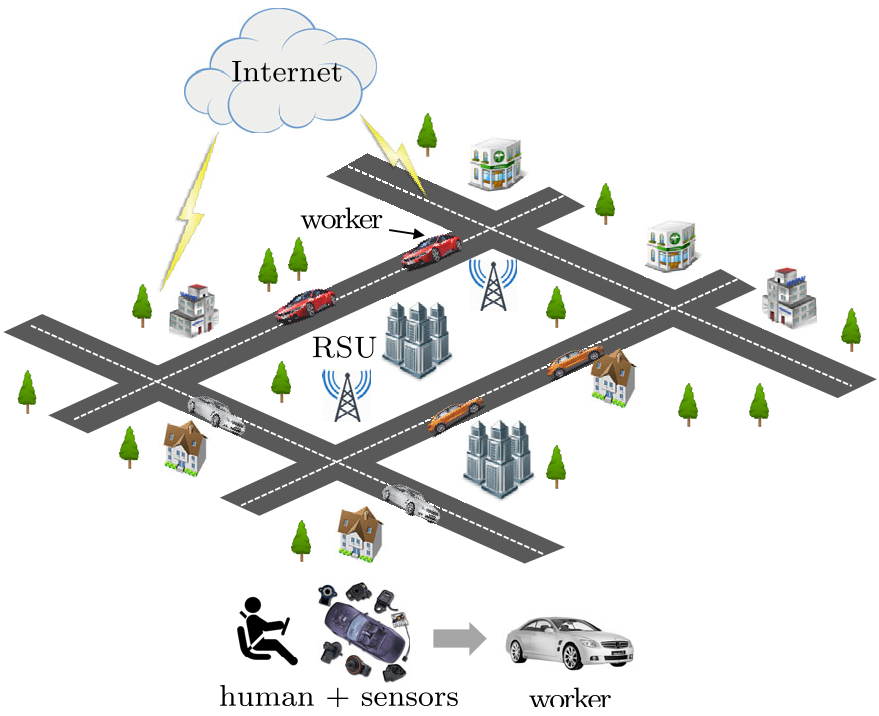
The Cryptographic Protocol
The scheme utilizes Bilinear Pairings and Blind Signatures to facilitate:
- Anonymous Registration: Using a Trust Authority (TA) that stays offline during operations.
- Blinded Credentialing: The server signs a worker's pseudonym without actually seeing the real identity.
- Double-Blinded Rewarding: A token system where the server rewards a worker for a job without knowing which specific task or pseudonym earned the reward.
Experimental Validation
Using a real-world taxi-trace dataset from San Francisco (comprising 533 taxis), the authors validated the privacy metric.
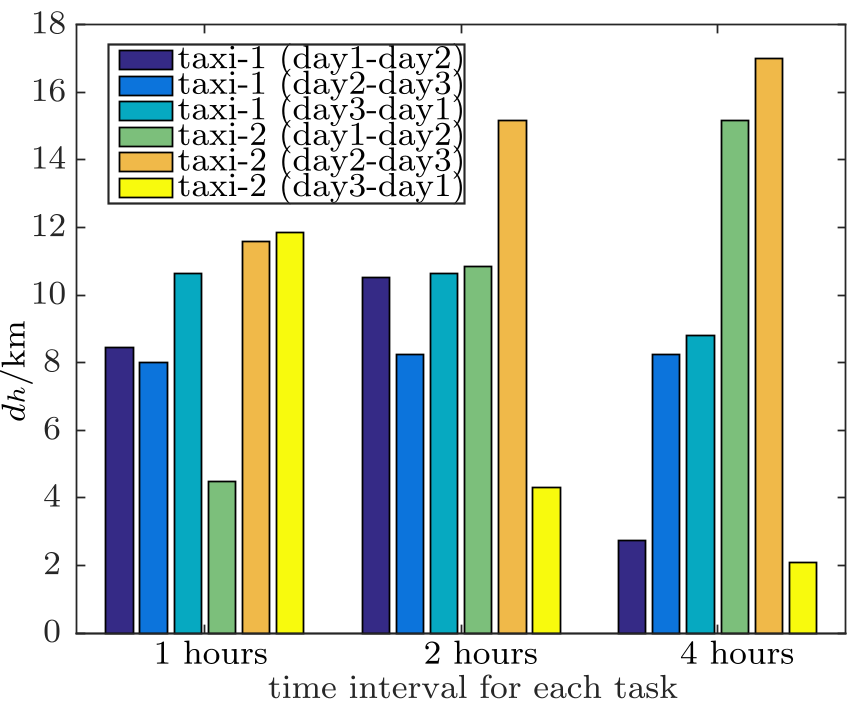
The results (Figure 5) show that as a worker accepts more tasks ( increases), the spatial randomness () shifts, indicating higher traceability. This proves that workers must be selective about which tasks they accept to maintain a low privacy-exposure profile.
On the efficiency side:
- SC-Server Performance: Can handle 200-250 concurrent requests per second.
- Latency: Most operations at the vehicle side (SV) take less than 60ms, which is trivial for modern on-board units.
Critical Insight & Conclusion
This work highlights that in the era of IoV, location privacy is not a static state but a dynamic trade-off. By providing vehicles with the mathematical tools (Hausdorff/Frechet metrics) to evaluate their own "traceability" in real-time, the scheme moves privacy from a central server's responsibility to the worker's own control.
Takeaway: Future crowdsourcing platforms must move beyond simple encryption and look at the "behavioral fingerprints" left by spatial-temporal data. The next frontier will likely involve balancing this privacy protection with the potential income loss for workers who must reject high-paying but "too revealing" tasks.