
Quantifying the Unseen: A Mathematical Framework for Privacy Impact in Social Networks
Privacy impact assessment for online social networks
The paper introduces a quantitative analysis framework for Privacy Impact Assessment (PIA) in Online Social Networks (OSNs). It utilizes unique privacy measurement metrics, including the Privacy Index (PIDX) and composite measurement functions (c-PIDX), to numerically evaluate privacy loss across direct, indirect, and potential data leaks.
TL;DR
Online Social Networks (OSNs) have turned privacy into a network effect problem. This paper moves past subjective audits by proposing a quantitative analysis approach to measure exactly how much privacy is lost when data is leaked. By defining the c-PIDX (Composite Privacy Index), the authors provide a mathematical way to assess risks from direct leaks, inferred data, and social engineering potential.
Background: The Limits of Checklists
In the traditional enterprise world, Privacy Impact Assessment (PIA) is often a "check-the-box" exercise. However, in the age of Facebook and Twitter, a single data point—like a zip code or birth date—is rarely isolated. The authors argue that privacy is a function of Attribute Sensitivity, Visibility Settings, and Network Proximity. When one account is compromised, the privacy risk doesn't stay with that user; it propagates.
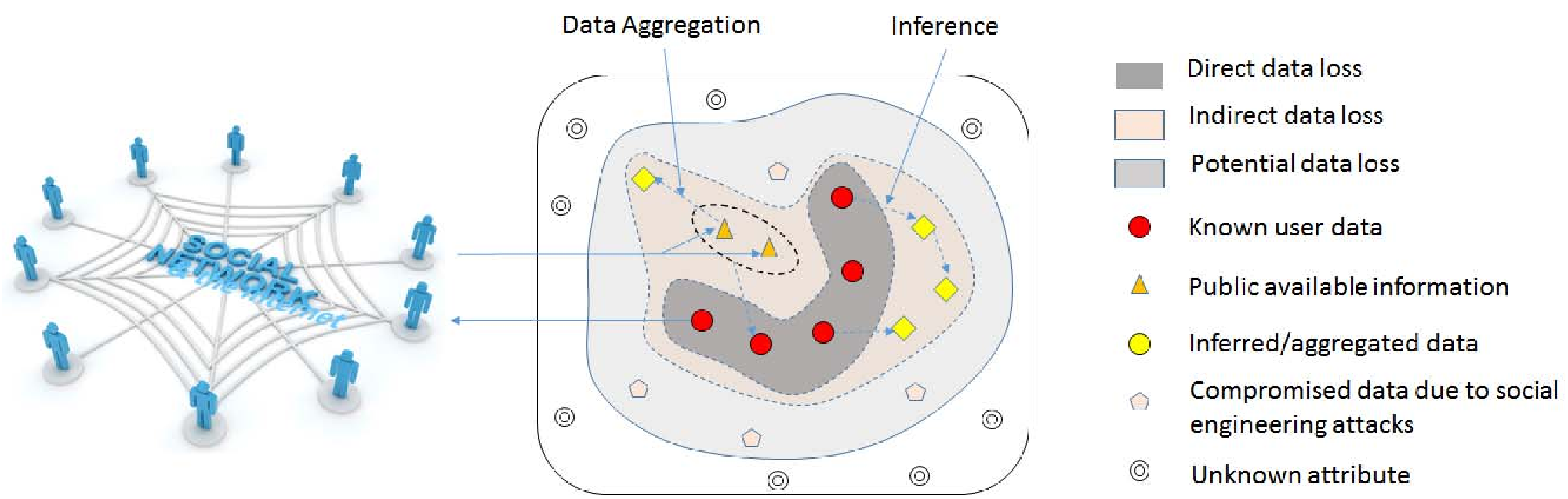
The Core Challenge: The Three Faces of Data Loss
The paper identifies a crucial gap in how we view security incidents. Assessment must cover:
- Direct Data Loss: Explicit PII like names and SSNs.
- Indirect Data Loss: Information revealed through deep analytics, aggregation (e.g., combining gender and zip code to uniquely identify 87% of users), and inference of hidden relationships.
- Potential Data Loss: The secondary risk of social engineering attacks where a hacker uses a compromised account to "phish" friends.
Methodology: Calculating the Privacy Index (PIDX)
The heart of this work is the Composite Privacy Index (c-PIDX). Instead of just counting leaked fields, the authors reflect the physical intuition that some attributes are more dangerous than others, and their impact depends on who is looking at them.
The Formula of Exposure
The exposure of User to Actor is defined by:
- : The privacy weight of attributes visible to .
- APIF (Attribute Privacy Impact Factor): A sensitivity weight assigned to specific data points.
- : The degree of separation (Friend, FOAF, Public).
The authors argue that a Composite Index (c-PIDX) is superior because it tracks both incremental attribute changes (weighted) and the "critical hit" of a high-sensitivity attribute (maximum).
Note: The model utilizes degree of separation and attribute visibility functions to determine its metrics.
Experiments: Assessing Group Compromise
One of the paper’s most practical contributions is an algorithm to assess the "contagion" of a breach. When a group of accounts is hacked, the malicious user gains an asymmetric advantage.
- Low Risk: The attacker learns more, but no PII is disclosed ().
- High Risk: The attacker gains PII, or the exceeds a predefined threshold .
By running a breadth-first search (BFS) starting from the victims, organizations can quantify how many users are affected at different "risk depths" ().

Critical Insight: Beyond the Binary
What makes this work stand out is its acknowledgement of Indirect Loss. In the era of Big Data, an attacker doesn't need your SSN to ruin your privacy; they only need enough "virtual attributes" to re-identify you. The paper correctly identifies that privacy settings are often "confusing and ineffective" once an account is compromised, as "friend" status bypasses most filters.
Conclusion and Future Outlook
Wang and Nepali have moved the needle from qualitative "maybe" to quantitative "how much." While the current model primarily focuses on direct and indirect inference, the authors note that de-anonymization and the specific mechanics of social engineering require further modeling.
For security practitioners, the takeaway is clear: your privacy impact isn't just about the data you lost; it’s about the new connections and inferences you’ve handed to the adversary.