
The Privacy Illusion: How Your Offline Meetups Betray Your Online Secrets
Privacy Inference Analysis on Event-Based Social Networks
2016-01-01
Summary
Problem
Method
Results
Takeaways
Abstract
This paper investigates privacy vulnerabilities in Event-Based Social Networks (EBSNs) like Meetup, where online and offline social activities are bridged. It demonstrates how user's hidden group memberships and offline event attendances can be inferred using content-based and collaborative filtering models, achieving high accuracy across a dataset of over 6.5 million users.
## TL;DR
While you might think clicking "Hide Group Membership" on a social platform keeps your interests private, this paper proves otherwise. By analyzing **Event-Based Social Networks (EBSNs)** like Meetup, researchers demonstrated that simple similarity-based models can predict your hidden groups and future physical locations with alarming accuracy (Recall up to 0.9), even if an attacker only has a fraction of your social history.
**Academic Context**: This work is a crucial "Red Team" analysis that bridges the gap between Online Social Networks (OSNs) and Location-Based Social Networks (LBSNs), identifying a new frontier of privacy threats where digital interests and physical presence are inextricably linked.
## The Core Challenge: Bridging the Virtual and Physical
Existing privacy research often treats your "Online Self" (who you follow on Twitter) and your "Physical Self" (where you check in on Foursquare) as separate entities. However, EBSNs like Meetup merge these. You join an online group (virtual) to attend a local hiking event (physical).
The authors argue that this coupling creates an inherently "leaky" system. If a user hides their membership in a politically sensitive group but their past event attendance shows a pattern of attending events hosted by that group, the "hidden" attribute is easily recovered.
## Methodology: Simple Models, Devastating Results
The researchers didn't use complex AI; they used the fundamental logic of social similarity. They proposed four models divided into two categories:
### 1. Online Privacy Inference (Group Membership)
* **Group Tag Similarity (GTS)**: A content-based approach. If the tags of a hidden group match the tags of groups you publicly belong to, you likely belong to the hidden one.
* **Group Member Similarity (GMS)**: A collaborative approach. If people in your public groups are also members of a hidden group, the model predicts you are too.
### 2. Offline Privacy Inference (Event Attendance)
* **Event Content Similarity (ECS)**: Uses a multi-dimensional histogram of your history (Time: e.g., "Wed@9:00", Location, and Topic) to predict if you'll attend an upcoming event.
* **Event Attendant Similarity (EAS)**: Analyzes the social circle of people RSVPing to an event to see if they overlap with your known associates.
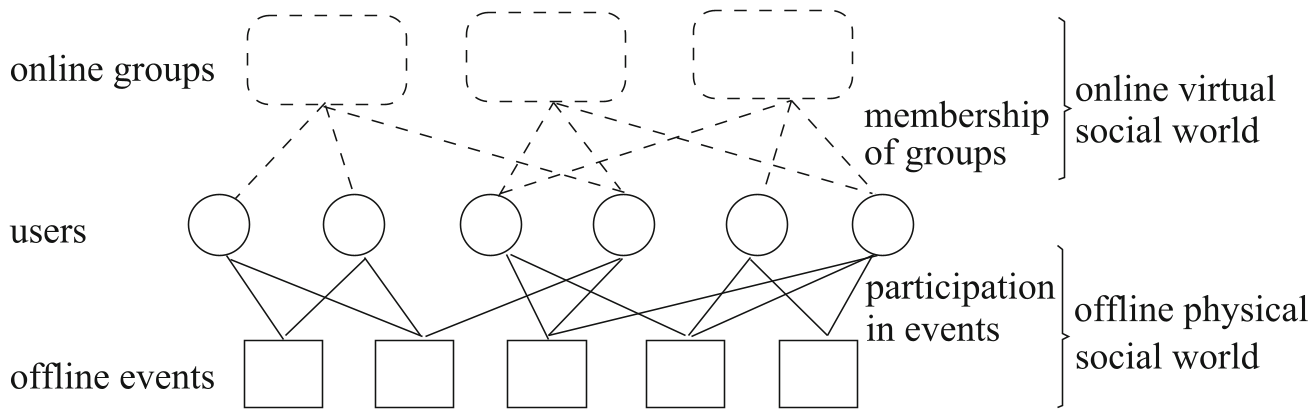
*Figure 1: The interrelated structure of EBSNs, showing the transition from online group creation to offline event interaction.*
## Experimental Insights: "You Are Who You Know"
The study used a massive dataset: **6.5 million users and 6 million events**.
The results were striking:
1. **Social Context is King**: The collaborative models (GMS/EAS) performed significantly better than content-only models. Your friends' public actions effectively de-anonymize your private ones.
2. **Low Barrier to Entry**: Attackers don't need a complete history. Even with only **20%** of a user's data as background knowledge, the models maintained high recall.
3. **The Precision vs. Recall Tradeoff**: While precision is lower (due to many possible groups to join), the recall is high enough (0.6 to 0.9 depending on K) that an attacker can narrow down a victim's "hidden life" to a very small set of candidates with minimal effort.
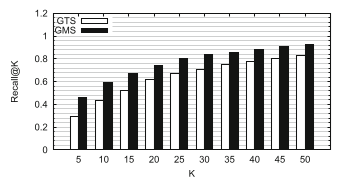
*Figure 2: Precision and Recall metrics across different levels of attacker background knowledge (20% to 80%).*
## Critical Analysis & Conclusion
The takeaway is clear: **Privacy settings are a surface-level fix for a structural problem.** The "Hybrid" nature of modern social lives means that our physical movements are predictable via our digital interests, and vice versa.
### Limitations
* **Static Modeling**: The models assume user interests remain relatively stable over the crawling period.
* **Simple Inference**: While the paper proves simple models work, more sophisticated Graph Convolutional Networks (GCNs) could likely achieve even higher precision, making the threat even more severe.
### Future Outlook
This research serves as a wake-up call for EBSN developers. Merely offering a "hide" button is insufficient. Future platforms may need to incorporate **Differential Privacy** at the group-recommendation level or "obfuscation" strategies for public RSVPs to protect their users' physical safety from inference-based tracking.