
Information Markets: The Future of Privacy in Decentralized Social Networks
Privacy and Information Markets: Controlling Information Flows in Decentralized Social Networking
This paper proposes a decentralized framework for Social Networking (DCSN) that integrates XACML-based information flow control with the micro-economics of information markets. By utilizing signed speech acts and "sticky policies," the system allows users to manage both incoming and outgoing data based on complex social, spatial, and temporal contexts.
TL;DR
Researchers from TU München propose a paradigm shift: treating privacy not just as a set of checkboxes, but as an Information Market. By combining decentralized architectures with XACML-based sticky policies and signed speech acts, the authors provide a framework where users regain control over their data, balancing the "cost" of privacy loss against the "revenue" of social capital.
The "Walled Garden" Problem and Disinhibition
Current Social Networking (SN) platforms like Facebook act as monopolistic intermediaries. This leads to two critical failures:
- Data Lock-in: Users cannot move their social context or information across platform boundaries.
- Online Disinhibition Effect: The virtual nature of these platforms causes users to reveal more than they would in real life, often violating their own long-term privacy interests because the "costs" of sharing are invisible.
The authors argue that privacy control, information filtering, and information markets are essentially the same problem: Information Flow Control.
Methodology: Speech Acts and the Matryoshka Principle
The core of the proposed Decentralized Contextual Social Networking (DCSN) architecture is the transformation of a data point into a Digital Speech Act.
1. The Signed Speech Act
Instead of a simple database entry, every post or context update is a signed package containing:
- Content: The actual data (text, photo, location).
- Illocutionary Intent: The goal (e.g., an assertion, a request).
- Sticky Policy: An XACML document defining who can 'read' or 'repost' based on context (location, social distance, or time).
2. The Matryoshka Principle
To solve "multi-party privacy" (e.g., when someone comments on your photo), the paper introduces the Matryoshka Principle. Policies are nested like Russian dolls; a reposted item must satisfy the intersection of the original producer's policy and the reposter's policy.
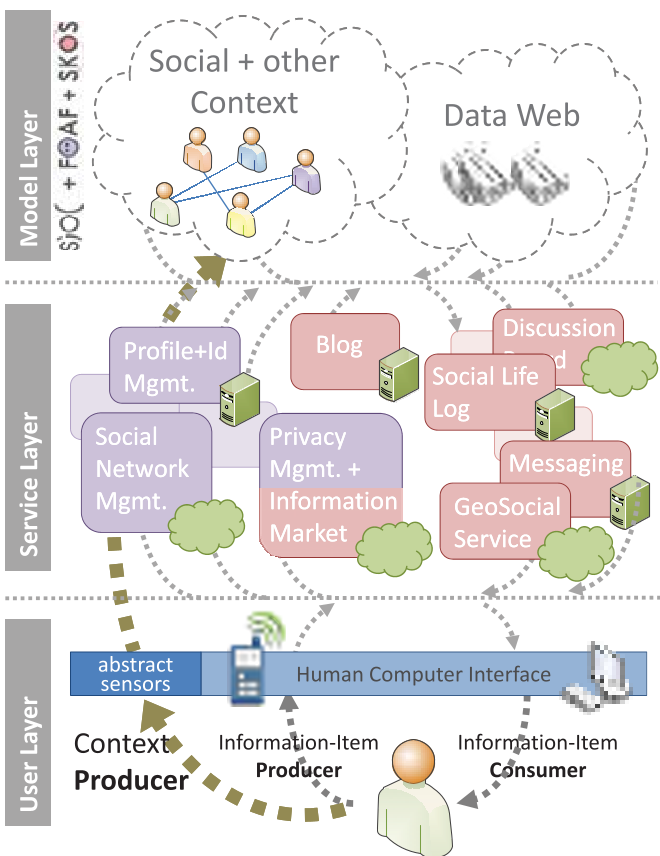 Figure 1: The Layered Architecture of DCSN, separating the UI from the Context/Model layers.
Privacy as Micro-Economics
The most striking insight is the formalization of sharing as a rational economic transaction. Every time you share data (Transaction ), you calculate:
- Revenue: Immediate utility + Social Capital gain + Potential micro-payments.
- Costs: Fixed production costs + Privacy Costs (the disadvantage of revealing info).
A transaction only occurs if:
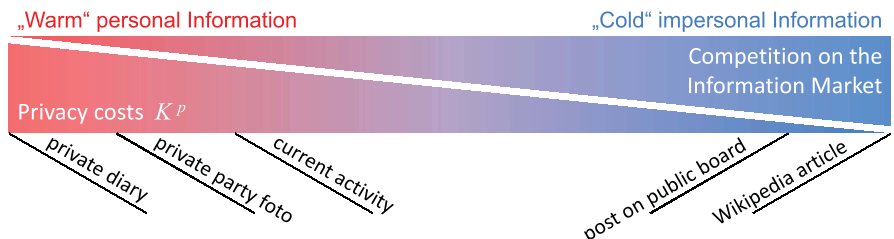 Figure 2: This graph illustrates how privacy costs increase as information moves from the private sphere to the public competitive market.
Implementation: Beyond DRM
Unlike traditional Digital Rights Management (DRM) which uses "hard" encryption to block access, this approach relies on Societal Conventions and Traceability. Because every speech act is signed and traceable, an organization (like an insurance company) using data illegally would face "substantial scandals" once a legal trial proves they accessed data without the requisite 'read' rights.
Critical Insight & Conclusion
The genius of this paper lies in its refusal to treat privacy as a technical barrier. Instead, it treats it as a value-calibration problem. By making the "Privacy Cost" explicit through market mechanisms, users can finally make informed decisions about what their "Social Capital" is actually worth.
Future Outlook
While the complexity of XACML and digital signatures might seem daunting for average users, the authors envision User Agents (on smartphones) negotiating these trades automatically in the background, allowing for a seamless yet "privacy-expensive" social experience.