
Digital Stalking at Scale: The Erosion of Privacy in GeoSocial Networks
Privacy Issues in Geosocial Networks
This paper provides a comprehensive taxonomic and qualitative analysis of privacy risks within GeoSocial Networks (GSNs), specifically examining the "content-location" link in modern mobile applications. It evaluates critical privacy-preserving protocols (such as LocX, Mobishare, and Smokescreen) and assesses the widening gap between rapid technological advancement and lagging legal frameworks like PIPEDA and ECPA.
TL;DR
Geosocial Networks (GSNs) have created a direct link between our physical movements and digital identities, turning real-time location into a high-value commodity. This paper deconstructs how GSNs collect data, why our current legal shields (like ECPA) are failing, and compares the technical protocols—from spatial cloaking to encryption—designed to keep our "spatiotemporal traces" out of the wrong hands.
Background: The End of Physical Anonymity
In the 2002 film Minority Report, personalized billboards greet citizens via eye-scanners. Today, we don't need scanners; we carry smartphones that broadcast our coordinates voluntarily. GSNs like Foursquare, Yelp, and Instagram have transformed from mere social apps into "locative media," where our location history acts as a fingerprint. As the paper points out, just four spatiotemporal points are enough to uniquely identify 95% of individuals.
The Core Dilemma: Motivation vs. Malice
The authors highlight an uncomfortable truth: the very features that make GSNs useful (finding friends nearby, localized reviews, emergency services) are the same ones exploited by malicious actors.
- The "Girls Around Me" Case: An app that scraped Foursquare and Facebook data to map the locations of women in real-time.
- The "Please Rob Me" Insight: Demonstrating how public "check-ins" act as a broadcast for burglars to know when a home is empty (78% of ex-burglars surveyed admitted to using social media for reconnaissance).
Methodology: How Data Leaks and How We Protect It
The paper categorizes location collection into System Collection (platform-level integration like Facebook Graph Search) and Third-Party Collection (apps like Highlight that run continuously in the background).
Technical Defense Mechanisms
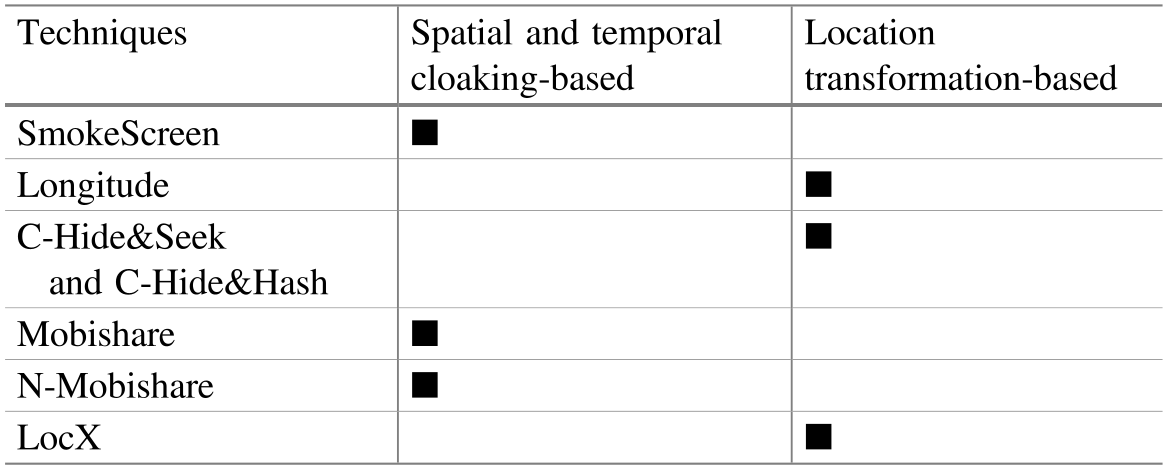
The authors compare two major schools of thought in privacy preservation:
- Spatial and Temporal Cloaking: This method (e.g., SmokeScreen, Mobishare) hides the user in a "crowd" of individuals or sends imprecise coordinates. While intuitive, it often kills the accuracy needed for "nearest neighbor" searches.
- Location Transformation: This uses cryptographic keys to transform coordinates (e.g., Longitude, LocX). The service provider stores an encrypted index, meaning they can facilitate connections without ever knowing the user's actual latitude and longitude.
Critical Results: The Efficiency Gap
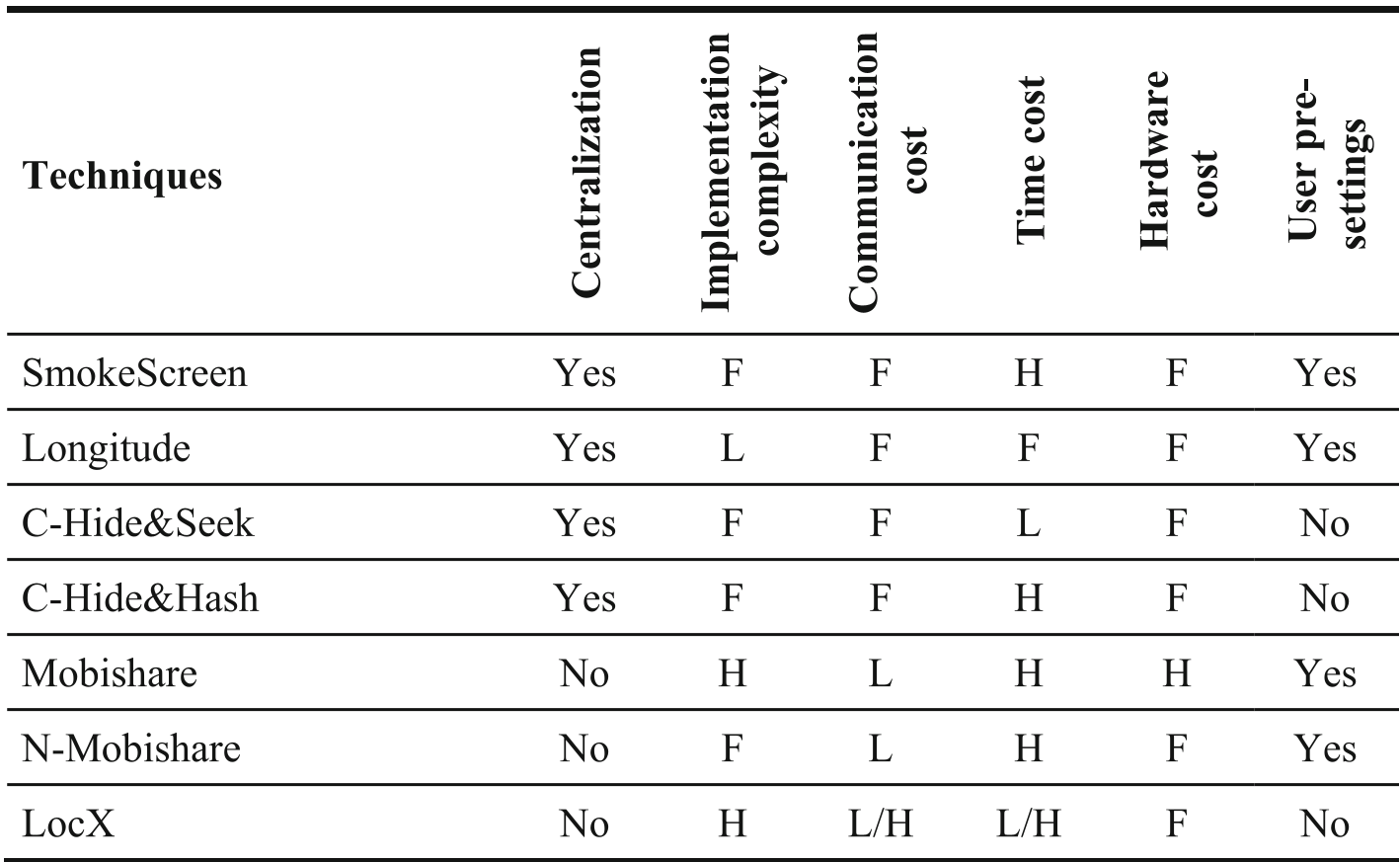
In a head-to-head comparison of seven major protocols, a significant "efficiency-privacy trade-off" emerged:
- Latency Issues: Early protocols like SmokeScreen took up to 10 seconds to resolve identities, making them useless for real-time mobile interaction.
- The Winner (LocX): Identified as the most adapted for modern GSNs. By using a "Proxy" to secure connections and an "Index Server" for encrypted location data, it allows for high utility without centralized data exposure. However, it still struggles with "nearest-neighbor" queries, which require high computational overhead.
Legal & Social Insights: The "Privacy Self-Management" Paradox
Technical solutions are only half the battle. The paper argues that legal frameworks have failed to keep pace. In the US, the Cable Act and ECPA are aging, while in Canada, PIPEDA is described as "insufficient" for the scale of modern data collection.
Furthermore, the paper exposes a psychological flaw: The Transparency Fallacy. 68% of young users believe that if a site has a "Privacy Policy," it automatically protects them—failing to realize that most policies are designed to protect the company, not the consumer.
Summary & Future Outlook
The takeaway is clear: we cannot rely on the "goodwill" of GSN providers. The paper advocates for:
- Decentralized Architectures: Moving away from centralized servers that act as "honeypots" for hackers.
- Inductive Information Awareness: Educating users that sharing a photo isn't just sharing a "moment"—it's sharing a coordinate and a timestamp that could be part of a larger, dangerous inference attack.
The path forward likely lies in LocX-style encryption and a radical update to international privacy laws that treat spatiotemporal data with the same severity as healthcare or financial records.
Limitations of the Study: The paper acknowledges that its comparison is qualitative; future work should focus on live-traffic benchmarks of these protocols on modern 5G/6G networks where data velocity is significantly higher.