
Privacy in the Palm of Your Hand: Re-evaluating Mobile Social Network Security
Privacy Issues in Mobile Social Networks
The paper investigates privacy risks in Mobile Social Networks (MSNs), specifically focusing on Location-Based Social Applications (LBSAs). It evaluates three defensive frameworks—Identity Servers (AIDs), Virtual Individual Servers (VISs), and Decentralized Multi-Domain OSNs—to enhance user trust and data protection.
TL;DR
As mobile devices transformed from simple communication tools to intelligent, location-aware companions, they opened a "Pandora's box" of privacy vulnerabilities. This paper dissects the inherent risks of Mobile Social Networks (MSNs) and evaluates three architectural shifts—from identity masking to full decentralization—aimed at restoring user sovereignty over their personal data.
The Privacy Paradox: Utility vs. Anonymity
The core motivation for this research stems from a disturbing trend: users are increasingly sharing high-precision location data with untrusted third-party servers in exchange for social convenience (e.g., finding nearby friends). The authors identify a "Privacy Paradox" where the perceived usefulness of a service often overrides security concerns, even though these systems are susceptible to:
- Eavesdropping & Spoofing: Intercepting unencrypted data flows.
- Wormhole Attacks: Manipulating location signals to misrepresent a user's physical presence.
- De-anonymization: Linking social IDs to specific physical movements over time.
Methodology: Three Pillars of Defense
The paper evaluates three distinct technical approaches to mitigate these risks:
1. Identity Servers & AIDs
This mechanism focuses on Identity Obfuscation. By using a central Identity Server (IS) to generate temporary Anonymous Identifiers (AIDs) via cryptographic hashes, the system ensures that third-party applications only see a transient "alias" rather than the user's true identity.
- Visual Logic: Imagine a mask that changes every time you enter a new room (connection).

2. Virtual Individual Servers (VIS)
The VIS approach introduces a Privacy-Preserving Proxy. Instead of interacting directly with a social network, the mobile device communicates with a personal virtual machine (VIS) running in a secure infrastructure.
- Why it works: The VIS holds the "administrative domain" for the user, allowing them to upload raw data just once. The VIS then interacts with external services based on strict, user-defined rules, effectively shielding the user from large-scale data breaches at the provider level.
3. Re-Socializing & Decentralization
This is the most radical shift—moving away from centralized "walled gardens" to a Multi-Domain OSN. It splits the social experience into:
- Social Webspace: For public interaction.
- Social Homespace: For private data storage.
- Social Mobilespace: For real-time interaction. Connection is established via Out-of-Band (OOB) invitation or Coupling, ensuring that trust is never managed by a single central authority.
Critical Comparison of Approaches
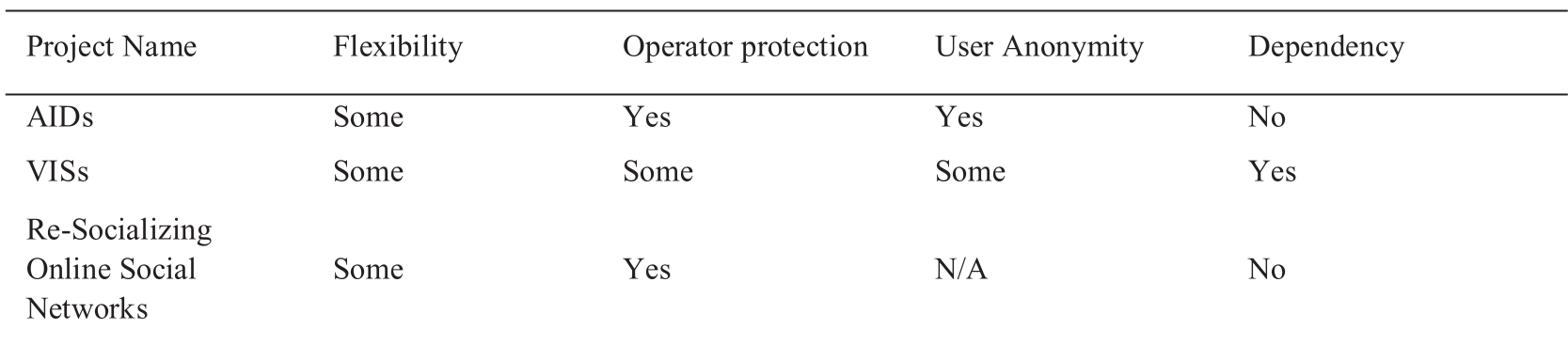
The paper provides a structured comparison across flexibility, protection, and dependency:
| Project Name | Flexibility | Operator Protection | User Anonymity | Provider Dependency |
|---|---|---|---|---|
| AIDs | Moderate | Yes | Yes | High |
| VISs | Moderate | Partial | Partial | Low (Independent) |
| Re-Socializing | Moderate | Yes | N/A | High |
Research Insights & Open Frontiers
The authors conclude that while technology exists to protect users, three hurdles remain:
- Granularity: Users need the ability to share location with Friend A and B, but hide it from Friend C, without disabling the entire service.
- Awareness: Many breaches occur not because of technical failure, but because users are unaware of the security tools already at their disposal.
- Performance Trade-offs: High-level encryption and decentralized routing naturally introduce latency—a cost many mobile users are unwilling to pay.
Takeaway for Future Research
The industry is moving toward a model where privacy is not an "all-or-nothing" setting but a dynamic negotiation between the user and the service. The most promising future lies in hybrid models that combine the independence of VIS with the cryptographic rigor of decentralized decoupling.