
Safeguarding the Mobile Social Frontier: Navigating Privacy in an Age of Ubiquitous Connectivity
Privacy Issues in Mobile Social Networks
This paper examines privacy risks in Mobile Social Networks (MSNs) and Location-Based Social Applications (LBSAs). It categorizes common MSNs and evaluates three defensive mechanisms—Anonymous Identifiers (AIDs), Virtual Individual Servers (VISs), and Decentralized Multi-domain Designs—to enhance user trust and data sovereignty.
TL;DR
In the rapidly evolving landscape of Mobile Social Networks (MSNs), our smartphones have become beacons of personal data. This research dissects the inherent privacy vulnerabilities of location-aware apps and evaluates technical architectures—specifically Anonymous Identifiers (AIDs) and Virtual Individual Servers (VISs)—designed to reclaim user anonymity without sacrificing social connectivity.
The Privacy Paradox: Why We Trade Location for Utility
The fundamental problem in modern MSNs is not just that data is collected, but how it is managed. Most Location-Based Social Applications (LBSAs) rely on a client-server model where location coordinates are sent to "un-trusted" third-party servers.
The authors identify a critical behavioral insight: The Privacy Paradox. Users are generally less concerned about privacy if they perceive the service as useful (e.g., emergency navigation or finding nearby friends), yet they feel significantly more vulnerable to "location-tracking" (server-side) than "position-aware" (device-side) technologies.
Technical Architecutures for Trust
The paper evaluates three core mechanisms to solve the trust deficit:
1. Identity Servers & Anonymous Identifiers (AIDs)
Instead of broadcasting a static Social Network ID, users request a temporary, cryptographic AID from a secure Identity Server.
- How it works: A unique AID is generated via a hash function for each connection (Bluetooth/Wi-Fi).
- The Intuition: It breaks the linkability of a user's physical movement to their permanent digital identity.
2. Virtual Individual Servers (VISs)
This approach shifts the "brain" of the social app from the provider's cloud to a virtual machine owned by the user.
- Visual Logic: Rather than uploading raw GPS data to a social network, the user uploads it to their private VIS. The VIS then interacts with the network on the user's behalf, filtering exactly what is shared.
- The Benefit: It provides "Provider Independence"—even if the social network goes offline or gets hacked, the user's data remains in their administrative domain.
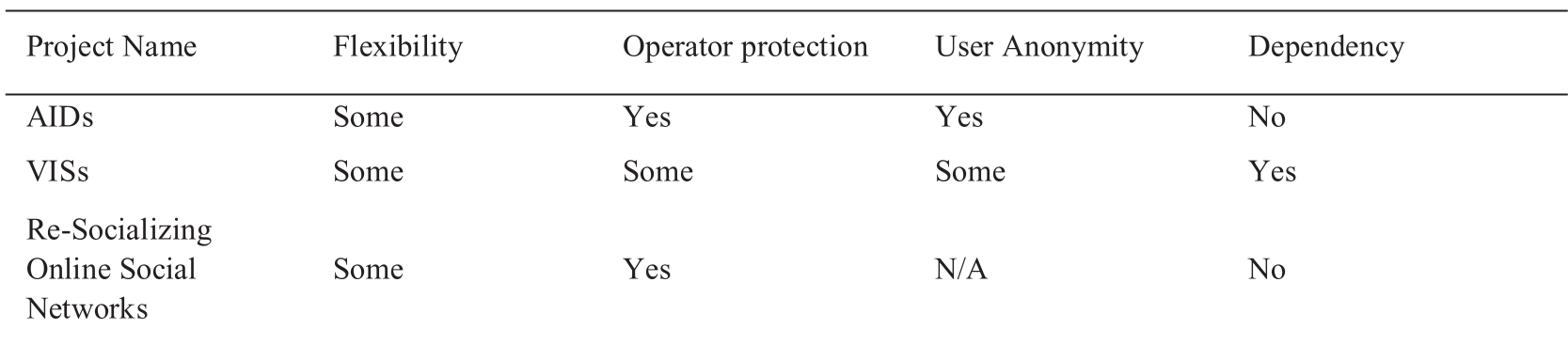
SOTA Comparison: Flexibility vs. Protection
The paper provides a qualitative benchmark of these technologies across four dimensions:
| Method | Flexibility | User Anonymity | Dependency on Provider |
|---|---|---|---|
| AIDs | Moderate | High | High (Depends on IS) |
| VISs | High | High | Low (Standalone) |
| Re-Socializing | High | Moderate | High |
Key Finding: While VISs offer the best privacy "fortress," they suffer from higher costs and management complexity for the end-user. Conversely, AIDs are more seamless but leave the user dependent on the availability of the Identity Server.
The Future: Granular Control and Contextual Privacy
The authors conclude that the next generation of smartphones must move beyond binary "Location On/Off" switches. Essential future features include:
- Selective Disclosure: Allowing User A to be visible to Friends B and D, but invisible to Friend C.
- Temporal Decay: Controlling how long a location history remains visible to peers.
- Cross-Protocol Security: Privacy mechanisms must work interchangeably across Wi-Fi, Bluetooth, and 5G without degrading system performance.
Critical Analysis
While the paper provides a robust framework for categorizing MSNs, it leaves the "performance-security tradeoff" relatively unexplored. As encryption and virtualization (VIS) become more complex, the impact on mobile battery life—a primary user concern—remains a hurdle for mass adoption. However, the shift toward a Decentralized Multi-domain Design (Social Webspace vs. Social Homespace) offers a promising roadmap for future "Privacy-by-Design" social platforms.
总结 (Takeaway)
Privacy in the mobile age is not about total secrecy, but about Information Self-Determination. By integrating decentralized proxies and cryptographic identifiers, we can build social networks where trust is a mathematical guarantee rather than a leap of faith.