
Reconstructing Privacy: The Hidden Power of Tie-Strength in Directed Social Networks
Privacy Leakage via Attribute Inference in Directed Social Networks
The paper introduces a novel attribute inference algorithm for directed social networks (e.g., Google+) that utilizes "tie-strength" and "attribute-circle dependency." By iteratively co-profiling user attributes and social circles within an ego network, it achieves state-of-the-art (SOTA) accuracy in predicting private profile information such as college, employment, and location.
TL;DR
Social media privacy is often an illusion. Even if you leave your profile attributes (like your college or employer) blank, your social "circles" and the strength of your connections can give you away. This paper presents a breakthrough algorithm that exploits directed links and tie-strength to infer hidden user attributes more accurately than ever before, outperforming existing state-of-the-art methods on real-world Google+ data.
Context: The Myth of the "Empty Profile"
Recent studies show that on platforms like Google+ or Twitter, up to 70-80% of users leave their profile information unpopulated or private. However, we live in an "Ego Network"—a subnetwork consisting of ourselves (the ego) and everyone we follow or who follows us.
The central problem is that previous research often treated these networks as undirected, assuming friendship is always mutual. In reality, directed networks are the norm. Furthermore, older models treated a casual celebrity follow the same as a close interaction with a colleague. This paper argues that not all links are created equal.
Methodology: High-Fidelity Inference via Influence
The authors suggest that to truly understand an ego user, one must look at two things:
- Attribute-Circle Dependency: You share your "Work" attribute with your professional circle, but not necessarily with your "Family" circle.
- Tie-Strength (Influence): A close connection should have more "weight" in determining who you are than a random follower.
The Model Architecture
The core of the solution is an iterative cost function that minimizes the "distance" between the attributes of users within the same circle, weighted by their Influence ().
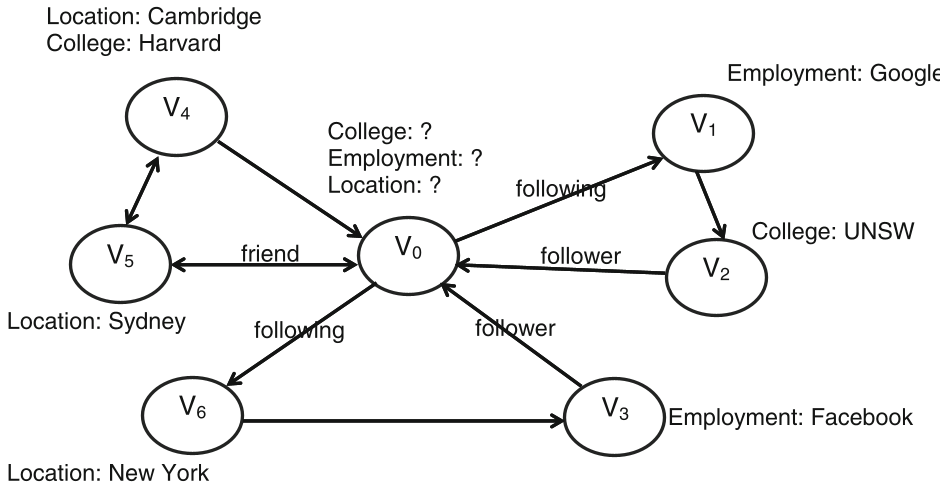
The algorithm follows a three-step iterative process (similar to coordinate descent):
- Update Attribute Vectors: It estimates the unknown attributes of the "Ego" and unlabelled users by propagating known values through the network.
- Circle Assignment: It re-evaluates which "Circle" a user belongs to based on link connectivity and attribute similarity.
- Associate Circle Values: It identifies the "defining" attribute for each circle (e.g., realizing Circle A is the "Harvard Alumni" circle).
Experiments: Breaking Down the Results
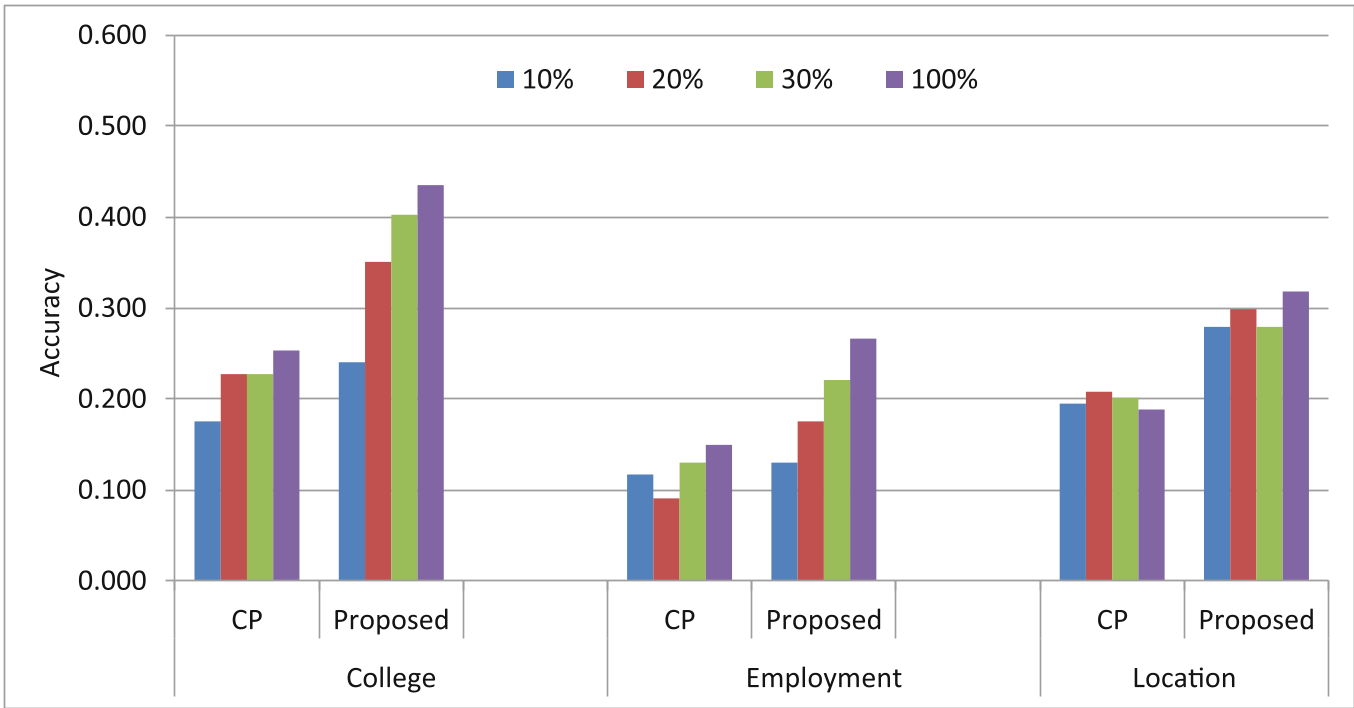
The researchers tested their model against the previous leading method, Co-Profiling (CP), using a dataset of nearly 40,000 users.
Performance Gains
The results were conclusive: the inclusion of tie-strength allows for much more precise inference.
| Method | College (Mean Acc) | Employment (Mean Acc) | Location (Mean Acc) |
|---|---|---|---|
| Proposed Method | 0.288 | 0.152 | 0.240 |
| Co-Profiling (CP) | 0.195 | 0.121 | 0.195 |
Critical Insights from the Data
- Partial Labels Matter: Unlike previous models that stagnated after seeing 20% of the network, this new method continues to improve as it absorbs "Partially Labelled" data (users who might only show one attribute).
- Independence vs. Joint Inference: Inferring attributes one by one (Independent) is more accurate, but inferring them all at once (Joint) is significantly faster for large-scale operations.
- Directed Subnetworks: The study found that even looking only at who you follow (following subnetwork) provides enough signal to leak your private attributes.
Critical Analysis & Future Outlook
This paper is a wake-up call for social media privacy. It proves that privacy is a collective responsibility. Your attributes aren't just leaked by your actions, but by the demographic consistency of your strongest social ties.
Limitations: The model currently assumes each user belongs to only one circle (no overlapping circles), which is a simplification of real human social structures where we often inhabit "overlapping" worlds (e.g., a colleague who is also a college friend).
Future Work: The next frontier involves State-Space Models or Graph Neural Networks that can handle hierarchical and overlapping circles, potentially increasing the "leakage" risk even further. For developers and users, the takeaway is clear: hiding your data is not enough if your network remains transparent.