
NHDS: Unmasking the Risks of Cross-Network Social Identity Linkage
Privacy Leakage Via De-Anonymization And Aggregation In Heterogeneous Social Networks
The paper introduces a Novel Heterogeneous De-anonymization Scheme (NHDS) designed to link user identities across disparate social networks. By integrating network topology with diverse profile attributes, NHDS achieves high precision in user mapping, enabling a large-scale empirical study of cross-network privacy leakage.
TL;DR
In the modern digital landscape, users often maintain multiple social identities across platforms like Flickr, Twitter, and LinkedIn. While users might think they are controlling their privacy by withholding information on one site, this paper proves otherwise. The Novel Heterogeneous De-anonymization Scheme (NHDS) demonstrates that by combining "who you know" (graph structure) with "what you say" (profile data), attackers can link accounts with over 90% precision, leading to a massive 39.9% increase in leaked personal information.
The "Blind Men and the Elephant" Problem in De-anonymization
Prior research into re-identifying anonymous users usually falls into two camps:
- Structure-based: Treating the network as a giant mathematical graph. This fails when two networks aren't mirror images (e.g., your LinkedIn network is professional, while your Flickr network is personal).
- Profile-based: Looking for similar usernames or bios. This fails in large populations where "John Smith" is ubiquitous, leading to endless false positives.
The authors' core Insight is that while either method alone is weak, they are powerful when combined. Graph structures can narrow down where to look (candidate sets), and profile matching can confirm who is who.
Methodology: The NHDS Pipeline
NHDS operates through a sophisticated three-step process designed to handle the "noise" and "heterogeneity" of real-world data.
1. Community-Level Pruning
Instead of comparing every user in Network A to every user in Network B (a computationally impossible task), NHDS uses the Infomap algorithm to group users into communities. By identifying a few "seed nodes" (users with identical names), the system aligns entire communities across platforms.
2. Multi-Faceted Profile Matching
Within these aligned communities, NHDS calculates a similarity score using four distinct logic engines:
- Value Matching: Direct comparison of fixed fields like gender or birth date.
- Syntactic Matching: Using the Monge-Elkan algorithm and Jaro-Winkler distance to handle typos or variations in names (e.g., "D. Jones" vs "David Jones").
- Keyword Matching: Using TF-IDF and Cosine Similarity to compare "About Me" sections.
- Semantic Matching: Utilizing the GeoNames database to realize that "Michigan" and "USA" have a logical geographical link even though the strings are different.
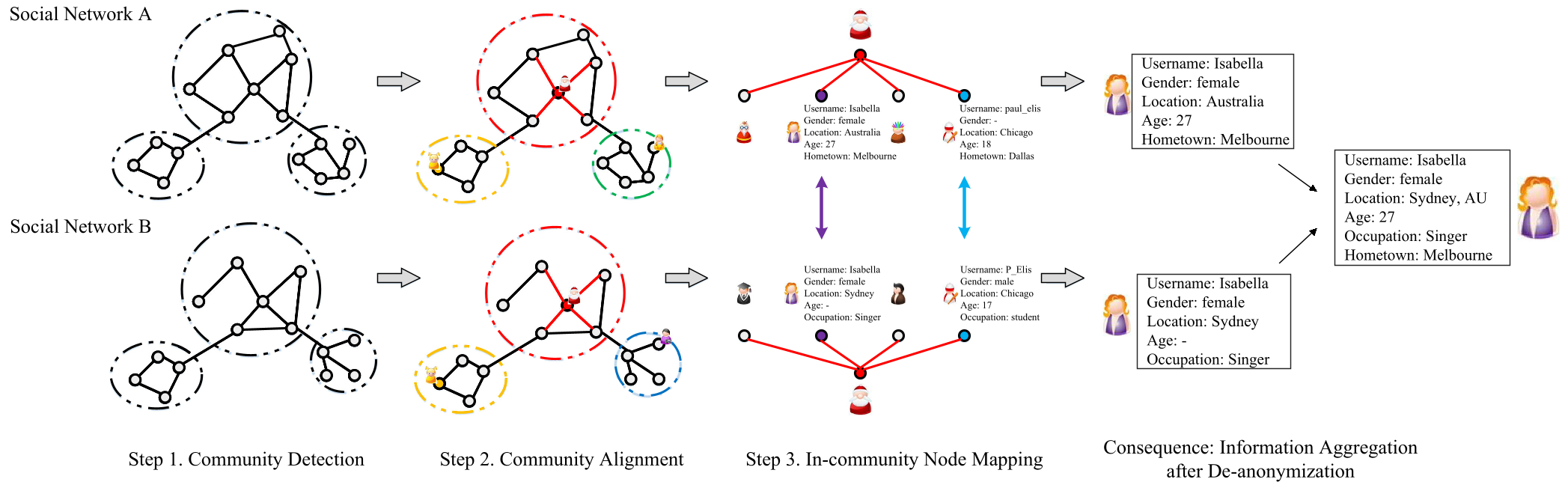 Fig 1: The architecture of NHDS showing community alignment and propagation.
Experimental Results: Precision is King
The authors tested NHDS on four massive datasets: LiveJournal, Flickr, Last.fm, and MySpace. Unlike previous tools like the "NS Algorithm" which struggled with heterogeneous data, NHDS maintained exceptional accuracy.
- High Confidence: When the threshold is set to 0.9, NHDS achieves near-perfect precision for platforms like Flickr and Last.fm.
- Resilience: The attack remains effective even if the attacker only has a partial view of the graph (e.g., 40% of edges missing).
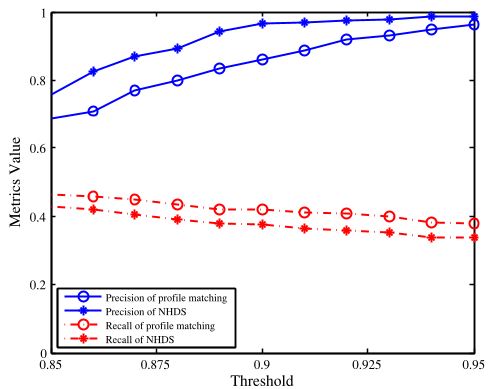 Fig 2: Trade-off between Precision and Recall. NHDS allows attackers to choose a high-precision threshold.
The Privacy Cost: 39.9% More Disclosure
The most chilling part of the study is the quantification of "Information Gain." The authors distinguish between Platform-Preserved (info one site doesn't ask for) and User-Preserved (info the user actively chose to hide).
Through de-anonymization, the researchers found:
- The Info-Gain was 39.9% on average.
- The De-anonymized Ratio reached 84%, meaning 84% of the information a user tried to hide on one platform could be recovered from another.
- Sensitive attributes like Religion, Occupation, and Ethnicity are the most frequent "leaks" during cross-network aggregation.
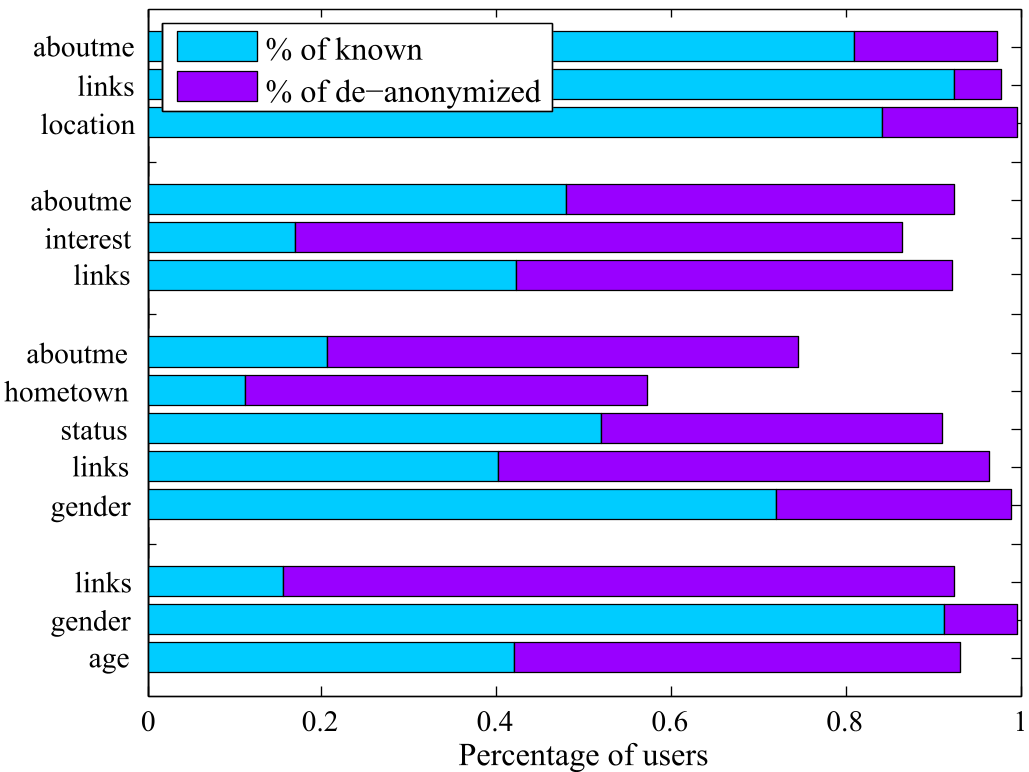 Fig 3: Quantification of how much a user's hidden attributes are exposed via aggregation.
Critical Insight & Conclusion
This paper serves as a wake-up call for both users and social network providers. The core takeaway is that anonymity is not local. You cannot be "anonymous" on Platform A if your "identity" on Platform B is public and the two can be mathematically linked.
Limitations: The method still requires a small set of "seed nodes" to start the alignment. However, as the paper demonstrates, finding these seeds is trivial given the public nature of usernames.
For future research, the industry must look toward Privacy-Preserving Personalization—finding ways to offer recommendations without allowing the structural data to be "reverse-engineered" into a full-scale identity reveal.