
Unmasking the Shadow: How Your "Check-ins" Reveal More Than Just Your Location
Privacy Leakage of Location Sharing in Mobile Social Networks: Attacks and Defense
This paper investigates the risks of demographic information leakage (age, gender, occupation, etc.) from location-sharing features in Mobile Social Networks (MSNs). The authors propose novel inference attacks using Maximum Common Trace (MCT) and machine learning, and introduce SmartMask, a context-aware defense system that automatically adjusts privacy levels to obfuscate sensitive locations.
TL;DR
In the era of Mobile Social Networks (MSNs), shared locations—whether via direct check-ins or indirect proximity discovery—function as a high-fidelity "digital fingerprint." This paper proves that even sparse sharing reveals sensitive demographics like age and gender through trace similarity. To counter this, the authors introduce SmartMask, a system that uses machine learning to automatically hide your most sensitive "Top-2" locations (home/work) while keeping your social discovery features functional.
The Hidden Cost of "Look Around"
We often think the privacy risk of apps like WeChat or Facebook is just someone knowing where we are now. However, the real threat is the History of Presence.
The authors distinguish between two sharing modes:
- Direct Sharing: Geotags and check-ins (e.g., Weibo, Instagram).
- Indirect Sharing: Distance-based discovery (e.g., WeChat's "People Nearby").
Even though these shares only cover 16% to 33% of a user's real total Points of Interest (POIs), they provide enough signal for a "Continuous Tracking Attacker" to reconstruct a mobility profile that identifies your identity.
Methodology: From Traces to Demographics
The technical core of the attack lies in the Maximum Common Trace (MCT) algorithm. The intuition is simple yet devastating: Birds of a feather travel together. People with similar educational backgrounds, ages, or professions tend to frequent similar locations.
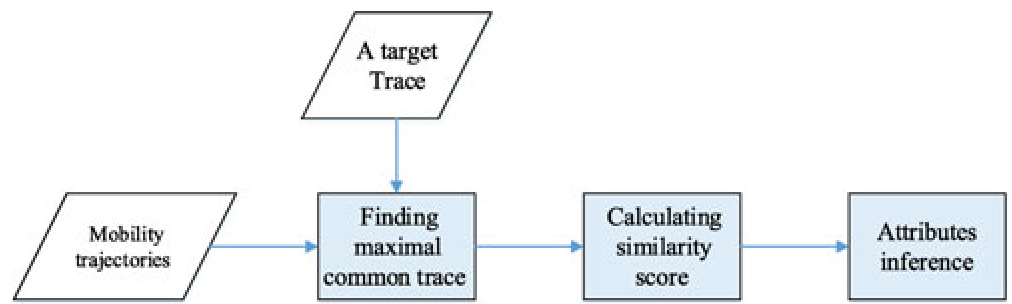
By comparing a target's trace with a database of users who have public profiles, the attacker identifies a "similarity group." Using a weighted similarity score that prioritizes sensitive POIs over public squares, the attacker performs a majority vote to guess the target's hidden attributes. In large-scale testing on over 22,000 users, this reached an alarming 76% accuracy for education levels.
Context-Aware Defense: The SmartMask Framework
Traditional defense involves "Random Obfuscation" (adding noise to the GPS), but this often ruins the utility of the app (e.g., you can't find nearby friends if your location is 5km off).
SmartMask solves this using a Decision Tree model to categorize locations into privacy levels (High, Medium, Low) based on:
- Frequency: How often do you go there?
- Duration: How long do you stay?
- Semantics: Is it a hospital or a park?
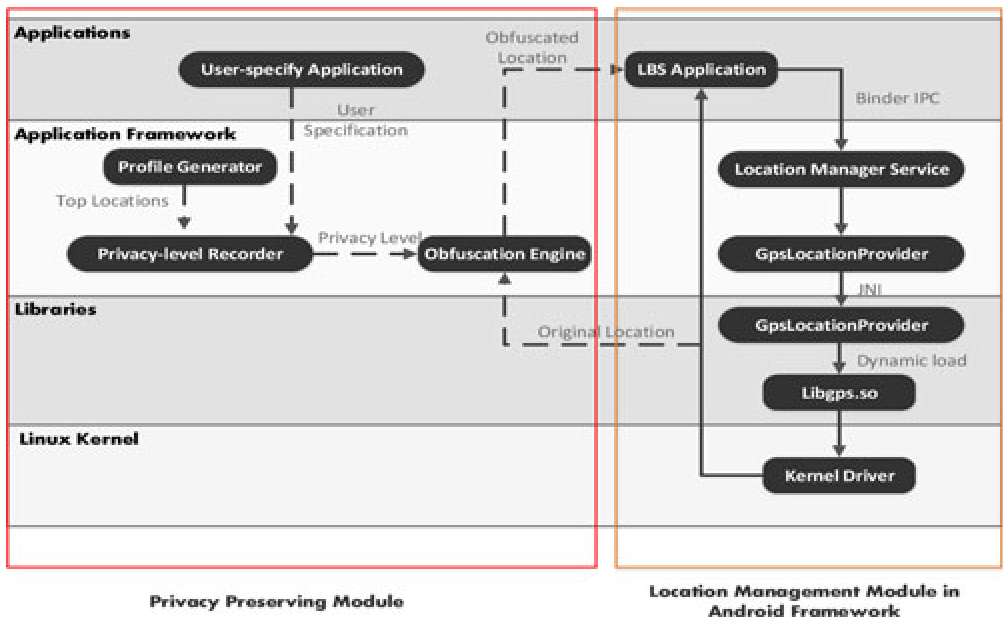
For "High Privacy" areas (like your home), SmartMask doesn't just add noise; it performs Center Shifting towards the nearest public region, effectively masking your real anchor points from the attacker’s probability distribution.
Experimental Results & Critical Insights
The evaluation proves that SmartMask outperforms simple random noise in two ways:
- Relative Entropy: It creates a significantly larger gap between the shared profile and the real profile (increasing entropy by 1.3 vs. 0.13).
- Utility Preservation: It keeps location accuracy high in "social" zones while being strictly protective in "private" zones.
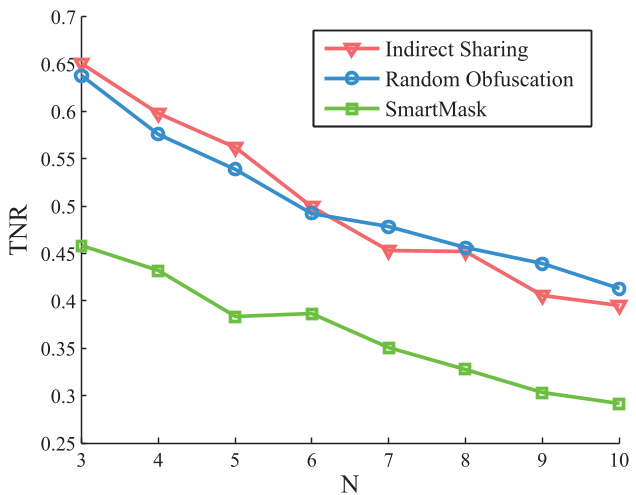
SOTA Comparison: Compared to traditional K-anonymity or standard obfuscation, SmartMask's system-level integration in Android ensures that all LBS apps are filtered through a consistent privacy policy, preventing "leakage by association" where one app reveals what another hides.
Conclusion and Limitations
This research highlights a critical vulnerability in MSNs: trace correlation. Even if you hide your profile, your movement patterns "betray" your demographics.
Future Outlook: While SmartMask is effective, the authors admit that sophisticated adversaries with access to regional datasets can still pose a threat. The next frontier for this research involves combining SmartMask's context-aware logic with Differential Privacy to provide mathematical guarantees of anonymity without sacrificing the "social" in social networks.