
Decoding Presence: How Your "Social Check-ins" Reveal More Than Just Your Location
Privacy Leakage of Location Sharing in Mobile Social Networks: Attacks and Defense
This paper investigates location privacy leakage in Mobile Social Networks (MSNs) by matching shared locations with real mobility traces. It proposes two main types of demographic inference attacks and introduces "SmartMask," a context-aware system-level defense mechanism that achieves SOTA performance in balancing privacy and utility.
TL;DR
Is your privacy safe just because you only "check-in" occasionally? This paper proves otherwise. By analyzing both direct social posts and indirect proximity features (like WeChat’s "People Nearby"), researchers can reconstruct your demographic profile—age, gender, and even education—with surprising accuracy. They propose SmartMask, an Android-based defense that uses Machine Learning to intuitively hide your "Top Locations" while keeping your social apps functional.
Reality vs. Check-in: The Data Gap
The research begins by identifying a critical misconception: that an attacker needs your full GPS history to know you. By comparing "Ground Truth Trace" (continuous GPS) with "Direct Sharing" (Weibo/Facebook) and "Indirect Sharing" (WeChat/Momo), the authors found that:
- Direct Sharing only reveals about 16% of real Points of Interest (POIs).
- Indirect Sharing reveals about 33%.
Despite this "big gap," the distribution of these points is not random. Humans are creatures of habit, and the entropy of our movement remains highly predictable.
The Attack: From Traces to Demographics
The authors pioneered two attack vectors to exploit this sparse data:
- Maximum Common Trace (MCT): This focuses on similarity. If User A has a movement sub-sequence similar to User B (whose profile is public), User A’s hidden attributes (like occupation) can be inferred via majority voting.
- Machine Learning Classification: Using a feature vector where each location is a binary "seen/unseen" flag, they trained models (SVM, Random Forest) to predict gender and education levels.
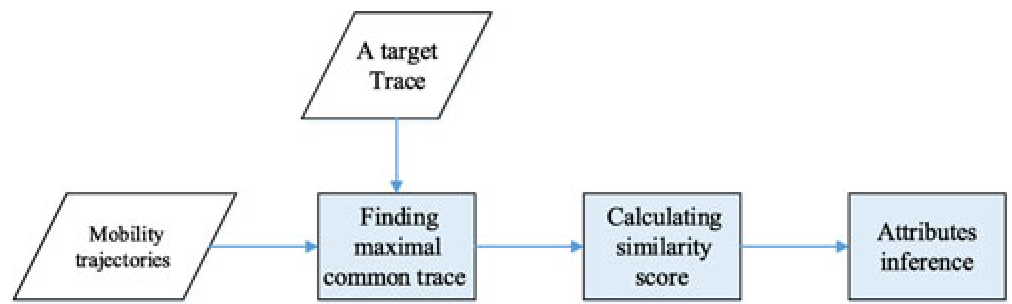 Figure 1: The workflow of mapping mobility traces to sensitive demographic profiles.
Methodology: The SmartMask Defense
The core innovation is SmartMask. The authors realized that privacy is not a binary switch but a contextual preference. You might want to be found at a public "Social Spot" (Cafe) but remain invisible at "Top Locations" (Home/Work).
1. Context-Driven Decision Trees
SmartMask doesn't just blur your location; it learns when to blur it. Using a Decision Tree model, it categorizes locations by:
- Frequency & Duration: How often and how long you stay.
- Semantics: Is it a hospital or a park?
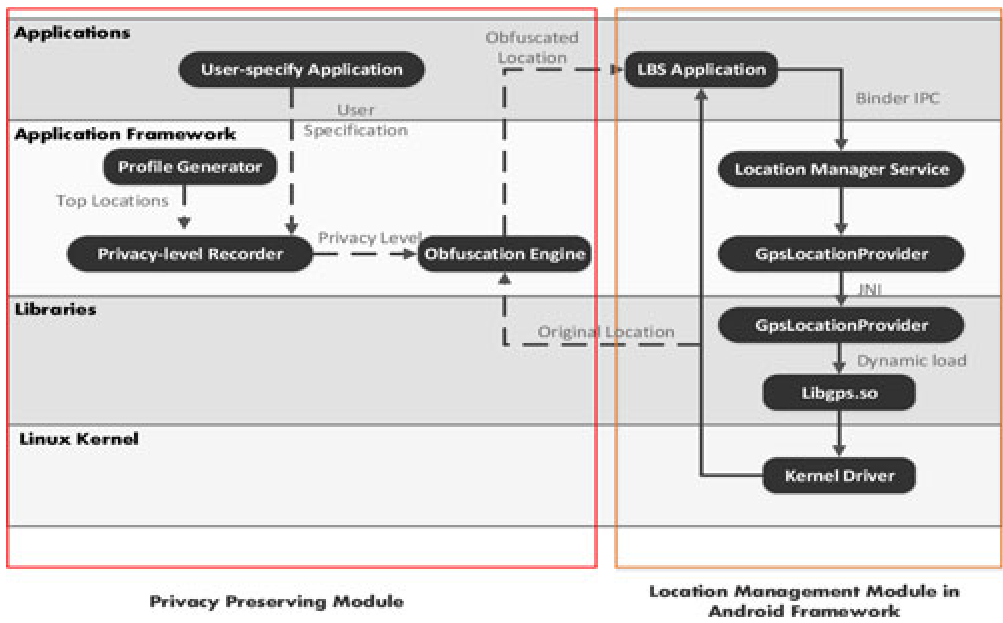 Figure 2: SmartMask system architecture integrated within the Android framework.
2. Hybrid Obfuscation
SmartMask employs three basic operators from SOTA privacy research: center shifting, radius enlargement, and radius reduction. For high-privacy areas, it uses a "cloaking strategy," purposely shifting the reported location to the nearest public region to maintain app utility without leaking the actual "hub."
Results and Impact
The results are a wake-up call for MSN users. The attack successfully predicted Education Level with 76% accuracy and Gender with 73% using only the partial data available in social networks.
SmartMask’s intervention reduced these success rates significantly (Accuracy -19%). Crucially, it maintained "Effective Utility," meaning your LBS apps (like Yelp or Google Maps) still work well in public areas, which is the "Social Capital" most users are unwilling to trade for privacy.
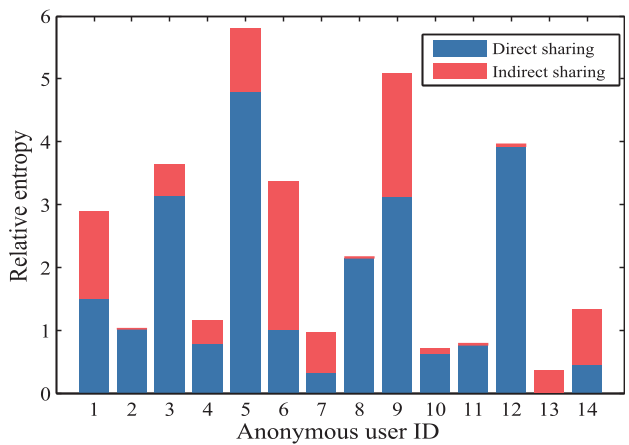 Figure 3: Quantifying the leakage—Coverage Rate and Relative Entropy of different sharing types.
Final Insight: The Future of Transparent Privacy
The genius of this work lies in its transparency. By implementing SmartMask at the system level (LocationManager), the user doesn't have to manually toggle settings for every app. It provides a blueprint for future OS-level privacy guards: systems that understand where we are and why we are there before deciding what the world should see.
Limitations noted: The study relied on a campus-based dataset (Dataset II), which might introduce demographic bias. However, the correlation between mobility and identity remains an undeniable physical reality that all LBS providers must now account for.