
Beyond the Privacy Paradox: Reclaiming Agency through Privacy Literacy
Privacy Literacy and the Everyday Use of Social Technologies
2019-01-01
Summary
Problem
Method
Results
Takeaways
Abstract
This qualitative study investigates how social media users manage their personal information through the lens of Privacy Literacy and Communication Privacy Management (CPM) theory. By analyzing 21 participants, the research highlights how users move beyond technical/legal protections to develop active, everyday strategies for protecting their informational privacy.
## TL;DR
In an era of relentless "dataveillance," this study argues that legal and technical walls are no longer enough to protect us. By interviewing 21 active social media users, Pingo and Narayan reveal that the real front line of privacy is **Privacy Literacy**: the cognitive ability to manage social boundaries, minimize data footprints, and navigate the "context collapse" of platforms like Facebook and LinkedIn.
## The Motivation: Why Tech and Law Fail
For decades, we’ve relied on two pillars for privacy: **Legal Rights** (the right to be left alone) and **Technical Security** (encryption and settings). However, the authors argue that these are insufficient. Why? Because social media creates a "Context Collapse"—where your grandma, your boss, and your high school friends all occupy the same digital space.
The authors move away from a purely structural view of privacy and toward an **individualistic perspective**. They want to know: *How do real people actually handle the risk of exposure when the platforms are designed to maximize disclosure?*
## Methodology: The Mental Calculus of Disclosure
The study employs **Communication Privacy Management (CPM) Theory**. Think of your personal information as something contained within a "boundary." You are the owner, and you decide who becomes a "co-owner" of that information.
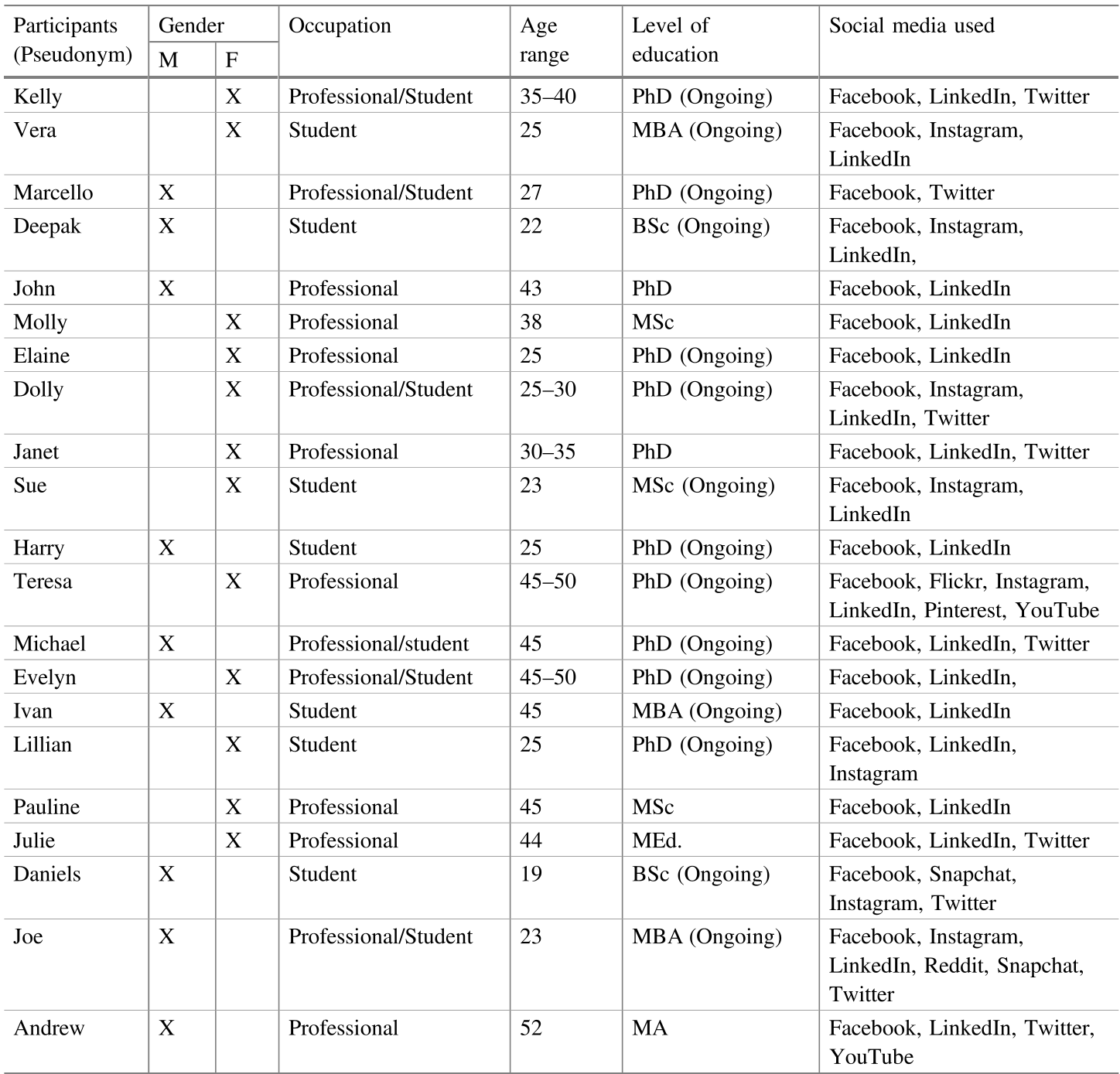
*Table 1: The study focused on diverse professionals and students, all savvy enough to use multiple platforms like LinkedIn, Twitter, and Facebook.*
The researchers didn't just ask questions; they performed **cognitive walkthroughs**. They sat with users as they navigated their Facebook settings and asked them to "Google" themselves to see if their public digital footprint matched their private identity.
## Key Insights: How "Privacy Literate" Users Fight Back
### 1. The Strategy of Compartmentalization
Users are not just passive victims of platforms. They actively segment their lives:
* **LinkedIn**: The Professional "Front." Purely for promotion and networking.
* **Facebook**: The Social "Back." Limited to friends and family, with strict boundary enforcement (e.g., blocking mothers or hiding posts from annoying acquaintances).
* **Twitter**: The "Secret Account." Used by some to express religious or personal views anonymously to avoid professional judgment.
### 2. Resisting the "Easy Path"
One of the most tactical findings was the rejection of **OAuth (Single Sign-On)**. While "Sign in with Facebook" is convenient, 71% of participants actively avoided it. They recognized that this creates a "direct link" between organizations, allowing for deeper tracking. They preferred the friction of creating a new account to keep their data silos separate.
### 3. Data Minimization & Digital Housekeeping
Participants engaged in "self-censorship" and "cleaning." This includes:
* Providing only mandatory information in forms.
* Deleting old photos or posts from younger years that no longer represent their current identity.
* Deactivating location services except when "desperate" (e.g., using Google Maps).
## Critical Analysis: Privacy Resilient vs. Privacy Vulnerable
The study concludes that while users are **vulnerable** (often ignoring long Terms of Service), they can become **resilient** through literacy.
**The Takeaway for Developers and Researchers:**
We must stop assuming users don't care about privacy just because they use social media (the Privacy Paradox). Instead, we see that users are in a constant "balancing act." Privacy Literacy is the skill set that allows users to perform this "mental calculus" effectively.
## Limitations & Future Outlook
The study sample is relatively small (N=21) and highly educated (mostly PhD and Master's students in Australia). Future research should explore if these "Privacy Literacy" habits exist among less tech-savvy populations or if the "convenience" of modern AI-driven personalization will eventually erode these boundary-management skills.
As we move toward even more invasive technologies like fitness trackers and always-on IoT, the cognitive frameworks developed in this paper will be essential for maintaining human autonomy in a networked world.