
Probabilistic Privacy: Solving the Facebook Data Harvesting Hole
Privacy Management for Facebook
This paper introduces a Privacy-Management System (PPS) for Facebook to mitigate the risks of automated data harvesting by third-party applications. The authors leverage a probabilistic approach based on user information revelation behavior to automatically configure privacy settings, achieving a 75% accuracy rate in predicting user-preferred privacy levels.
TL;DR
In the early era of social networking, Facebook's "Open Platform" became a double-edged sword: it fostered innovation but created a massive "privacy hole" allowing developers to harvest user data silently. This paper proposes a Privacy-Management System (PPS) that uses the statistical behavior of the crowd to predict and automate individual privacy settings. By switching from an "opt-in" to a "recommended opt-out" model, the system achieves 75% accuracy in protecting sensitive profile data.
The "Privacy Hole": Innovation at the Cost of Security
The core issue identified by Baatarjav et al. is the architecture of the Facebook API. In 2008, Facebook operated on an "opt-in" policy by default—meaning your data was accessible unless you manually restricted it.
The authors demonstrate that a malicious developer could use a simple PHP script to traverse a user’s social graph (friends and groups) and collect everything from birthdays to political affiliations for thousands of people in seconds. This isn't just a technical flaw; it's a social one. Users share data to find commonalities, but they frequently do not understand that "sharing with friends" often meant "sharing with any application my friends install."
Methodology: The Logic of the Revelation Matrix
The authors don't just suggest better UI; they propose a mathematical framework to categorize users. They discovered that demographics (Age, Gender, Relationship Status, Political View) are strong predictors of privacy behavior.
1. The Revelation Matrix ()
The system calculates the probability that a user in a specific subgroup will reveal a certain feature .
2. The Threshold Matrix ()
A baseline "tolerance" for privacy is established for each subgroup by averaging the revelation probabilities across all features.

3. Joint Probability Configuration
When a new user joins, the system calculates a Joint Probability. If the product of their demographic revelation probabilities exceeds the product of the group's thresholds, the feature is made public. Otherwise, it is locked.
Logic Check: If you belong to a group that is statistically very protective of their "Current Residence," the system will default that field to "Inaccessible" for you, even if you forgot to check the setting.
Experimental Results: Accuracy and Tolerance
The study analyzed nearly 5,000 members of the University of North Texas network. The findings were striking:
- Gender Differences: Male users were found to reveal significantly more personal and social information than female users across almost all categories.
- Age Peaks: The 20-24 age group was the most "transparent," sharing the highest volume of data.
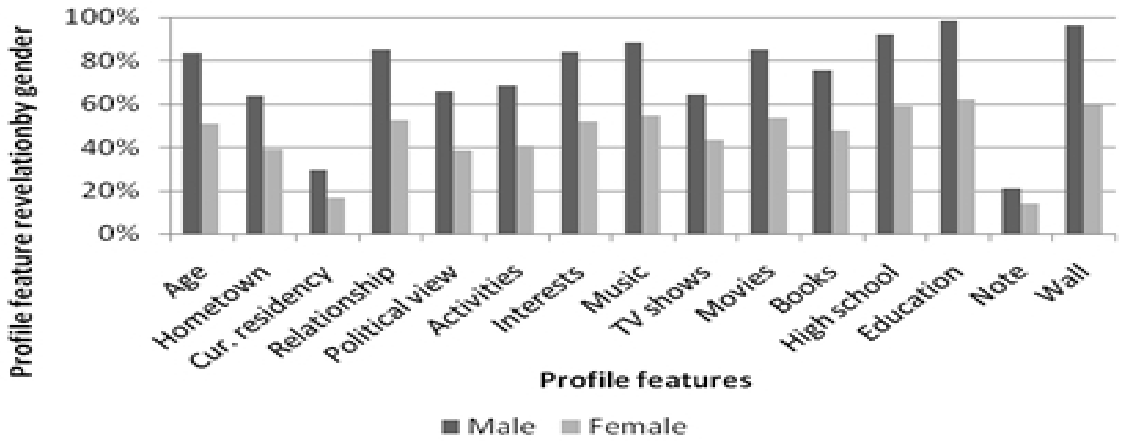
The PPS was tested against actual user settings. It achieved a 75% convergence rate. Perhaps most importantly, the system showed high error tolerance—dropping only 5% in accuracy even when users left several "core" demographic fields blank.
Critical Insight: The Business of Privacy
The authors conclude with a sharp observation of the "business-privacy trade-off." While a strict "Inaccessible-by-default" model is safest, user data is a social network’s primary asset. The PPS represents a middle ground: it doesn't break the social nature of the site, but it provides a "data safety net" for the thousands of users who are unaware of the harvesting scripts running in the background.
Conclusion
This paper serves as an early but vital blueprint for automated privacy governance. In an age where third-party apps like those involved in the later Cambridge Analytica scandal became household names, the "Probabilistic Privacy" approach reminds us that the best defense against data harvesting is a system that understands user behavior better than the users do themselves.
Key Takeaways for Today's Researchers:
- Privacy is predictable: Community standards can define default security.
- Opt-out is insufficient: Technical systems must provide "Privacy-by-Design" to protect the less tech-savvy.
- Data Harvesting is Structural: If an API allows access by default, it will be exploited.