
Beyond the Privacy-Performance Paradox: Reimagining the Social Networking Business Model
Privacy & Online SOcial netwOrkS
This paper introduces "Footlights," a semicentralized social networking architecture designed to decouple privacy from the traditional zero-price business model. By combining untrusted commodity cloud storage with locally enforced cryptographic access control, it achieves SOTA-level performance and availability while preventing service providers from accessing private user content.
TL;DR
The conventional wisdom that "Social Networking requires giving up privacy" is a fallacy driven by ad-revenue business models rather than technical limitations. Researchers from the University of Cambridge present Footlights, a semicentralized architecture that proves we can have SOTA performance and absolute privacy by treating the cloud as an "untrusted" storage bucket and moving authority back to the user's local hardware.
The Problem: You are the Commodity
The fundamental conflict in Online Social Networks (OSNs) like Facebook or LinkedIn is Incentive Misalignment. Because these services are "free," the user is the product, and the advertiser is the customer.
Current academic and commercial attempts to fix this usually fall into two traps:
- Overlay Privacy: Encrypting data inside a centralized OSN (like NOYB). The failure: The provider still sees the "social graph" (who you talk to), which is often enough to infer your religion, politics, and identity.
- Pure P2P: Decentralizing everything (like Safebook). The failure: It suffers from terrible availability (~90%) and high latency, as your data disappears when your friends turn off their computers.
Methodology: The Footlights Architecture
The authors propose a "Semicentralized" model. The key insight is to treat infrastructure as commodity and untrusted.
1. Untrusted Cloud Storage
Instead of the OSN "owning" your data, Footlights breaks data into fixed-sized (4-Kbyte) ciphertext blocks. To the cloud provider (Amazon, Google, etc.), your profile is just a "sea of identically sized blocks."
- Content-Addressing: The block's name is the hash of its content.
- Low Cost: The authors estimate this costs less than $1/user/year to match Facebook-scale performance.
2. Local Enforcement & Sandboxing
Rather than relying on the "honor system" of an OSN's privacy settings, Footlights enforces access control locally.
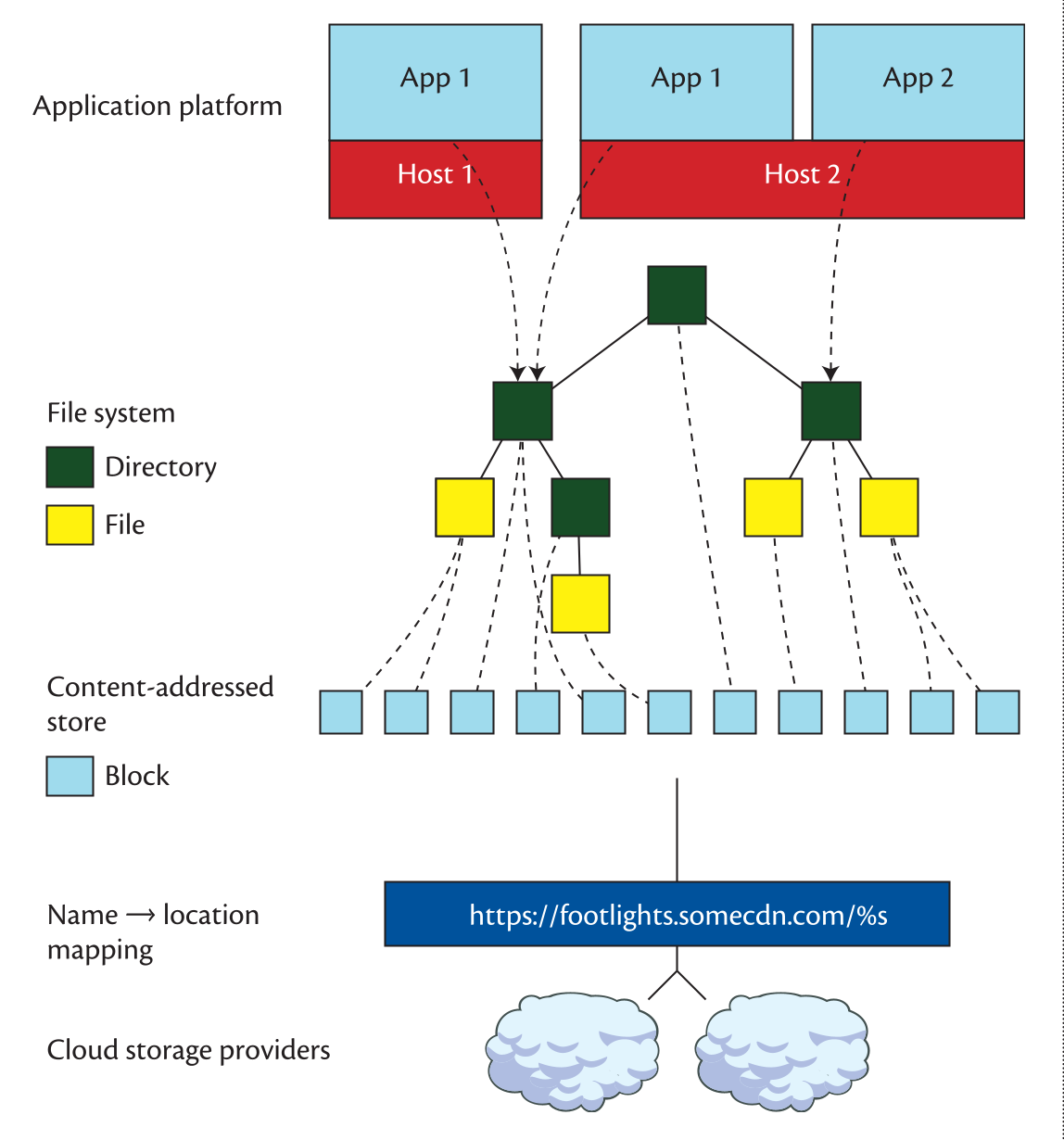 Figure 1: The Footlights stack, where the application layer is separated from the raw block store by a cryptographic security API.
When you "share" a photo, the system reveals the decryption keys only to the client software of your chosen friends. Third-party applications (the "FarmVilles" of the world) are sandboxed. They interact with your data through indirection—they can see a "placeholder" for a user's name to display it, but they cannot exfiltrate that name to their own servers without your explicit permission.
Experiments & Results: The Feasibility of Privacy
The paper argues that the technical hurdles are surmountable:
- Performance: By using CDNs and centralized block stores, Footlights avoids the "churn" of P2P networks, offering 99.9%+ availability.
- Economics: Users have shown a willingness to pay small amounts for privacy (the "Freemium" model). If a subscription costs the price of a single premium SMS per year, the "Users as Commodity" model becomes obsolete.
- Social Search: Finding friends in a decentralized world is handled through "Social Tokens"—you give a friend a "please tell your friends about me" token, replicating the "Friends of Friends" feature without a central authority mining your data.
Critical Analysis & Conclusion
The true barrier to Footlights is Metcalfe’s Law: the network effect. It is hard to convince users to leave a populated network for an empty one, regardless of how private it is.
Takeaway: This work provides a rigorous technical blueprint for a future where privacy is a feature, not a sacrifice. It shifts the privacy conversation from a "policy" discussion to an "architecture" discussion.
Limitations:
- Traffic Analysis: While content is hidden, persistent adversaries could still perform traffic analysis on block uploads/downloads to reconstruct the social graph.
- Global Analytics: Distributed systems make "Global Trends" harder to compute, as there is no central database to query.
Future work will likely focus on integrating Differential Privacy and Zero-Knowledge Proofs to allow for global analytics (like "trending topics") without exposing the individual identities behind those trends.