
Footlights: Reclaiming Privacy in Social Networks Without Sacrificing Performance
Privacy & Online SOcial netwOrkS
The paper introduces Footlights, a semicentralized Online Social Network (OSN) architecture that decouples data functionality from service provider trust. It demonstrates that privacy and social networking are not mutually exclusive by leveraging local cryptographic enforcement and commodity cloud storage, achieving performance parity with current SOTA centralized platforms.
TL;DR
Is privacy the inevitable sacrifice for social connectivity? This paper challenges the "cynical observation" that users must be commodities for services to be free. By introducing Footlights, the authors present a semicentralized architecture that uses untrusted cloud storage and local cryptographic enforcement to provide a high-performance OSN that keeps user data—and the social graph—out of the hands of providers.
The "Freemium" Illusion and the Incentive Gap
The core of the privacy crisis in Online Social Networks (OSNs) isn't just a lack of encryption; it is an incentive misalignment. Traditional OSNs (Facebook, LinkedIn) are two-sided markets where developers and advertisers are the true customers.
The authors argue that previous solutions failed because they fell into two traps:
- Centralized "Scrambling": Systems like flyByNight encrypt profile data but leave the social graph exposed. In the age of Big Data, who you know is often more revealing than what you say.
- Pure P2P Networks: Systems like Safebook offer privacy but suffer from the "capricious churn" of home computers, leading to unacceptable 90% availability in a world that expects 99.9%.
Methodology: The Footlights Architecture
Footlights breaks the deadlock by shifting the design space into a "semicentralized" region. It assumes the infrastructure (the "Cloud") is efficient but untrusted.
1. Untrusted Semicentralized Storage
Instead of a proprietary database, Footlights uses commodity cloud storage. Data is fragmented into fixed-size 4-Kbyte blocks, content-addressed (the name is the hash of the ciphertext). To the provider, the network looks like a "sea of identical blocks," making it impossible to reconstruct files or map relationships simply by looking at the storage layer.
2. Local Enforcement & Sandboxed Apps
The "Boss" of the system is the local Footlights kernel running on the user’s machine.
- Access Control: Decryption keys are shared directly with friends' clients, not the server.
- Application Confinement: Third-party apps (like photo editors) run in a sandbox. They don't see raw data; they use indirection. An app might "apply a filter to this user's photo" without ever knowing the user's name or being able to "phone home" to an ad server.
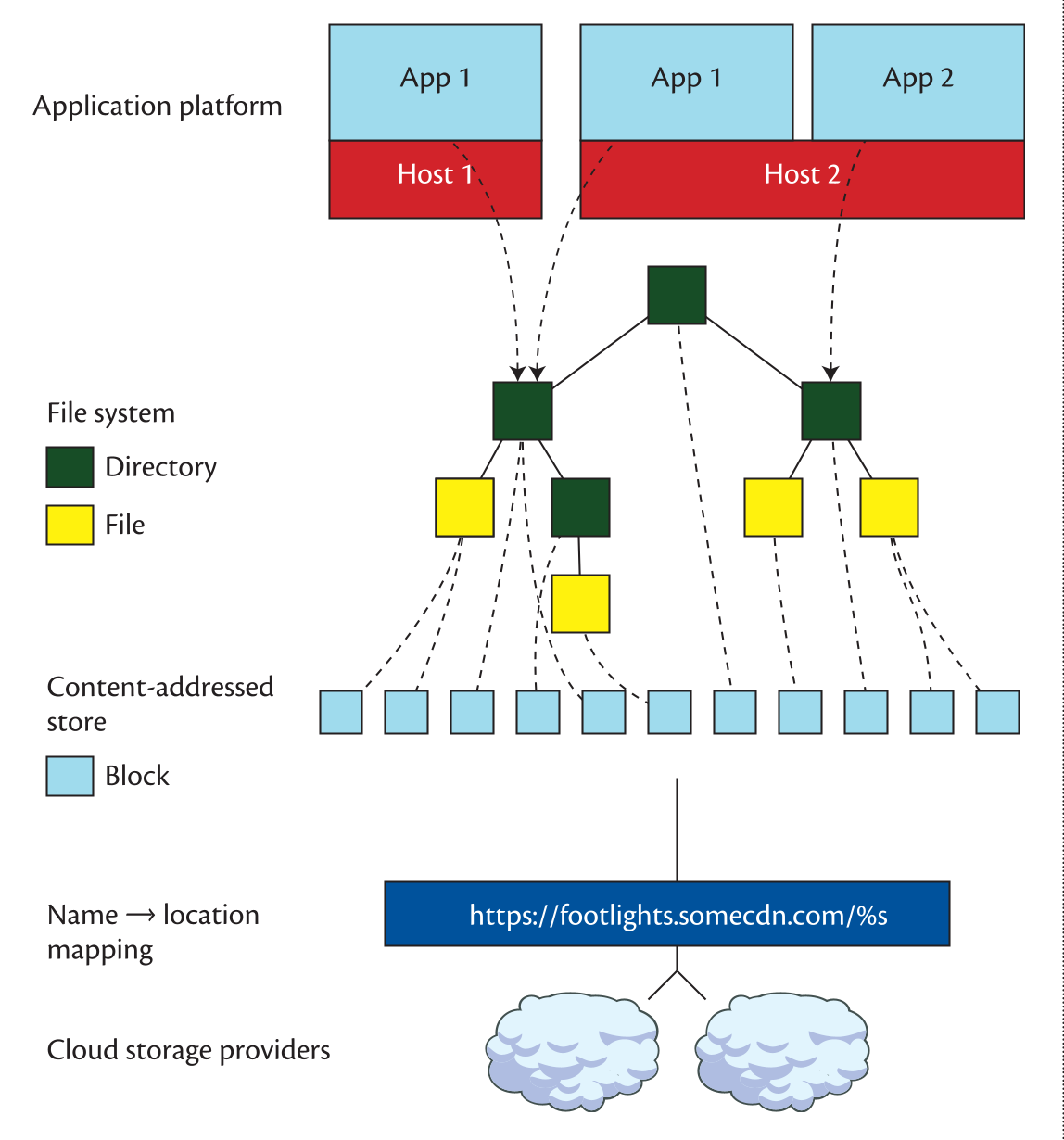 Figure 1: The Footlights file system stack. The storage provider at the bottom is blind to the relationships between the blocks it serves.
Economics: The $1 Privacy Tax
One of the most striking insights of the paper is the cost analysis. Based on Facebook’s own IPO data, the authors estimate that storing and transmitting the average user's media content (approx. 115 MiB) would cost less than $1 USD per user per year using commercial infrastructure.
The barrier to private OSNs isn't technical or even prohibitively expensive—it’s the Network Effect (Metcalfe’s Law). It's hard to convince users to pay $1 (or stay through a subscription) for a network where their friends haven't migrated yet.
Key Results & Comparative Advantage
The authors demonstrate that Footlights achieves:
- Performance: Near-instant resolution of content via URLs and JSON-over-HTTP.
- Availability: Cloud-level uptime, unlike P2P solutions.
- Security: Protection against "Instant Personalization" abuses and third-party data leaks (the "FarmVille" problem), as applications are technically restricted from exfiltrating data.
Critical Insight: The "New Friends" Doctrine
The authors address a common critique of decentralized systems: What if Bob, my friend, chooses to leak the photo I shared with him?
Their stance is refreshingly blunt: "If they do, you don’t need new technology; you need new friends." Technical systems can prevent providers from selling your data, but they cannot (and perhaps should not) solve the social problem of interpersonal trust.
Conclusion
Footlights proves that the "Social vs. Privacy" trade-off is a choice, not a technical necessity. While the "freemium" model has dominated the first era of the social web, the technical and economic feasibility of semicentralized, user-controlled networks is now proven. The future of OSNs may lie not in a single "walled garden," but in a landscape where we pay a pittance for infrastructure to ensure our digital lives remain our own.