
PrivateBox: Solving the Multi-User Privacy Conflict in Social Networks via Game Theory
Privacy policies for shared content in social network sites
The paper introduces PrivateBox, a collective privacy management framework for Social Network Sites (SNS) that addresses the problem of shared content ownership. It utilizes a Clarke-Tax mechanism from game theory to aggregate conflicting privacy preferences and proposes automated inference techniques to reduce user burden.
TL;DR
In the era of Web 2.0, sharing is collaborative, but privacy remains individualistic—a structural flaw that leaves many users exposed. This paper presents PrivateBox, a system that treats shared photos as "public goods" and uses the Clarke-Tax mechanism to let co-owners bid on privacy levels. It moves privacy from a "dictatorship of the uploader" to a fair, incentive-compatible collective decision.
Context & Positioning
Most Social Network Sites (SNS) like Facebook or MySpace operate on a "User-Centric" model: if you upload a photo, you own the rules. However, if Alice uploads a photo of Bob and Charlie, their privacy is at the mercy of Alice’s settings. This paper, published at the dawn of sophisticated SNS privacy research, identifies this as a Shared Content Ownership crisis and provides one of the first game-theoretic solutions to resolve it.
The Problem: The Tyranny of the Originator
Existing methods fail in three major ways:
- Selective Disclosure is Impractical: You can't "blur" a friend out of every photo without destroying the image's social value.
- The Least Common Denominator Problem: Simply choosing the strictest policy (e.g., "Only Owners") ignores the social benefit of sharing and can be overridden by a single uncooperative user.
- Privacy Paradox: Users claim to care about privacy but rarely spend the time to configure complex settings.
Methodology: Privacy as an Auction
The authors re-envision privacy settings (distances in the social graph) as items in an auction. To ensure users don’t just "lie" to get their way, they implement the Clarke-Tax, a variant of the Vickrey-Clarke-Groves (VCG) mechanism.
1. The Incentive System (Numeraire)
Users earn credits by:
- Uploading content.
- Granting co-ownership to others (incentivizing social trust).
- Participating in the network.
2. The Decision Logic
Each co-owner bids on a privacy preference (e.g., "Friends Only" vs. "Public"). The system calculates the Social Welfare Function: Essentially, the option with the highest collective "value" wins.
3. The Clarke-Tax (Preventing Manipulation)
If a user is "pivotal"—meaning their bid changed the outcome for the group—they are taxed an amount equal to the "harm" (lost utility) they caused the others. This makes truthfulness the dominant strategy; lying brings no benefit and potentially higher costs.
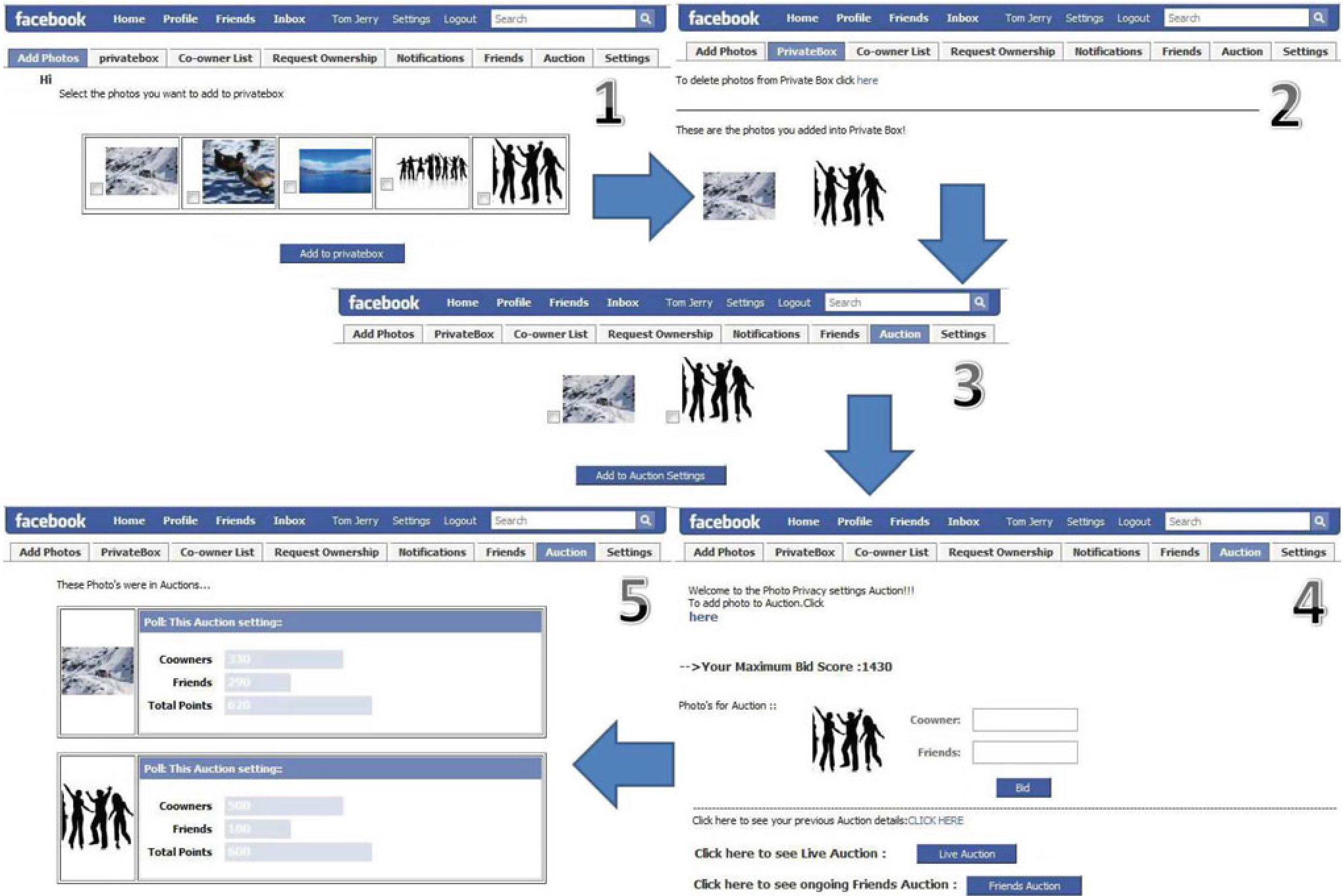 Figure 1: The PrivateBox interaction flow within the Facebook environment.
Automating the Burden: Folksonomies and Inference
Realizing that users won't bid on every single one of their 1,000 photos, the authors propose a Similarity Analysis. By looking at "tags" (folksonomies), the system can identify a "Champion Image"—a previously auctioned photo with similar tags and co-owners—and suggest its policy for the new content.
Experimental Validation
The authors built PrivateBox as a Facebook application and tested it for scalability and user perception.
- Performance: The time to compute the Clarke-Tax is negligible (~ms range), showing that game theory can be applied in real-time social interactions.
- The User Study: 122 participants found the system surprisingly "Fair" (3.76 Mean Score). Interestingly, the study found that understanding co-ownership was the single greatest predictor of whether a user would find the auction fair.
 Table 1: Descriptive statistics showing high user acceptance for fairness and usefulness.
Critical Analysis & Takeaways
Why it works: By attaching a "cost" (even if virtual) to privacy decisions, it forces users to weigh the importance of their social visibility against the rights of their friends. Limitations:
- The system assumes a "closed loop" where all co-owners are on the same platform (though the authors propose an OpenSocial cross-site fix).
- It relies on users having enough numeraire to remain "competitive."
Future Outlook: While this paper used id-tags, today’s AI could automate this entire process using facial recognition and automated policy negotiation, potentially removing the "bidding" step entirely while keeping the game-theoretic fairness.
Conclusion
Squicciarini et al. provided a landmark bridge between economic mechanism design and social media privacy. PrivateBox serves as a blueprint for any platform handling multi-stakeholder data, proving that when privacy is shared, the decision-making must be shared too.