
Checking In Without Being Followed: A New Frontier in LBSN Privacy
Towards privacy preservation for "check-in" services in location-based social networks R
Towards privacy preservation for "check-in" services in LBSNs proposes a k-anonymity framework using a dummy-location selection algorithm and a novel hash-table index to protect location privacy without a trusted third-party server. It achieves high uncertainty for adversaries while maintaining fast check-in and search capabilities.
TL;DR
Location-Based Social Networks (LBSNs) like Foursquare and Facebook Check-ins offer great convenience but at a high privacy cost. This paper introduces a robust framework that achieves k-anonymity without needing a trusted third party. By using a sophisticated Dummy-Location Selection protocol based on joint entropy and a high-performance Hash-Table Index, it ensures that neither the server nor curious observers can pinpoint a user's true location, all while keeping search speeds blazing fast.
The "Curious Server" Problem
Most existing privacy solutions fall into two traps. They either rely on a Trusted Third Party (TTP)—which is a massive target for hackers and a performance bottleneck—or they use simple "dummy" locations that are easily filtered out by looking at a user's historical movement patterns. If you always check into coffee shops, a dummy location in the middle of a lake is a dead giveaway.
The authors argue that privacy isn't just about hiding among people; it's about making the Joint Entropy of your movement so high that an adversary can't distinguish your real path from the fake ones.
Methodology: Entropy-Driven Anonymity
The core innovation is the Dummy-Location Selection (DLS) Protocol. Unlike random selection, it picks dummy candidates based on two strict criteria:
- Probability Synchronization: The conditional probability (the chance of going to venue given you were at ) for dummies must match the real location.
- Physical Feasibility: The distance between consecutive locations must be reachable within the time interval at a realistic maximum speed .
Architecture Overview
The system utilizes Delegatable Pseudorandom Functions (PRFs). When you check in, you generate a "trapdoor." Your friends can use a conversion key to search your check-ins, but the LBSN server only sees encrypted blobs and hashes.

The framework ensures that the LBSN server remains "faithful but curious," following the protocol without gaining insight into actual user coordinates.
Revolutionary Index Structure
Traditional encrypted search methods often use AVL trees, which require traversal. This paper proposes an Improved Hash Table Index.
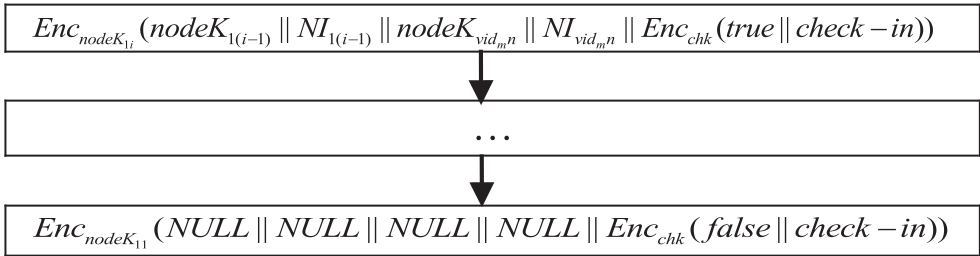
- Check-in List: Each user ID is hashed into an index. The records are linked in a chain, hidden behind symmetric encryption keys.
- Performance Leap: By removing the need to traverse entire tree structures, the system achieves near-constant search time.
Experimental Battleground
The researchers compared their approach against established baselines like DLS and DGD using a Levy Walk model to simulate human mobility patterns.
1. Privacy Strength (Entropy)
As (the anonymity degree) increases, the joint entropy of the proposed method stays consistently higher than its counterparts. This confirms that the dummies generated are "higher quality" and more confusing to attackers.
2. Efficiency (Search Time)
In a head-to-head comparison, the search response time for the proposed Protocol-3 remained flat at ~1ms, while the competition's response time climbed steeply as the number of nodes in the social network grew.
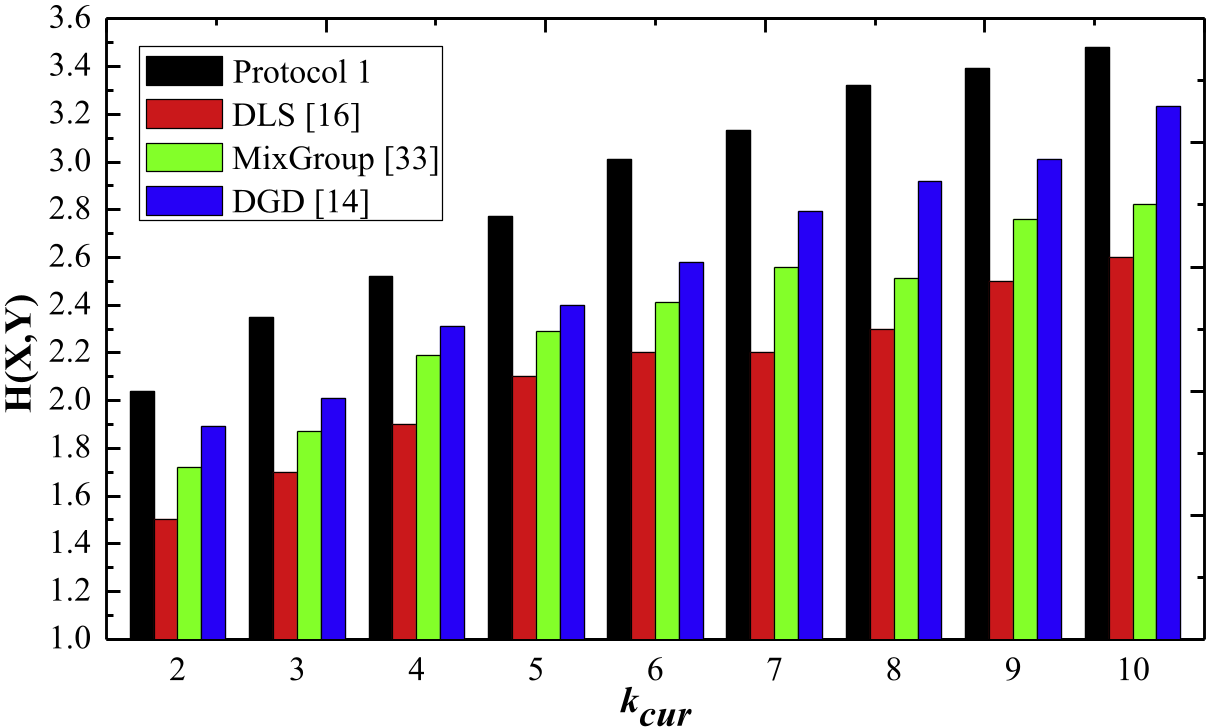 Figure: The proposed protocol (Protocol-1) achieves significantly higher Joint Entropy than existing SOTA methods as and increase.
Critical Insight & Future Outlook
The beauty of this work lies in its Inductive Bias toward real-world movement. By acknowledging that human mobility is not independent (we follow paths), the authors closed a major loophole in LBSN privacy.
Limitations: The primary cost of this security is increased traffic overhead. Sending locations instead of one naturally consumes more bandwidth and power on mobile devices.
Future Direction: The next step is optimizing the Trade-off between Privacy and Overhead. Can we achieve the same entropy with fewer, smarter dummies? Integrating this with 5G/6G edge computing could further reduce latency, making "invisible check-ins" the standard for the next generation of social apps.
Takeaway
This paper serves as a blueprint for decentralized privacy. By moving the "anonymizer" from a central server to the user's own device and using information theory to validate dummies, we can finally enjoy social services without an digital shadow following our every move.