
Decentralizing Privacy: The Architectural Battle for the Future of Social Networks
Privacy Preservation in Decentralized Online Social Networks
This survey examines the landscape of Decentralized Online Social Networks (DOSNs), categorizing them into server federations (e.g., Diaspora) and Peer-to-Peer (P2P) systems (e.g., Safebook, LifeSocial). It evaluates their efficacy in privacy preservation through end-to-end encryption, metadata obfuscation, and social graph hiding, while considering mobile device constraints.
TL;DR
The monopoly of centralized social giants poses a massive privacy risk. This technical survey explores the shift toward Decentralized Online Social Networks (DOSNs). It pits Server Federations against P2P Architectures, concluding that while P2P offers theoretical "serverless" security, Federated models currently win on mobile efficiency and practical usability.
The Core Conflict: Integration vs. Autonomy
Modern social networks are built on a paradox: we want seamless, global connectivity, but we need private, local data control. Centralized providers (FaceBook, etc.) solve the "How" via data aggregation, which unfortunately enables mass surveillance and metadata harvesting.
The technical challenge is that in a decentralized world, simple tasks like "finding a friend" or "signing into a group" become complex cryptographic and routing problems.
Methodology: Two Paths to Decentralization
The paper categorizes the ecosystem into two primary architectural paradigms:
1. Server Federations (The Pragmatic Approach)
Systems like Diaspora and OneSocialWeb use a network of independent servers (pods).
- Mechanism: Users choose a trusted provider or host their own.
- Encryption: While early federations relied on server-side access control, newer iterations like Persona and SoNet introduce end-to-end encryption.
- Insight: This model retains the "always-on" availability of traditional servers while limiting the blast radius of a data breach.
2. Peer-to-Peer (P2P) Systems (The Radical Approach)
Systems like LifeSocial, PeerSoN, and Safebook eliminate dedicated servers entirely.
- Mechanism: They utilize Distributed Hash Tables (DHTs) to store and route data across user devices.
- The Matryoshka Principle: Safebook uses concentric circles of trusted friends to route messages, effectively masking the IP addresses and identities of the core users.
 Figure 1: Comparison between Federated and P2P structures.
The "Invisible" Threat: Metadata and Social Graphs
The paper makes a critical distinction: End-to-end encryption is not enough. Even if a server cannot read your messages, it can see:
- Who you talk to (The Social Graph).
- When you are active (Online Status).
- The size of your data (Object analysis).
Systems like Vegas try to solve this by creating unique aliases for every single friendship, but this leads to a "multicast explosion"—sending one status update to 100 friends requires 100 separate encrypted operations, which can take several seconds on a mobile device.
Experimental Performance Evaluation
The authors highlight a stark reality in performance:
- DHT Latency: In DHT-based systems, fetching a newsfeed can take up to 10 seconds because data is scattered across random peers globally.
- Mobile Viability: Symmetric encryption is fast, but complex schemes like Identity-Based Broadcast Encryption (IBBE) or Attribute-Based Encryption (ABE)—essential for decentralized group management—are often too heavy for 2014-era mobile CPUs.
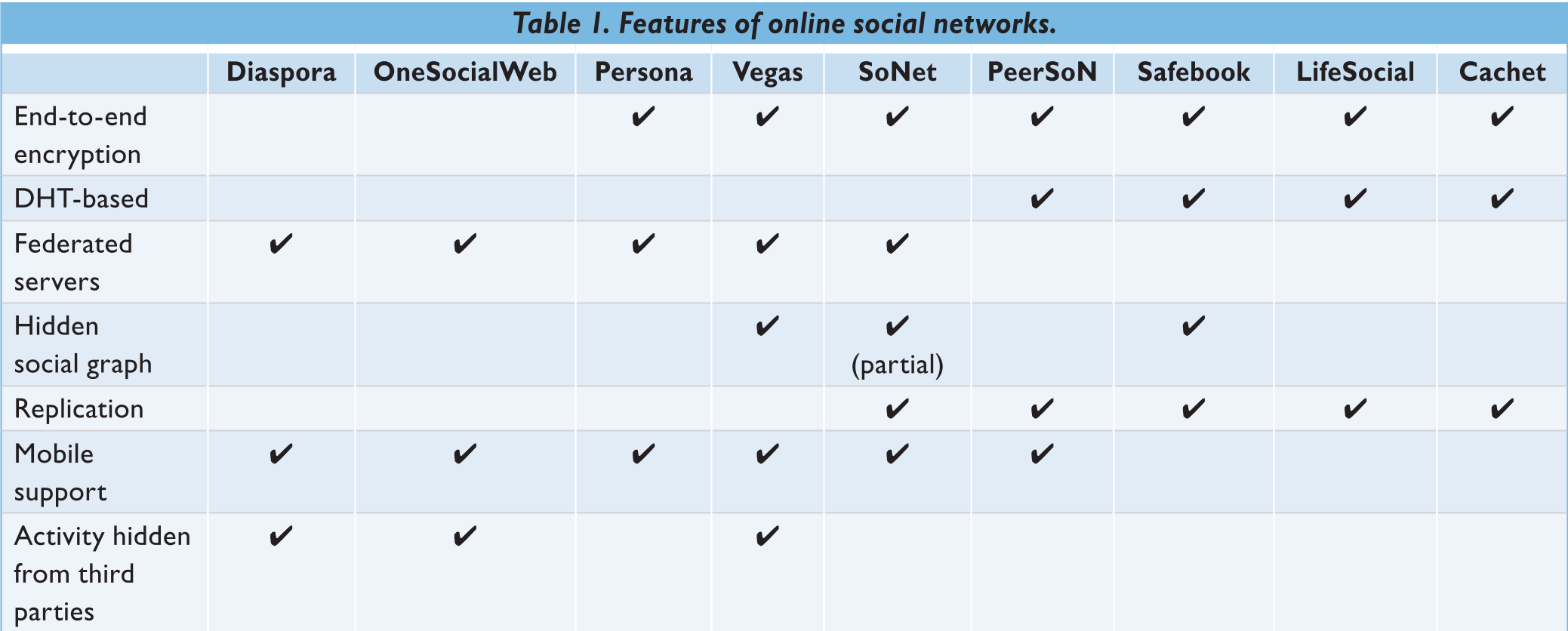 Table 1: Feature comparison showing the trade-offs between encryption, social graph hiding, and mobile support.
Critical Insight & Conclusion
The fundamental takeaway is that Decentralization is a spectrum.
- Federated Systems are the current frontrunners because they align with mobile usage patterns (asynchronous availability).
- P2P Systems offer superior "censorship resistance" but struggle with the high churn of mobile nodes and energy consumption.
Future Outlook: The next generation of DOSNs must bridge this gap. We need more efficient "Social Graph Obfuscation" that doesn't rely on linear cryptographic overhead. Until then, federated servers with client-side encryption remain the most viable path to reclaiming our digital privacy.