
SHIM: Leveraging Structural Holes to Maximize Influence in Large-Scale Social Networks
SPECIAL SECTION ON PRIVACY PRESERVATION FOR LARGE-SCALE USER DATA IN SOCIAL NETWORKS
This paper introduces SHIM (Structural-Hole-based Influence Maximization), a novel algorithm that integrates structural hole theory with the Independent Cascading (IC) model to identify influential seed nodes in large-scale social networks. By leveraging the Fiedler vector from spectral graph theory, the method identifies "bridge" nodes that control information flow between communities, achieving superior influence spread compared to traditional greedy methods.
Executive Summary
TL;DR: The paper "A New Structure-Hole-Based Algorithm For Influence Maximization" introduces SHIM, an algorithm that shifts the focus from "how many neighbors a node has" to "where the node sits in the network architecture." By identifying Structural Hole Spanners—nodes that act as essential bridges between isolated communities—the researchers developed a method that is both faster and more effective at spreading information than traditional greedy algorithms.
Positioning: This work is a strategic refinement of the classic Influence Maximization (IM) problem, moving away from pure Monte Carlo heuristics toward a topology-aware selection strategy rooted in sociological theory.
Problem & Motivation: The "Bridge" Oversight
Current SOTA methods for Influence Maximization often treat networks as homogeneous blobs, focusing on local propagation probabilities. However, real-world social networks are composed of distinct clusters.
- The Gap: Most algorithms overlook the Structural Hole—the gap between two social groups.
- The Insight: A person bridging two large departments in a company has more "social leverage" than someone with many friends all within the same small circle. These "spanners" prevent information from being "locked" within a single community.
Methodology: Spectral Theory Meets Social Influence
The core of the SHIM algorithm is a two-step process designed to shrink the search space and prioritize high-value targets.
1. Quantifying the "Hole" (SHVC Algorithm)
To find these bridges, the authors turn to Spectral Graph Theory. They construct a Laplacian Matrix () and calculate its second smallest eigenvalue's eigenvector, known as the Fiedler Vector.
- Nodes with specific values in this vector are mathematically proven to be positions of structural weakness (bridges) if removed.
- This allows the algorithm to filter out thousands of irrelevant nodes before the heavy computation begins.
2. The Structure-Based Greedy (SG) Selection
The algorithm then calculates a combined score for each candidate node:
- : The structural hole value (bridge importance).
- : The marginal influence gain (propagation power).
- : A tuneable parameter that balances structural position vs. raw reach.
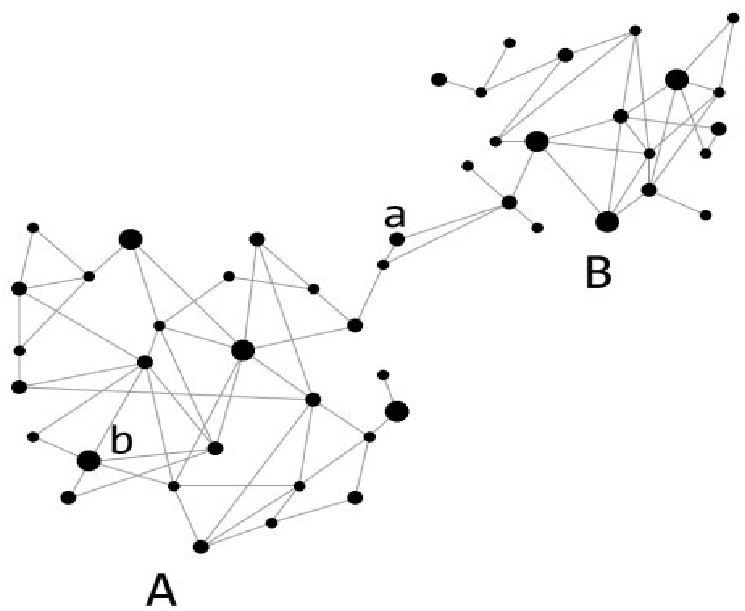 Figure 1: Node 'a' acting as a structural hole spanner between two distinct groups A and B.
Experiments & Results
The authors tested SHIM against industry-standard baselines (CELF, NewGreedy, etc.) using Twitter and RayLeague datasets.
Key Findings:
- Superior Reach: SHIM consistently influenced a larger percentage of the network than traditional greedy methods because its seeds were strategically placed to "jump" across communities.
- Efficiency: By pruning the candidate set using structural hole values, the algorithm avoids the computational "death loop" of simulating every possible node in the network.
- The Alpha Sweet Spot: The research found that a balanced weight () yielded the widest influence spread, confirming that neither topology nor individual influence alone is sufficient.
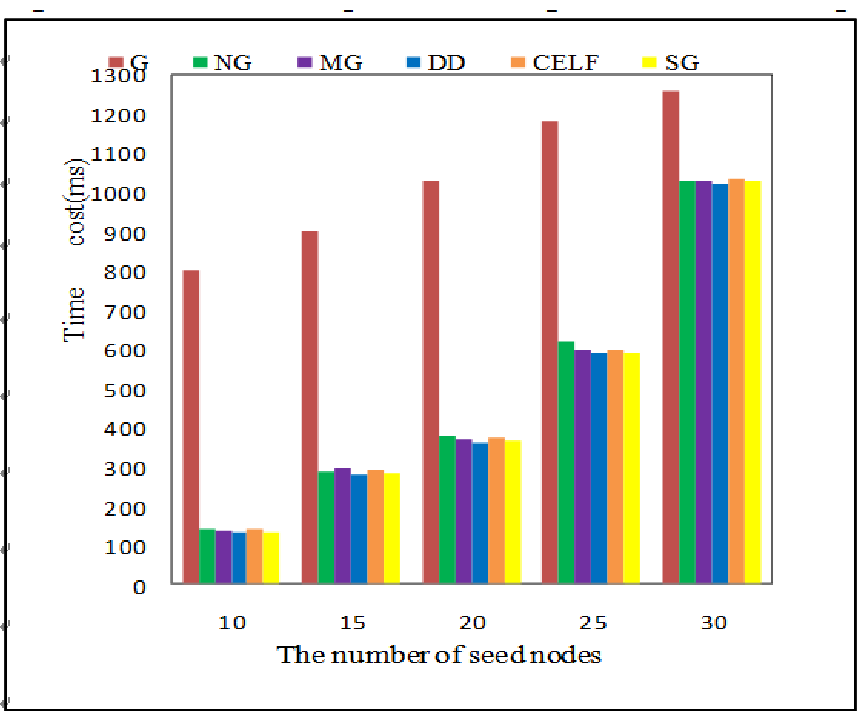 Figure 2: Influence range comparison between SHIM and baseline algorithms.
Critical Analysis & Conclusion
Takeaway
SHIM proves that topology is density. By mathematically identifying "weak ties" that serve as "strong bridges," the algorithm maximizes the efficiency of limited seed budgets.
Limitations & Future Work
While SHIM is highly effective, its reliance on the Laplacian Matrix calculation ( in the worst case) still poses challenges for "ultra-massive" graphs (billions of nodes). The authors suggest that moving toward dynamic programming or parallel processing in dynamic networks will be the next frontier. Furthermore, incorporating privacy protection into the selection process—ensuring that spanners do not become single points of data leakage—remains an open research direction.