
Defending Against the Fingerprint of Friendship: Understanding Attribute Couplet Attacks
SPECIAL SECTION ON PRIVACY PRESERVATION FOR LARGE-SCALE USER DATA IN SOCIAL NETWORKS
This paper identifies a novel privacy threat called the "Attribute Couplet Attack" and proposes "k-couplet anonymity" to safeguard social network datasets. By utilizing a pair of connected users' attributes, adversaries can deanonymize identities even in sanitized graphs; the authors introduce heuristic algorithms (AG, ACA, and AMAG) to achieve protective anonymity while maintaining data utility.
TL;DR
In the era of big data, simply removing names from a social network dataset is no longer enough. This paper introduces the Attribute Couplet Attack, a method where an attacker uses the known attributes of two friends (e.g., a "Doctor" connected to a "Teacher") to find them in an anonymous graph. To fight this, the authors develop k-couplet anonymity and a suite of algorithms to blur these relationship fingerprints without destroying the data's research value.
Background: The Hidden Map in Social Data
When social media companies release datasets for research, they typically use "Anonymization" by stripping names and IDs. However, the graph structure—the web of who knows whom—remains. Background knowledge transforms this web into a map. Most prior research focused on Neighborhood Attacks (who are your neighbors?) or Structural Attacks (what does your local graph look like?). This paper identifies a more subtle leak: the Attribute Couplet.
The Problem: The Unique "Couplet" Fingerprint
Imagine a network where everyone’s name is removed, but their profession remains. If an attacker knows that "Mary" (a Teacher) is friends with "Bob" (a Doctor), they only need to look for a "Teacher-Doctor" edge in the graph. If that pair is unique, Mary and Bob are exposed.
Standard k-anonymity ensures a node looks like others. But it doesn't account for the edges. A node might look common, but its connection to a specific type of friend might be unique.
Methodology: Achieving k-Couplet Anonymity
The authors propose a two-stage defense strategy to ensure that for every attribute couplet, there are at least identical pairs in the network.
1. Attribute Generalization (AG)
Instead of deleting info, the AG algorithm "zooms out." Using a Generalization Tree (GTree), a "Dentist" becomes a "Doctor," and an "Undergraduate" becomes a "Student." The goal is to cluster nodes such that their attributes become less specific, making it harder to find unique pairs.
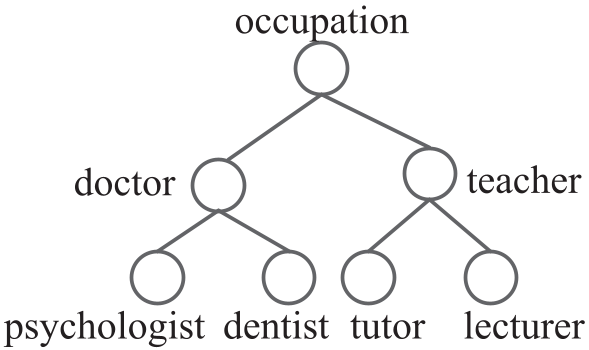 Figure: The GTree allows for controlled information loss, balancing privacy with specificity.
2. Attribute Cluster Anonymization (ACA)
Once attributes are generalized, the graph structure itself must be modified. If a "Teacher-Doctor" pair still appears fewer than times, the ACA algorithm makes a choice based on Edit Distance:
- Add Edges: Connect other Teachers to other Doctors to reach the threshold.
- Delete Edges: Remove the unique connection entirely if it's too rare.
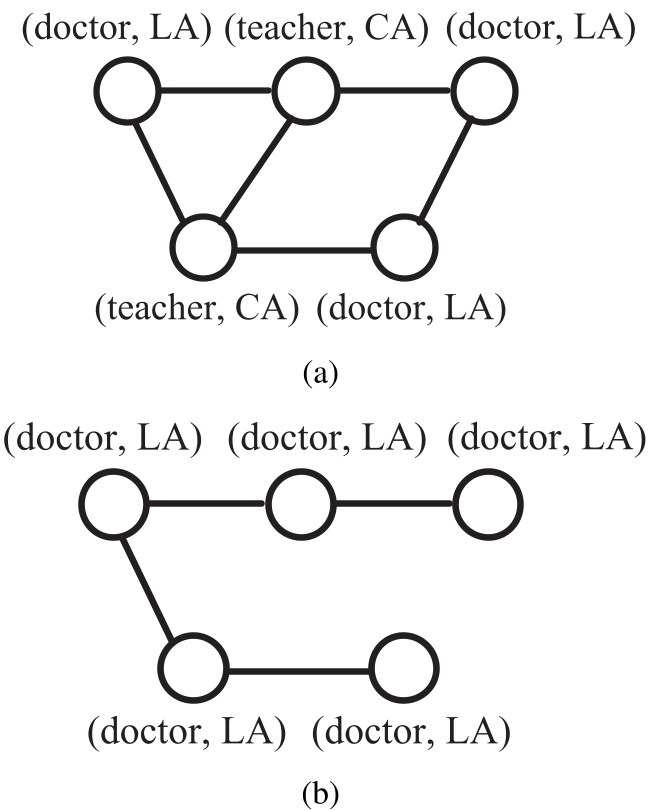 Figure: Redesigning the network to ensure no pair is a "loner."
Experimental Results: Privacy Without the Cost
The researchers tested their approach on real-world datasets: a Coauthor Network and a Citation Network.
1. Structural Integrity
A major worry with data anonymization is that the data becomes "garbage" for researchers. The study shows that Degree Distribution—the statistical heart of a network—was preserved almost perfectly after the anonymization process.
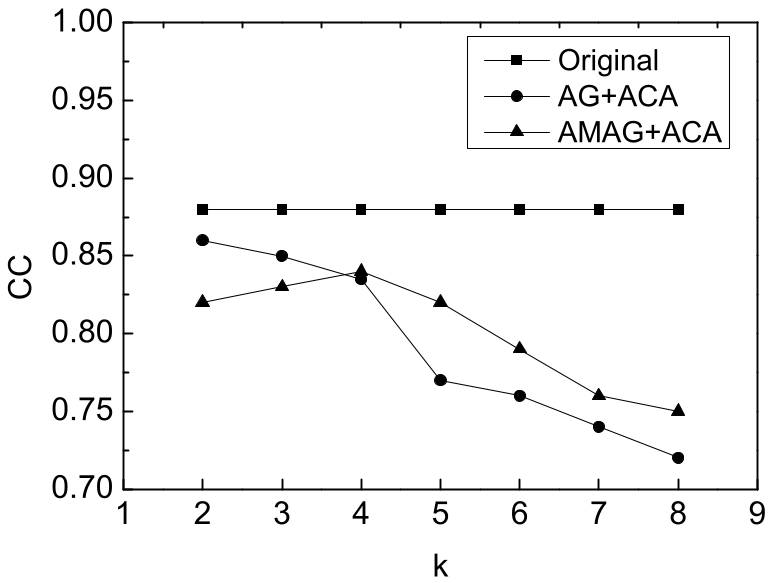 Figure: The original vs. anonymized degree distributions show high similarity.
2. Efficiency
The algorithm scales effectively. While Multiple-Attribute Generalization (AMAG) is more computationally expensive than single-attribute handling, it remains practical for large-scale social graphs.
Deep Insight & Conclusion
This paper serves as a wake-up call for data privacy officers. It proves that privacy is not just about the individual, but about the relationship.
Key Takeaways:
- Relationships are Metadata: Friendly connections act as high-dimensional identifiers.
- The Power of Generalization: Hierarchical trees are a powerful tool for maintaining "semantic consistency" while hiding identities.
- Limitations: The method relies on the "Edit Distance" of the graph. If is set too high, the "social" aspect of the network (who is actually friends with whom) might be distorted too much for certain types of sociological research.
In the future, we can expect these "couplet" concepts to merge with Differential Privacy, providing even stronger mathematical guarantees for social data sharing.