
Beyond Node Anonymity: Defeating Attribute Couplet Attacks in Social Networks
SPECIAL SECTION ON PRIVACY PRESERVATION FOR LARGE-SCALE USER DATA IN SOCIAL NETWORKS
The paper introduces the "Attribute Couplet Attack," a novel re-identification risk in social networks that exploits the relationship and attribute pairings between two connected users. To counter this, the authors propose "k-couplet anonymity" and a suite of heuristic algorithms (AG, ACA, and AMAG) that generalize attributes and modify network topology to ensure privacy while maintaining data utility.
TL;DR
Existing social network anonymization often fails because it ignores the unique "fingerprint" created by the attributes of two connected friends. This paper identifies the Attribute Couplet Attack and introduces k-couplet anonymity, a defense mechanism that ensures no pair of connected users has a unique attribute profile. By combining attribute generalization with minimal graph structure modifications, the researchers provide a way to publish social data that is both private and research-ready.
The Hidden Vulnerability: Why Individual Anonymity Isn't Enough
Imagine a social network dataset where names are removed. You might think Mary is safe because there are 100 "Teachers" in the data. However, if an adversary knows Mary is friends with Bob (a "Doctor"), and there is only one Teacher-Doctor edge in the entire graph, Mary’s identity is instantly compromised.
This is the core of the Attribute Couplet Attack. Most prior work (like k-anonymity or k-automorphism) focuses on making nodes look like others or making the graph structure symmetric. They overlook the joint probability of attributes across an edge.
Methodology: The k-Couplet Framework
The authors propose a robust defense strategy centered around two main phases.
1. Attribute Generalization (AG & AMAG)
To reduce the uniqueness of attributes, the authors use a Generalization Tree (GTree). Instead of being a "Neurosurgeon," a node might be generalized to "Doctor."
- Heuristic Ranking: Nodes are ranked so that those with similar attributes are grouped.
- Cost Optimization: The algorithm selects generalized values that minimize the "distance" moved up the tree, preserving as much specific information as possible.
- Multiple Attributes: For complex datasets, the AMAG algorithm handles multiple GTrees simultaneously, finding an approximate balance across different dimensions (e.g., Profession + Location).
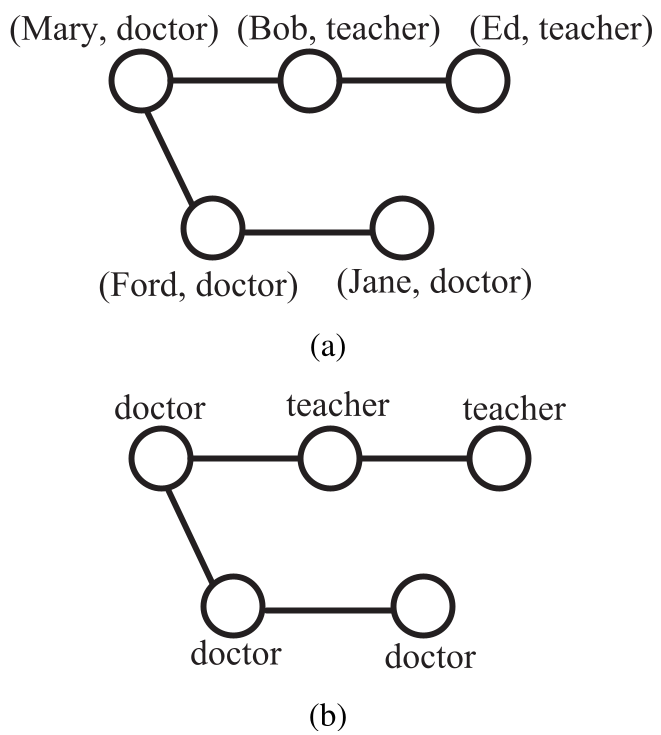 Figure 1: Comparison between (a) an original network and (b) an anonymized version where identities are obscured but relational patterns persist.
2. Attribute Cluster Anonymization (ACA)
Once attributes are generalized, the graph structure must be "fixed" to ensure every attribute pairing appears at least times.
- Edge Modification Strategy: If a (Teacher, Doctor) couplet appears only twice in a 5-couplet requirement, the ACA algorithm chooses the path of least resistance: either add 3 new edges between other Teachers and Doctors or delete the existing 2 edges.
- Utility Preservation: When adding edges, the algorithm prioritizes nodes that are already close in the original graph to minimize changes to the "Average Path Length."
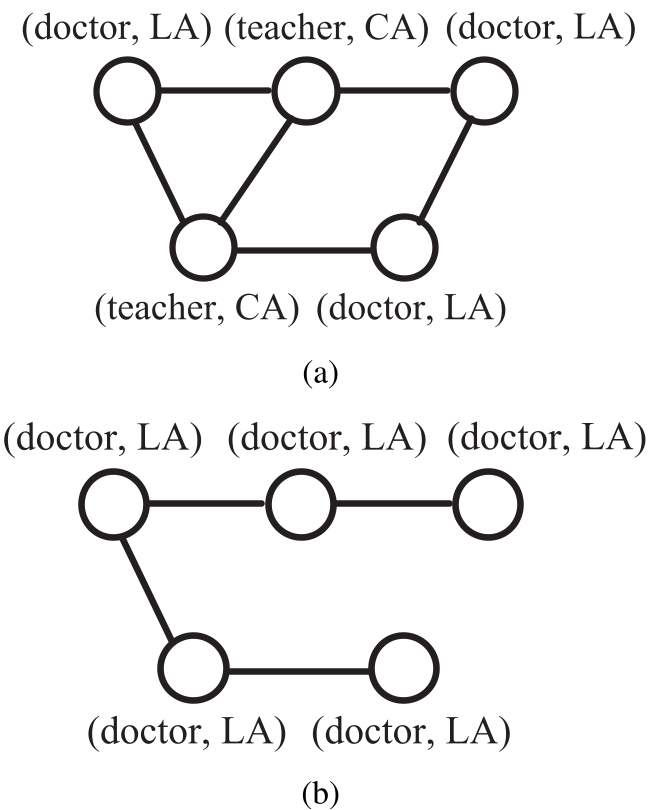 Figure 2: Examples of achieving k=2 and k=5 anonymity through structural tuning.
Experimental Insights
The researchers tested their approach on real-world Coauthor and Citation networks. The results were telling:
- Structural Integrity: Even at higher levels of , the Degree Distribution remained remarkably similar to the original data. This means researchers can still perform meaningful network analysis on the anonymized data.
- Efficiency: The algorithms proved scalable. While multiple-attribute generalization (AMAG) is more computationally intensive, it remains viable for large-scale datasets.
- Comparison: The paper notes that in dense networks (like the Citation network), adding edges is often "cheaper" than deleting them to maintain utility, whereas the opposite is true for sparse networks.
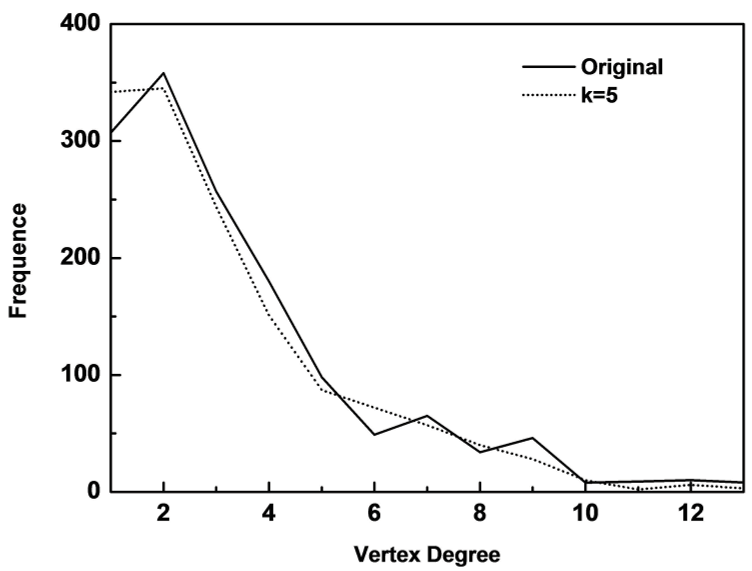 Figure 3: Impact of k-anonymity on Degree Distribution—the overlap shows high utility retention.
Critical Analysis & Conclusion
The Attribute Couplet Attack is a significant contribution to the field of privacy-preserving data publishing (PPDP). By recognizing that relationships are just as identifying as node attributes, this work closes a dangerous loophole.
Takeaway: Effective privacy isn't about hiding the person; it's about hiding the uniqueness of their connections.
Limitations:
- The reliance on a predefined Generalization Tree assumes that the data curator has a deep hierarchical understanding of the attributes.
- The current model considers undirected graphs; extending this to directed graphs (where "Friend" vs "Follower" creates asymmetry) would be a complex but necessary next step.
For data scientists and social media platforms, this research provides a practical roadmap for sharing data with the research community without betting the farm on user privacy.