
Physical Layer Security in 5G Social Networks: Beyond Traditional Cryptography
SPECIAL SECTION ON PRIVACY PRESERVATION FOR LARGE-SCALE USER DATA IN SOCIAL NETWORKS
This paper explores Physical Layer Security (PLS) in the context of 5G-based large-scale social networks. It proposes a cross-layer optimization framework encompassing physical, link, and application layers to enhance secrecy rates beyond traditional encryption.
TL;DR
As 5G networks evolve into ultra-dense social ecosystems, traditional application-layer encryption is no longer sufficient. This paper shifts the focus to Physical Layer Security (PLS), leveraging the inherent randomness of wireless channels and social logical links. By integrating beamforming, power control, and cross-layer design, the authors propose a robust framework to secure communications against sophisticated eavesdroppers in large-scale environments.
Background: The Vulnerability of Wireless Signals
In the era of 5G, social networks are defined not just by physical proximity, but by logical connections (e.g., family, colleagues). Traditional security relies on the computational complexity of encryption algorithms like AES. However, because wireless signals propagate in free space, unauthorized users (Eve) can harvest signal power and potentially decode "secured" information if enough cipher text is intercepted.
The authors argue that PLS provides a fundamental solution by ensuring the Secrecy Rate—the difference between the legitimate channel capacity (Alice-Bob) and the wire-tap channel capacity (Alice-Eve)—remains positive.
The Core Challenge: Large-Scale Social Complexity
Moving from a simple Alice-Bob-Eve model to a large-scale social network introduces two major hurdles:
- Logical vs. Physical Mapping: Friends may be physically distant but logically close, or strangers may be physically adjacent, increasing the risk of "proximal eavesdropping."
- User Density: In ultra-dense networks (UDN), the sheer number of potential wire-tap users makes traditional individual modeling impossible.
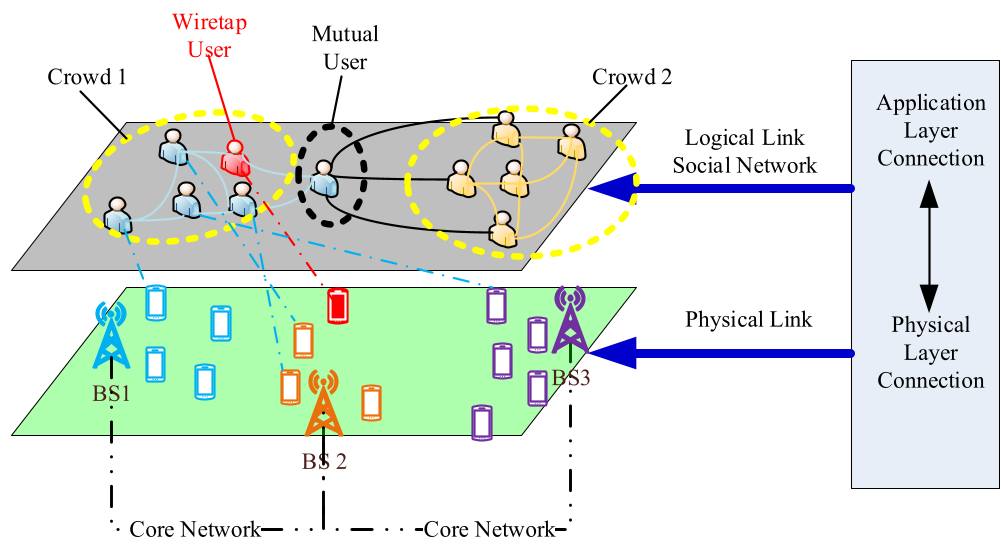
Methodology: A Multi-Layer Defense Strategy
The paper breaks down the opportunities for securing 5G networks into three distinct layers:
1. Physical Layer Optimization
- Dynamic Power Control: Adjusting transmission power based on the detected position of illegal listeners.
- Beamforming: Using directional signal transmission to "steer" data away from wire-tap zones.
- Joint Clustering: Grouping legitimate social users together and excluding identified threats from the cluster.
2. Link Layer: Adaptive Modulation and Coding (AMC)
The researchers highlight that while Gaussian signals are used in theory, real systems use discrete constellations like QPSK and 16QAM. By adapting modulation specifically to frustrate Eve’s Bit Error Rate (BER), the system can maintain high throughput for Bob while rendering the signal unreadable for Eve.
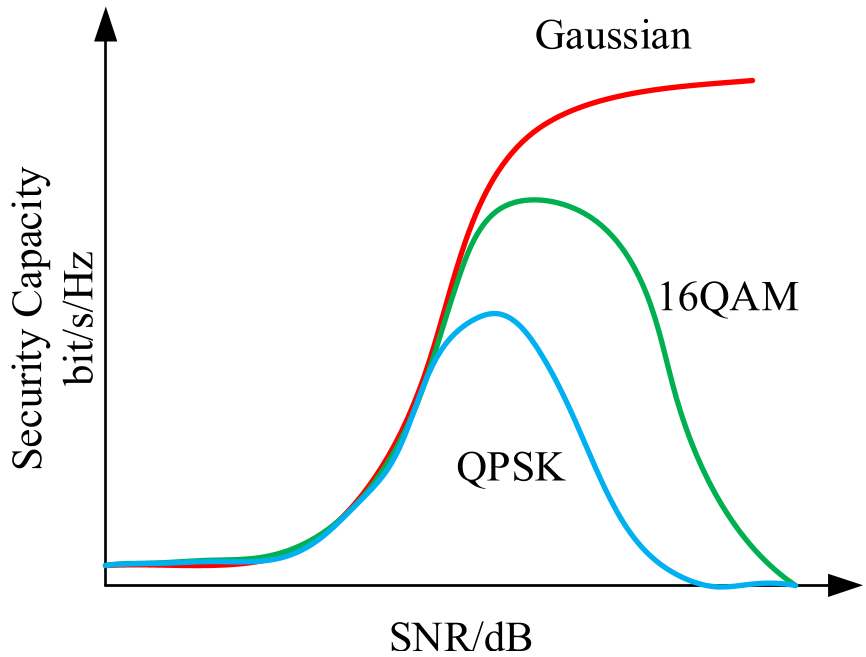
3. Cross-Layer Design
The most potent strategy is the joint optimization of parameters across the stack. The paper proposes a non-convex optimization problem that accounts for traffic models, artificial noise, and connection graphs.
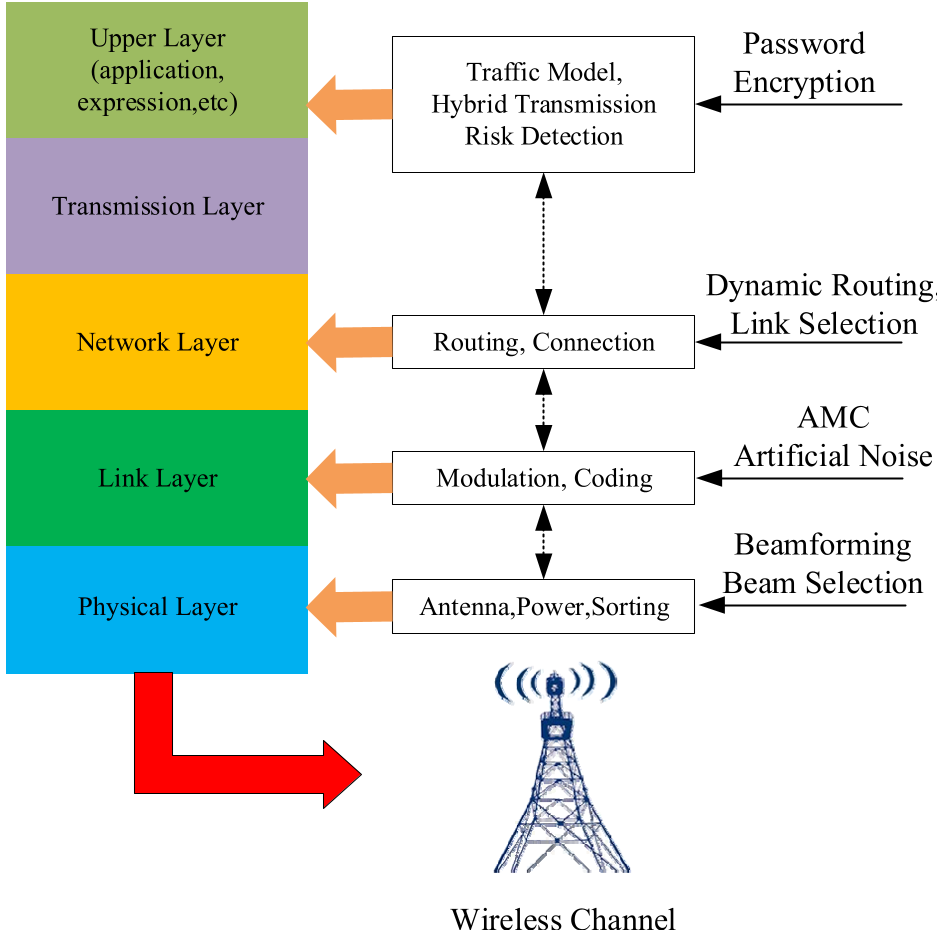
Critical Insight: The "Hidden" Eavesdropper
A major challenge identified is the Passive Wire-tap User. If an eavesdropper does not transmit or attack the network, they remain invisible. The authors suggest that in such cases, the transmitter must inject Artificial Noise into all "orthogonal spaces" not occupied by target users—essentially "poisoning" the channel for anyone but the intended recipient.
Conclusion and Future Outlook
This work serves as a vital roadmap for 5G security. The takeaway is clear: security must be an end-to-end, cross-layer endeavor. While traditional encryption protects the content, Physical Layer Security protects the medium.
Limitations: The current framework assumes some level of global information for optimization, which is difficult to achieve in highly dynamic social environments. Future research must focus on heuristic algorithms that can handle the non-convex nature of these security problems in real-time.