
Physical Layer Security: Reinforcing the 5G Social Backbone
SPECIAL SECTION ON PRIVACY PRESERVATION FOR LARGE-SCALE USER DATA IN SOCIAL NETWORKS
This paper explores Physical Layer Security (PLS) within the context of 5G-based Large Scale Social Networks (LSSNs). It proposes a cross-layer optimization framework—integrating physical, link, and application layers—to enhance security rates through techniques like beamforming, power control, and Adaptive Modulation and Coding (AMC).
TL;DR
As 5G scales into massive social networks, traditional encryption isn't enough to stop sophisticated eavesdropping. This paper shifts the focus from "math-heavy" application encryption to Physical Layer Security (PLS). By treating the random nature of wireless channels as a natural encryption key, the authors propose a cross-layer framework that optimizes beamforming and power control to protect data at the source.
The Core Motivation: Why Crypto Isn't Enough
In the current 5G landscape, we rely on AES-256 or TLS at the upper layers. However, the physical reality is that wireless signals leak. An illegal user (Eve) within the signal's range can capture the power and eventually brute-force or intercept metadata.
In Large Scale Social Networks (LSSNs), the problem is twofold:
- Physical Link: The dense deployment of base stations and users.
- Logical Link: Friends or family connected logically who may be physically distant, creating a complex graph of potential leakage points.
The author’s insight is that PLS can act as a "first line of defense," ensuring that even if Eve receives the signal, the Secrecy Rate (the difference between Bob's and Eve's channel capacity) remains optimized so Eve cannot decode anything.
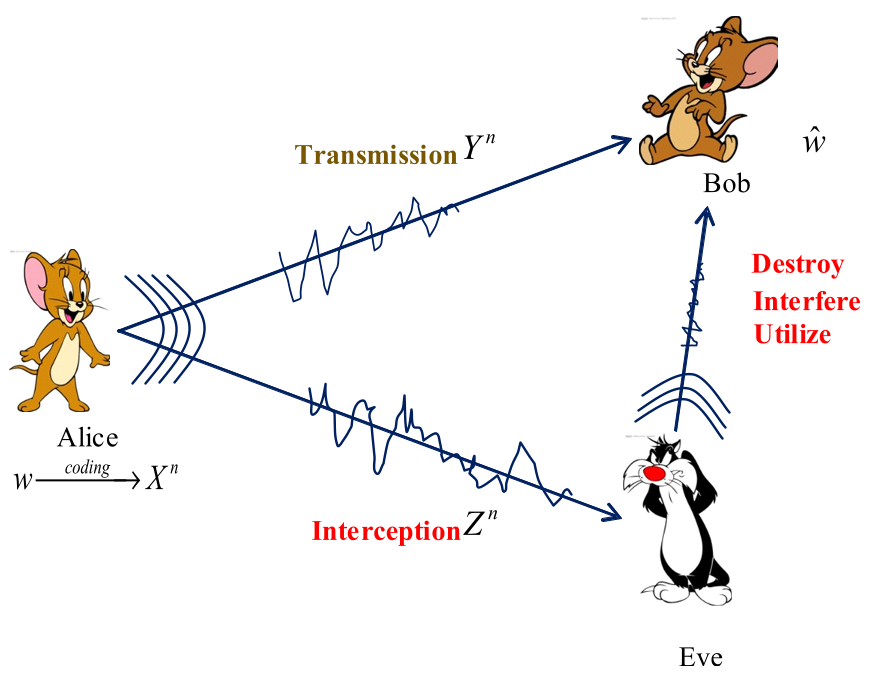
Methodology: The Alice-Bob-Eve Model at Scale
The paper utilizes the classic Alice-Bob-Eve model but expands it to multi-antenna (MIMO) and multi-carrier (OFDM) scenarios.
1. Architectural Logic
The core mechanism is to ensure that the channel gain of the "Main Channel" (Alice to Bob) is significantly higher than that of the "Wiretap Channel" (Alice to Eve).
2. Cross-Layer Opportunities
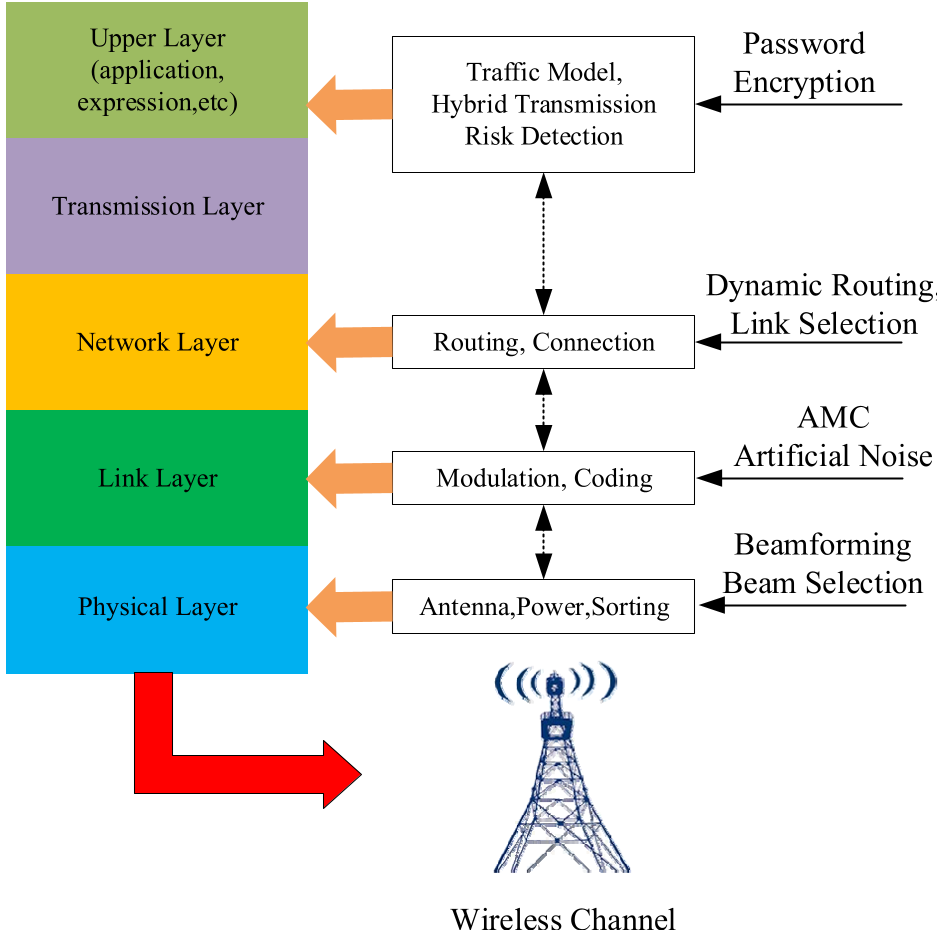
The authors break down the optimization into three levels:
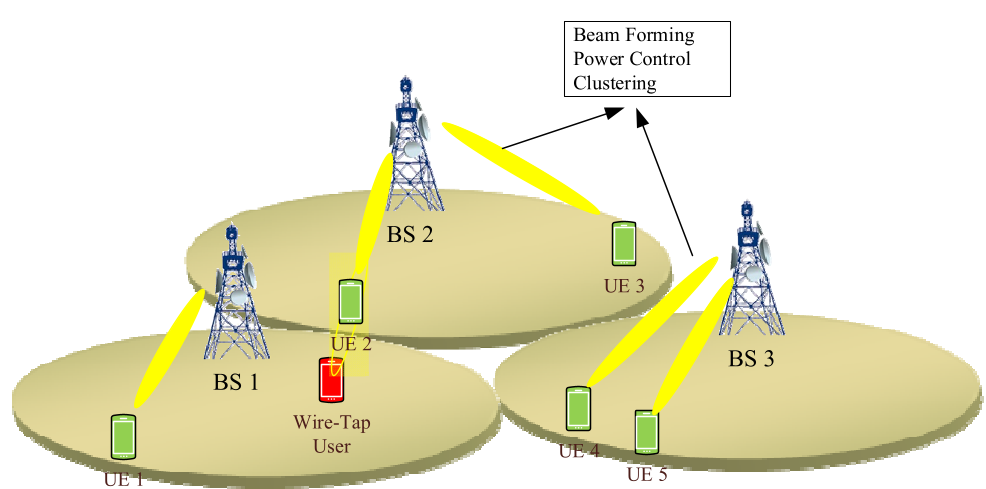
- Physical Layer: Using high-precision beamforming and power control to "starve" the wire-tap user of signal power.
- Link Layer: Adaptive Modulation and Coding (AMC). By using higher-order modulation (like 16QAM) when Eve's channel is weak, the system creates a high Bit Error Rate (BER) for the attacker.
- Application/Cross Layer: Integrating traffic models (like video streaming vs. web browsing) with physical resource allocation.
Breakthroughs and Challenges
Quantifying Security
The secrecy rate for a MIMO system is defined by the difference in mutual information. The paper highlights that in 5G, we must move away from the assumption of Gaussian noise and focus on discrete constellation inputs (PSK/QAM) which reflect real-world hardware.
The "Passive Eve" Problem
One of the biggest hurdles identified is the Detection of passive wiretap users. If Eve is only listening and not transmitting, the Base Station cannot always know she is there. The paper suggests using Artificial Noise (AN)—injecting "garbage" signals into the null space of Bob’s channel to specifically jam potential eavesdroppers without affecting the legitimate user.
Critical Analysis & Conclusion
Takeaway: This paper successfully argues that PLS is not a replacement but a necessary complement to modern cryptography. In an era of Ultra-Dense Networks (UDN), the physical signal itself must be secured.
Limitations: The framework still relies on some "ideal information" assumptions (knowing Eve’s channel state in some cases). Furthermore, the cross-layer exchange of information between the application and physical layers lacks a standardized protocol, which could introduce latency.
Future Outlook: The next step in this field is likely the integration of Game Theory (Alice vs. Eve) and Active Risk Detection via AI to identify passive listeners in the high-dynamic environment of 6G social networks.