
Enhanced IM Security: Balancing Robust Protection and Mobile Efficiency
SPECIAL SECTION ON PRIVACY PRESERVATION FOR LARGE-SCALE USER DATA IN SOCIAL NETWORKS
The paper introduces a comprehensive secure Instant Messaging (IM) scheme for mobile social networks, combining the Elliptic Curve Cryptosystem (ECC) and Advanced Encryption Standard (AES). It achieves SOTA-level security by providing offline key agreement, mutual authentication, and encrypted local storage while maintaining high efficiency for mobile devices.
Executive Summary
TL;DR: This paper presents a holistic security framework for Instant Messaging (IM) on mobile social networks. By leveraging Elliptic Curve Cryptography (ECC) for key agreement and AES for high-speed data encryption, the scheme addresses the holy grail of mobile security: providing end-to-end confidentiality, integrity, and privacy-at-rest without draining the device's battery.
Context: Positioned as a comprehensive refinement of previous fragmented security models, this work is a "SOTA integration" that proves industrial-grade security can be lightweight enough for the standard smartphone.
Problem & Motivation
Most IM applications either prioritize performance, leaving data vulnerable in plaintext, or implement heavy cryptographic protocols that aren't optimized for mobile hardware. The authors identify three critical gaps in existing literature:
- Computational Complexity: Excessive use of bilinear pairings makes security protocols sluggish on mobile CPUs.
- The "Offline" Dilemma: Many protocols fail when two users aren't online simultaneously to perform a "handshake."
- Local Leakage: Even if a message is secure in transit, it is often stored in plaintext on the device, posing a risk if the phone is lost or stolen.
Methodology: The Core Insight
The proposed scheme utilizes an Identity-Based Public Key Cryptosystem. Unlike traditional PKI, the user's ID (email/phone) acts as their public key, removing the overhead of managing digital certificates.
1. Hybrid Encryption Architecture
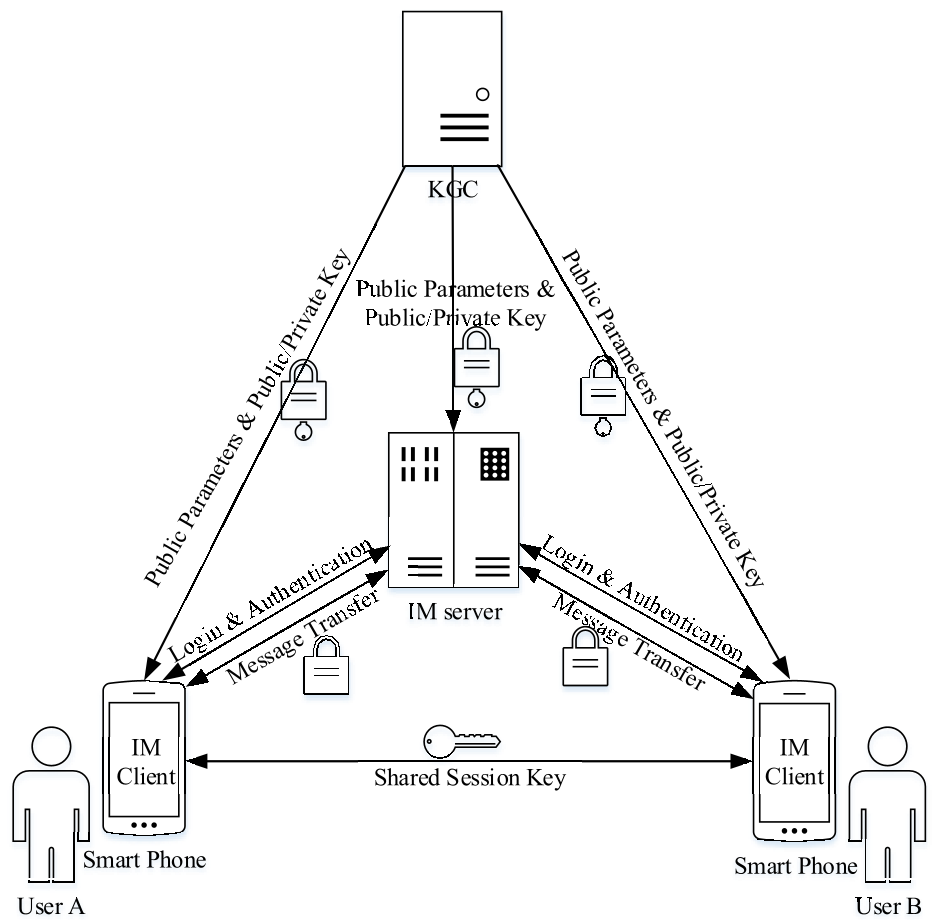
The architecture relies on a three-module system: the Key Generation Center (KGC), the IM Server, and the IM Client.
2. Offline Key Agreement
The most innovative part of the methodology is the session key management. To handle users who are rarely online at the same time, the system maintains a dual-list structure (L1 and L2) to track ephemeral keys and periodically update them. This ensures asynchronicity while maintaining Forward Secrecy.
3. Attack Resistance
- Replay Attacks: Prevented by strict timestamping and a tuple-check mechanism on the server.
- Forgery Attacks: Prevented by ECDSA (Elliptic Curve Digital Signature Algorithm).
Experiments & Results
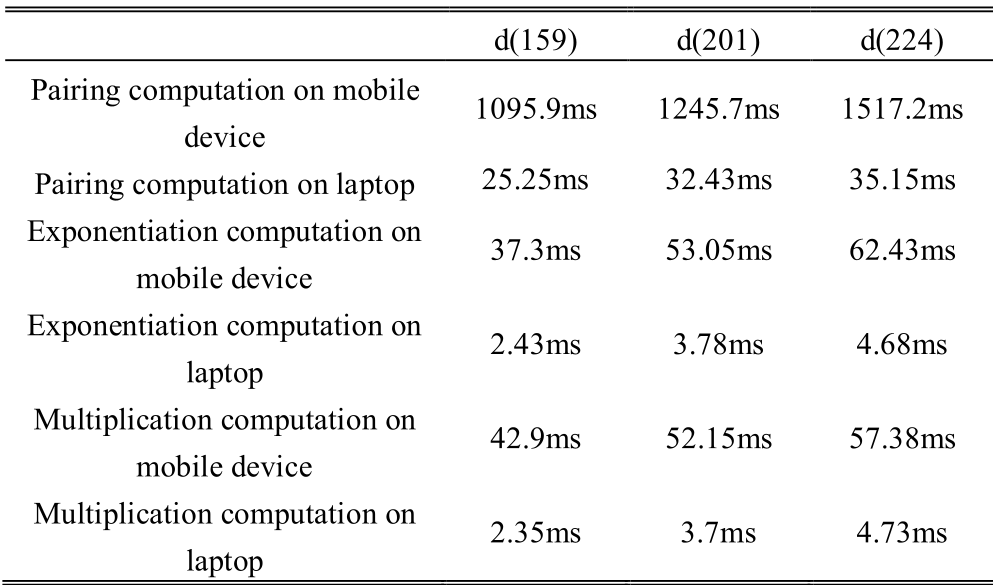
The authors conducted benchmarking on a Huawei Honor 8 and a standard laptop to compare their ECC-based approach with pairing-based methods.
Performance Gains
The results confirm that while pairing operations take over 1 second on mobile devices, the proposed ECC multiplication takes only ~43 ms.
Feature Comparison
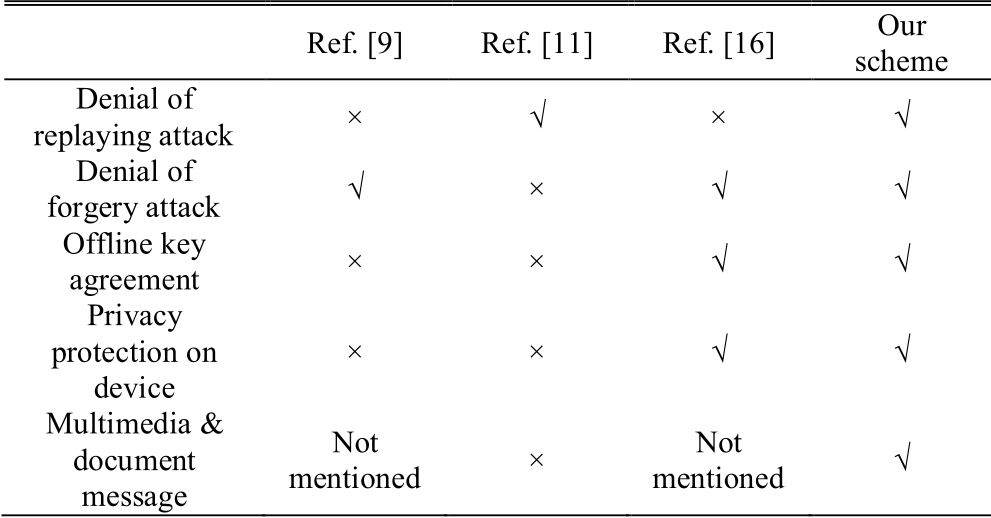
Compared to prior works like [9] and [16], this scheme is the only one to support the full trifecta of:
- Multimedia/Document encryption.
- Offline key agreement.
- Encrypted local storage.
Deep Insight & Conclusion
Takeaway
The genius of this scheme lies in its pragmatism. By avoiding the "mathematical elegance" of bilinear pairings in favor of the "computational efficiency" of ECC and AES, the authors created a protocol that is deployable in real-world apps like WhatsApp or WeChat.
Limitations & Future Work
While the scheme is robust, it relies on a centralized KGC, which represents a single point of failure and potential trust issue. Moving towards a decentralized or distributed key generation center would be the logical next step to align with modern "zero-trust" architectures.
Final Verdict: A foundational work for anyone designing secure communication protocols where hardware constraints are as important as cryptographic proofs.