
Guardian in the Graph: A Deep Dive into Social Network Privacy Preservation
SPECIAL SECTION ON PRIVACY PRESERVATION FOR LARGE-SCALE USER DATA IN SOCIAL NETWORKS
This empirical study provides a comprehensive survey of privacy preservation in Online Social Networks (OSNs), modeling them as network graphs. It categorizes privacy into node, link, and attribute components, while reviewing core mechanisms like K-anonymity, L-diversity, and T-closeness, alongside various decentralized alternative architectures to mitigate SOTA identity and inference attacks.
TL;DR
Online Social Networks (OSNs) are essentially massive, living graphs. While they offer unprecedented connectivity, they create significant privacy risks—from stalking to advanced identity theft. This study empirically audits the transition from basic graph anonymization (like K-Anonymity) to sophisticated decentralized architectures (like Safebook and Lockr), providing a roadmap for balancing data utility with user security.
Background: The Social Network as a Mathematical Construct
To a computer scientist, your Facebook or LinkedIn profile isn't just a page; it’s a Node () in a graph, and your friendships are Edges (). This abstraction () allows us to apply rigorous mathematical models to privacy. However, the rise of "Behavioral Advertising" and "Identity Theft" has proven that simply removing names (Naive Anonymization) is insufficient.
The Evolution of Anonymization: Beyond Naive Hiding
The paper categorizes the fundamental pillars of graph privacy:
- K-Anonymity: Ensuring every node is indistinguishable from at least other nodes regarding its degree.
- L-Diversity: A move beyond structure to content. It requires that sensitive attributes within a group be "well-represented" to prevent attackers from guessing values through homogeneity.
- T-Closeness: The most rigorous of the three, requiring the distribution of a sensitive attribute in any group to be close to the distribution of the attribute in the entire table, preventing similarity attacks.
The Core Methodology: Neighborhood and Link Privacy
The authors detail how privacy is compromised at different layers. Node Privacy focuses on the user, whereas Link Privacy protects the relationships.
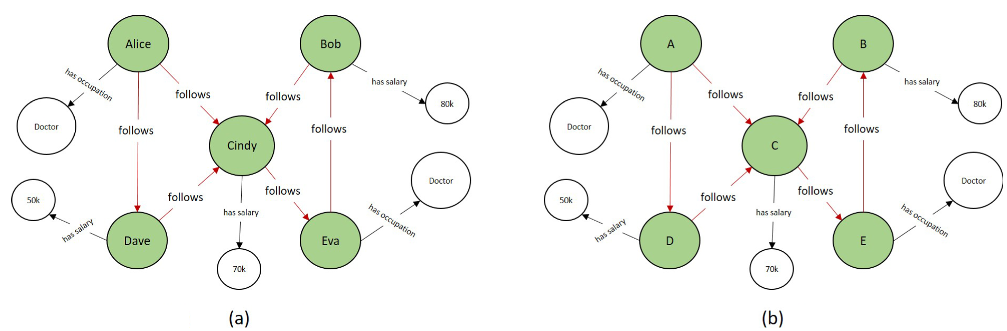
As shown in the figure above, Naive Anonymization (replacing names with IDs) fails because an adversary can still identify you based on the "shape" of your network (Structural Re-identification). If an attacker knows you have exactly 3 friends, and only one node in the anonymized graph has a degree of 3, the anonymity is broken.
Defeating the Sybil Attack
One of the most dangerous threats discussed is the Sybil Attack, where one attacker creates multiple fake identities to subvert the network. The paper reviews two critical defense mechanisms:
- SybilLimit: A decentralized approach based on the "Fast Mixing" property of social graphs. It uses random walks and edge keys to limit the number of accepted Sybil nodes.
- SybilInfer: A Bayesian logic approach that calculates the probability of a node being "honest" based on the bottleneck between honest regions and Sybil regions of the graph.
Decentralized Alternatives: The Future of OSNs
The study provides a deep dive into "Alternative Systems" that move away from the centralized "Big Tech" model to Peer-to-Peer (P2P) structures:
- SPROUT: Uses social links for routing, reducing communication costs in DHT-based networks.
- Lockr: Decouples social data from the network itself, using "Social Attestations" to manage access control for specific friends.
- Safebook: A unique three-tier architecture that uses "Matryoshka" (concentric rings of trusted friends) to hide a user's physical location and data.
Experimental Insights: Datasets and Real-World Scale
The paper summarizes the performance of these theories against real-world datasets, ranging from the Enron email corpus to massive Facebook friendship graphs.

The challenge highlighted is scalability. Algorithms that work for 2,000 nodes (Club Nexus) often become computationally infeasible (NP-hard) when applied to the 1.5 million nodes of Friendster or the billions of nodes in a modern OSN.
Critical Insight: The "Attribute" Blind Spot
The most striking takeaway from the authors is that while we have focused heavily on structural privacy (the links), we are losing the battle on attribute privacy. Even if the graph is anonymized, your "Likes," "Tags," and check-ins create a unique signature that can be used to re-identify you with high probability via cross-referencing public databases.
Conclusion
Privacy preservation in social networks is currently in its "infancy." As we move into the era of Big Data and Mobile Social Networks, simple perturbation is no longer enough. The industry must move toward Decentralized Online Social Networks (DOSNs) where the user, not the provider, holds the keys to their digital identity.