
Defending the Private Self: Tackling Public Neighborhood Attacks in Social Networks
Privacy Preservation in Social Network against Public Neighborhood Attacks
This paper introduces a privacy-preserving framework for social networks targeting "Public Neighborhood Attacks." It combines -anonymity for structural obfuscation with -diversity for sensitive label protection, achieving SOTA results in balancing data utility and privacy on datasets like Facebook and Arxiv.
TL;DR
In the era of hyper-connectivity, following a celebrity or a public institution isn't just a social choice—it’s a digital fingerprint. This paper proposes a robust anonymization framework that combines -anonymity and -diversity to protect users against adversaries who use public connection data to unmask private identities and sensitive labels (like income or medical history).
Academic Positioning: This work builds upon the foundational "Neighborhood Attack" theories by Zhou et al., specifically refining the threat model to distinguish between public and private nodes while optimizing for data utility.
The Problem: The Transparency of Public Connections
Most social network privacy research treats all neighbors as equally "anonymous." However, the reality is different: some nodes are Public (e.g., official accounts, influencers), and their information is globally accessible.
If an attacker knows you follow Obama and Twitter—and you are the only person in a localized dataset with that specific combination—you are compromised. Even if the attacker can't identify you specifically, if everyone with your connection pattern has the same "Sensitive Label" (e.g., a specific disease), your privacy is still leaked.
Methodology: The Dual-Layer Defense
The authors propose a three-step pipeline to transform a vulnerable graph into a privacy-preserving one.
1. Vectorization of Public Neighborhoods (PNS)
Each private node's connections to public nodes are represented as a binary vector. This formalization allows the use of Hamming Distance to mathematically measure how "similar" two users are based on their public interests.
2. -Anonymity via Edge Modification
To prevent re-identification, the algorithm ensures that for every private node, there are at least others with the identical set of public neighbors. This is achieved by adding "noise edges"—minimal connections added strategically to make users indistinguishable in the eyes of the PNS attack.
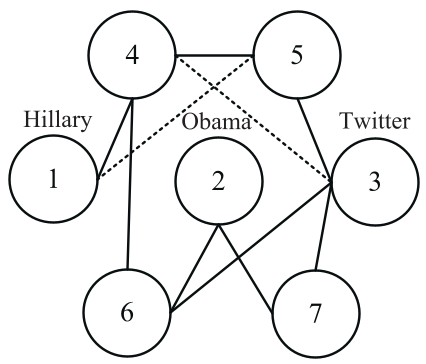 Figure: Achieving 2-anonymity through minimal edge modification.
3. -Diversity for Label Protection
Structural anonymity isn't enough. If a group of anonymous nodes all share the same sensitive attribute (e.g., "Salary: ll$ distinct sensitive label values.
Experimental Results & Data Utility
A critical challenge in privacy Is Utility Loss. If you change the graph too much, it becomes useless for social science or business analysis. The authors tested their method on Facebook and Arxiv datasets using four centrality metrics:
- Degree Centrality
- Closeness Centrality
- Betweenness Centrality
- Eigenvector Centrality
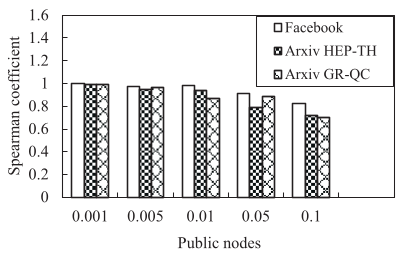 Figure: The algorithm maintains high Spearman's rank correlation (close to 1), meaning the relative importance of nodes remains consistent after anonymization.
The results across Facebook, Arxiv HEP-TH, and Arxiv GR-QC show that even as the proportion of public nodes increases, the network's structural integrity (Closeness and Betweenness) remains remarkably stable.
Critical Insights & Conclusion
This paper succeeds in identifying a realistic and dangerous attack vector: the Public Neighborhood. By focusing graph modification efforts specifically on these fingerprints, they achieve a "surgical" anonymization that preserves the global properties of the network better than "blind" -anonymity.
Limitations: The reliance on edge modification can still slightly distort shortest-path distances. Furthermore, as the value of and increases, the computational cost grows, and the trade-off between privacy and data utility becomes more aggressive.
Future Work: The next frontier involves optimizing these algorithms for "big data" scales where millions of nodes must be processed in real-time without losing the intricate "brokerage" positions of specific influential users.