
NFH: Engineering Self-Organizing Privacy in Decentralized Social Networks
5331_A Privacy-Preserved Probabilistic Routing Index Model for Decentralised Online Social Networks.
This paper proposes a self-organized decentralized architecture for Online Social Networks (OSNs) to enhance privacy and search efficiency. The core method is the Node Fingerprint Hash (NFH), which leverages a probabilistic query routing mechanism to optimize resource discovery in a peer-to-peer (P2P) environment without relying on a central authority.
TL;DR
The paper introduces a decentralized Online Social Network (OSN) architecture that replaces central servers with a peer-to-peer system. By utilizing Node Fingerprint Hash (NFH) and a Probabilistic Query Routing algorithm, the authors enable efficient content discovery while preserving user privacy, achieving a self-organizing "Small-World" effect.
Background & Motivation: The Privacy Trap
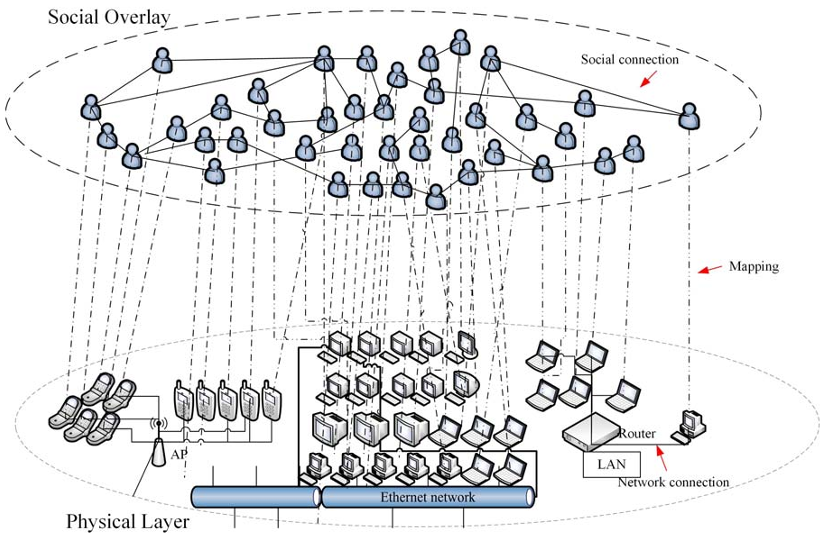
In the current era of social media, users trade their privacy for connectivity. Centralized OSNs are "walled gardens" where data is a commodity. While decentralized P2P networks offer a solution, they often face the "needle in a haystack" problem—finding a specific service or user without a central index is computationally expensive and slow. The authors seek to bridge this gap by making the network "smarter" about how it routes queries.
Methodology: The Node Fingerprint Hash (NFH)
The cornerstone of this paper is the Node Fingerprint Hash. Instead of broad broadcasting, each node generates a compact signature of its available services.
1. Generating the Fingerprint
A service is represented as a set of terms. These are hashed into a -bit vector. The node then aggregates these hashes into a single NFH using a weighting mechanism:

The final bit is set to 1 if the sum of weights for that bit position is positive, creating a semantic summary of the node's local knowledge.
2. Probabilistic Query Routing
To find information, a node doesn't just ask everyone. It calculates the Similarity () between its needs and its neighbors' fingerprints using Normalized Hamming Distance. The routing probability is defined as:
This ensures that queries "gravitate" towards nodes that are more likely to contain the answer, effectively reducing network congestion.
Experiments and Results
The authors evaluated their system using a real-world social network dataset.
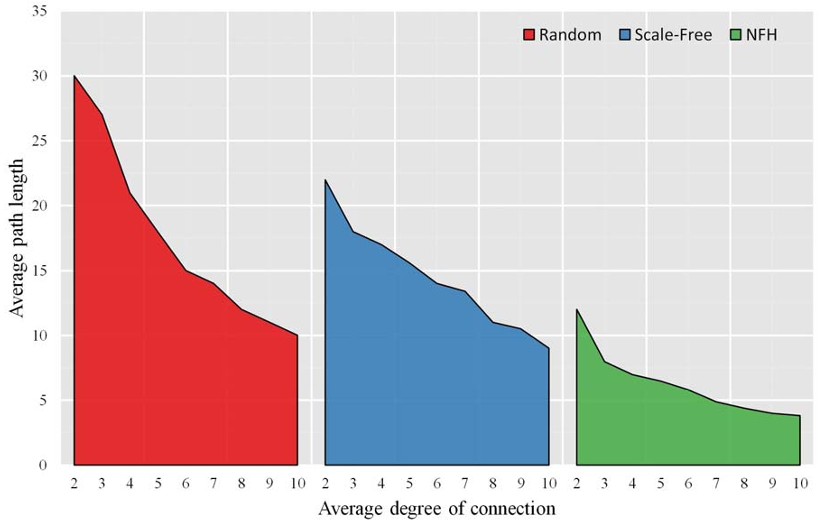
- Network Topology: The NFH-based approach successfully induced "Small-World" characteristics. The Average Clustering Coefficient (ACC) was significantly higher than that of random networks, meaning nodes with similar interests naturally formed tight-knit communities.
- Search Efficiency: Comparing the Local Service Index (LSI) and Local Knowledge Index (LKI), the results showed that the system could achieve high success rates with fewer "hops," significantly reducing the Time-to-Live (TTL) required for successful discovery.
Critical Insight: Why it Works
The genius of the NFH approach lies in its Inductive Bias. In social networks, interests are not uniformly distributed; they exhibit "homophily." By encoding this homophily into the routing layer via fingerprints, the authors transform a flat P2P network into a semantically structured graph. This allows the network to "self-organize" based on content rather than just random connection strings.
Conclusion & Limitations
This work provides a robust framework for building OSNs where privacy is the default, not an option. However, there are trade-offs:
- Dynamic Updates: As a user's interests change, the NFH must be re-propagated, which could lead to overhead.
- Fingerprint Sparsity: In very diverse nodes, the NFH might become saturated (too many 1s), reducing its routing precision.
Future work could involve exploring Adaptive Fingerprints that adjust their bit-length based on the density of local services, further optimizing the balance between privacy and search speed.