
Beyond Identity: Decentralizing Trust with Attribute-Based Reputation Systems
A Privacy-Preserving Attribute-Based Reputation System in Online Social Networks
The paper introduces a fine-grained, attribute-based reputation system for Online Social Networks (OSNs) that allows users to rate specific attributes rather than identities. Using Non-Interactive Zero-Knowledge (NIZK) proofs and structured encryption, it achieves verifiable reputation scores while maintaining strict anonymity for both voters and receivers.
TL;DR
In the digital age, we often ask "Who is saying this?" to establish trust. This paper argues we should instead ask "What expertise does the speaker have?" The authors propose a system where reputations are built on verified attributes (e.g., "Certified Mechanic") rather than real-world identities, using advanced cryptography (NIZK and Proxy Re-encryption) to ensure that users can prove their credibility without ever sacrificing their privacy.
The Granularity Gap: Why Your "Five-Star" Rating is Broken
Most Online Social Networks (OSNs) treat reputation as a monolithic block. If you have a high "Karma" or "Endorsement" score, it follows you everywhere. However, human expertise is specialized. A "trustworthy" user in a car enthusiast forum isn't necessarily a reliable source for medical advice.
Current systems face a Catch-22:
- Identity-Based: Link reputation to real IDs (like LinkedIn). This builds trust but destroys privacy.
- Pseudonym-Based: Use handles/nicknames. This protects privacy but invites "Sybil attacks" where one person creates 100 accounts to inflate their own score.
Methodology: The Cryptographic Engine
The core innovation lies in decoupling the Validation of Expertise from the Disclosure of Identity.
1. Attribute Verifcation (NIWI Proofs)
Instead of logging in with a username, a voter proves they possess a specific attribute credential—signed by a Trust Authority (TA)—using Non-Interactive Witness-Indistinguishable (NIWI) proofs. This allows a user to say, "I am a verified expert in this field," without revealing which specific expert they are.
2. Preventing the Double-Vote
To prevent a user from voting for themselves repeatedly, the system adopts a mechanism inspired by e-Cash. Every vote generates a "serial number" . If a user attempts to vote twice on the same message, the mathematical properties of the proof reveal their "secret key," allowing the system to identify and revoke the malicious actor.
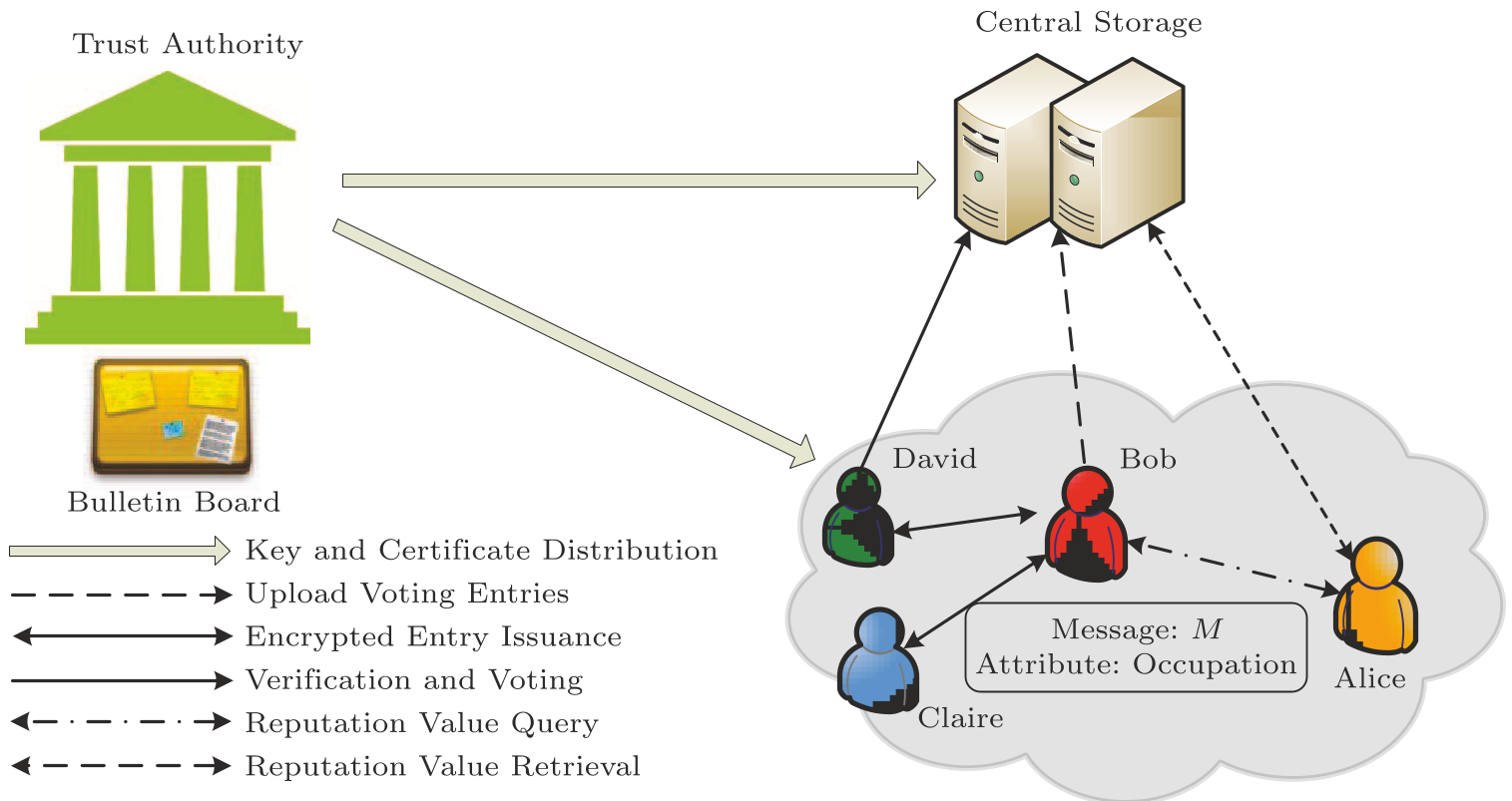 Figure 1: High-level overview of the attribute-based interaction between Bob (Poster), David (Voter), and the Central Storage.
3. Homomorphic Aggregation
Votes are stored in a semi-trusted Central Storage (CS) in encrypted form. Because the encryption is homomorphic, the CS can add up the votes (positives and negatives) without ever knowing what the individual votes were or who cast them.
Experimental Results & Performance
The researchers implemented the system using the PBC (Pairing-Based Cryptography) library. The primary focus was on the trade-off between privacy and latency.
- Computational Efficiency: Unlike previous "Signatures of Reputation" works that scaled quadratically () during retrieval, this system scales linearly ().
- Retrieval Speed: By utilizing a structured dictionary and hash tables for indexing, querying a user's reputation is nearly instantaneous, even as the number of attributes grows.
 Table 1: Complexity comparison showing the significant efficiency gains in reputation retrieval over previous benchmarks.
Critical Insight: The "Semi-Trusted" Paradigm
The brilliance of this architecture is its realism. It doesn't assume a perfectly decentralized utopia. It acknowledges that OSNs like Facebook or LinkedIn will use central servers. The "Semi-Trusted" assumption ensures that even if the server is "curious" (wants to know your data), as long as it follows the protocol, the math prevents it from seeing your secrets.
Conclusion & Future Outlook
This paper provides a robust blueprint for the next generation of social trust. By shifting from Identity-centric to Attribute-centric reputation, we can build digital spaces that are both high-trust and high-privacy.
Limitations: The system still relies on a "Trust Authority" to initialy verify attributes (e.g., verifying a diploma). Future work could explore decentralized Oracles to remove this final point of centralization.