
Why Privacy is the Secret to Market Diversity: A Deep Dive into Competitive Diffusion
Preserving Privacy Enables “Coexistence Equilibrium” of Competitive Diffusion in Social Networks
The paper investigates competitive diffusion in social networks using the SI1I2S model, proposing a privacy-aware mechanism where users may misreport or hide their product adoption. It mathematically proves that incorporating privacy enables a "co-existence equilibrium" where both products survive, unlike the traditional "winner-takes-all" result.
TL;DR
Why haven't Android or iPhone killed each other off yet? Traditional social network theory suggests a "winner-takes-all" outcome where the weaker product inevitably disappears. This paper, "Preserving privacy enables 'co-existence equilibrium' of competitive diffusion in social networks," argues that our tendency to hide or lie about our preferences (privacy) is exactly what allows competing products to survive together in the market.
The "Winner-Takes-All" Paradox
In classical epidemic modeling, if two viruses compete for the same population, the one with the higher "reproduction number" eventually drives the other to extinction. In the context of social networks (SI1I2S models), this implies that if everyone honestly recommends the product they use, the market should eventually consolidate into a monopoly.
However, the real world is messy. Users are often dissatisfied, frustrated, or simply private. We don't always broadcast our true state. The authors hypothesize that this privacy-aware behavior—the noise in the signal of social influence—is the missing link that explains market co-existence.
Methodology: Engineering Controlled "Honesty"
The authors modify the standard SI1I2S model by introducing a Privacy Scheme matrix. Instead of a user in state (adopting product 1) always spreading , they now:
- Spread with probability
- Pretend to spread with probability
- Stay silent with probability
This is inspired by the Randomized Response technique in statistics. If and , the system achieves Perfect Privacy, meaning an observer cannot tell what you use based on what you recommend.
The Graphical Intuition
 The dynamical system equations (10a-d) describe how the probability of adoption changes over time, influenced by the network adjacency matrix and the privacy-perturbed rates.
The Breakthrough: The Co-existence Theorem
The most significant contribution is the mathematical proof that privacy "resurrects" products. In a privacy-oblivious world, if a product’s adoption drops to zero, it stays dead. In a privacy-aware world, users of Product A might "pretend" to use Product B, essentially acting as a seed for Product B’s revival.
Key Stability Condition
For arbitrary networks, the system reaches a stable co-existence if: Where:
- : Spreading strength (infection rate / healing rate).
- : The probability of spreading a specific product.
- : The largest eigenvalue of the network (spectral radius).
Experimental Results: Real-World Validation
The authors tested their theories against massive datasets, including the Google+ social graph and Portland contact networks.
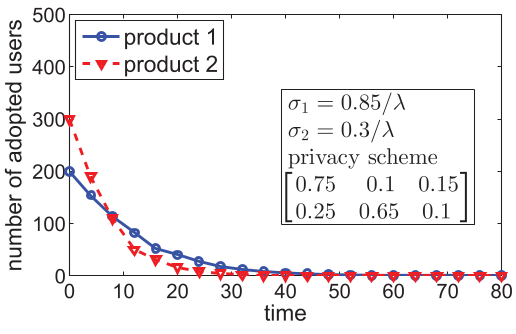 Figure 3: Contrast between Privacy-Aware (Co-existence) and Privacy-Oblivious (Winner-takes-all) scenarios. Note how the blue and red lines both stabilize above zero in the privacy-aware plots.
The experiments confirm that as long as at least one product is strong enough to survive on its own, privacy mechanisms act as a "cross-pollinator," allowing the weaker product to find a niche and persist at a non-zero equilibrium.
Critical Insight & Future Outlook
This work reframes privacy from a "barrier to data" into a "structural stabilizer." By introducing noise into the social contagion process, privacy prevents the system from falling into the "trap" of a global monopoly.
Limitations: The model assumes homogeneous healing and infection rates. In reality, your "healing rate" (how likely you are to stop using a phone) is highly personal.
Future Work: This framework could be applied to the diffusion of "competing truths" or "echo chambers." Could providing more privacy in social media algorithms actually reduce the "winner-takes-all" effect of viral misinformation and allow balanced viewpoints to co-exist? It’s a compelling theoretical path for the next generation of social platform design.