
Vehicular Social Networks: Balancing Connectivity and Cloud-Edge Privacy
Privacy-Preserving Content Dissemination for Vehicular Social Networks: Challenges and Solutions
"Privacy-Preserving Content Dissemination for Vehicular Social Networks: Challenges and Solutions" is a comprehensive survey that explores the intersection of vehicular ad hoc networks (VANETs) and social properties. It systematically classifies privacy requirements, identifies cross-layer attacks (OBU, RSU, and Server-related), and evaluates seven major technical countermeasures to secure information sharing in intelligent transportation systems.
TL;DR
As vehicles transform from mere transport tools into social entities, Vehicular Social Networks (VSNs) are emerging as a dominant paradigm. However, the blending of human social behavior with high-speed mobility creates a "Privacy Paradox." This survey dissects the architectural vulnerabilities of VSNs and maps out the path from traditional encryption to advanced game-theoretic and physical-layer defenses.
The Evolution of the "Social" Vehicle
Unlike traditional VANETs, a VSN integrates human factors—habits, preferences, and social ties. While this enables applications like collaborative driving and real-time news sharing, it exposes users to sophisticated tracking. The "Physical Distance vs. Social Relationship" matrix defines how we interact with strangers, acquaintances, and family members on the road.
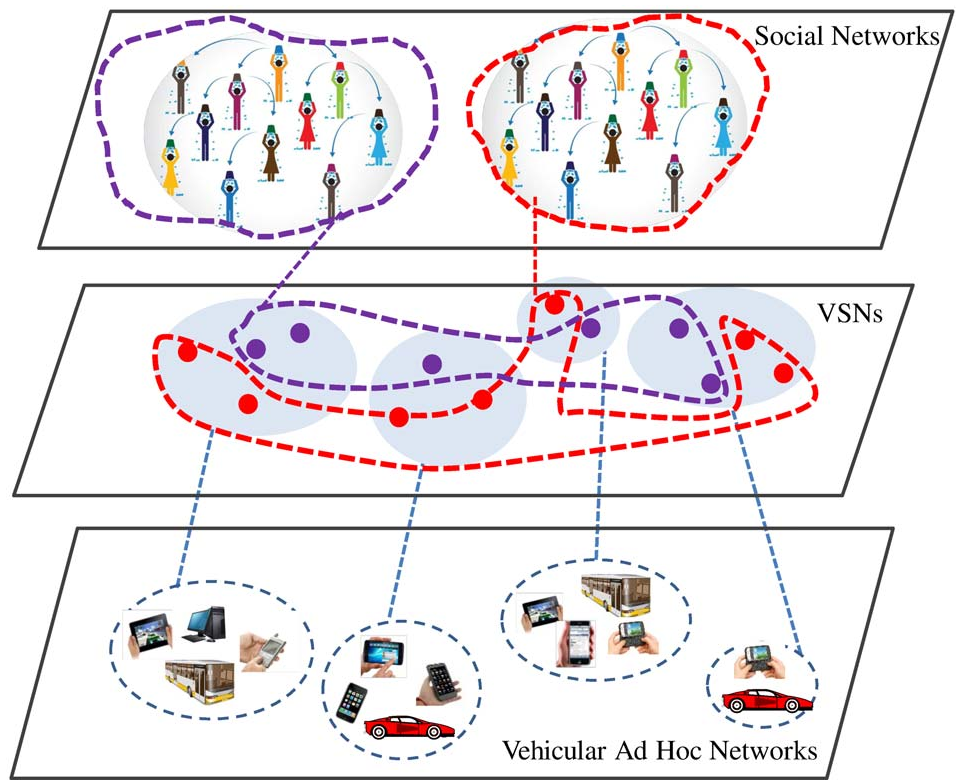
Multi-Vector Attack Surface
The paper identifies three critical points of failure in the VSN architecture:
- OBU (Onboard Unit) Attacks: Targeting the vehicle itself (e.g., Sybil attacks, black hole routing).
- RSU (Road-Side Unit) Attacks: Compromising the infrastructure to link pseudonyms to real identities.
- Server/Cloud Attacks: Exploiting semi-trusted third parties that manage location-based services (LBS).
Methodology: The Seven Pillars of Defense
The core of the methodology lies in evaluating seven distinct solution categories. The authors argue that no single method is a "silver bullet."
1. Cryptography and Signatures
Modern solutions leverage Bilinear Pairings and Group Signatures. Group signatures allow a vehicle to sign a message on behalf of a group without revealing its specific identity, though a Trusted Authority (TTA) can still trace misbehaving nodes if necessary.
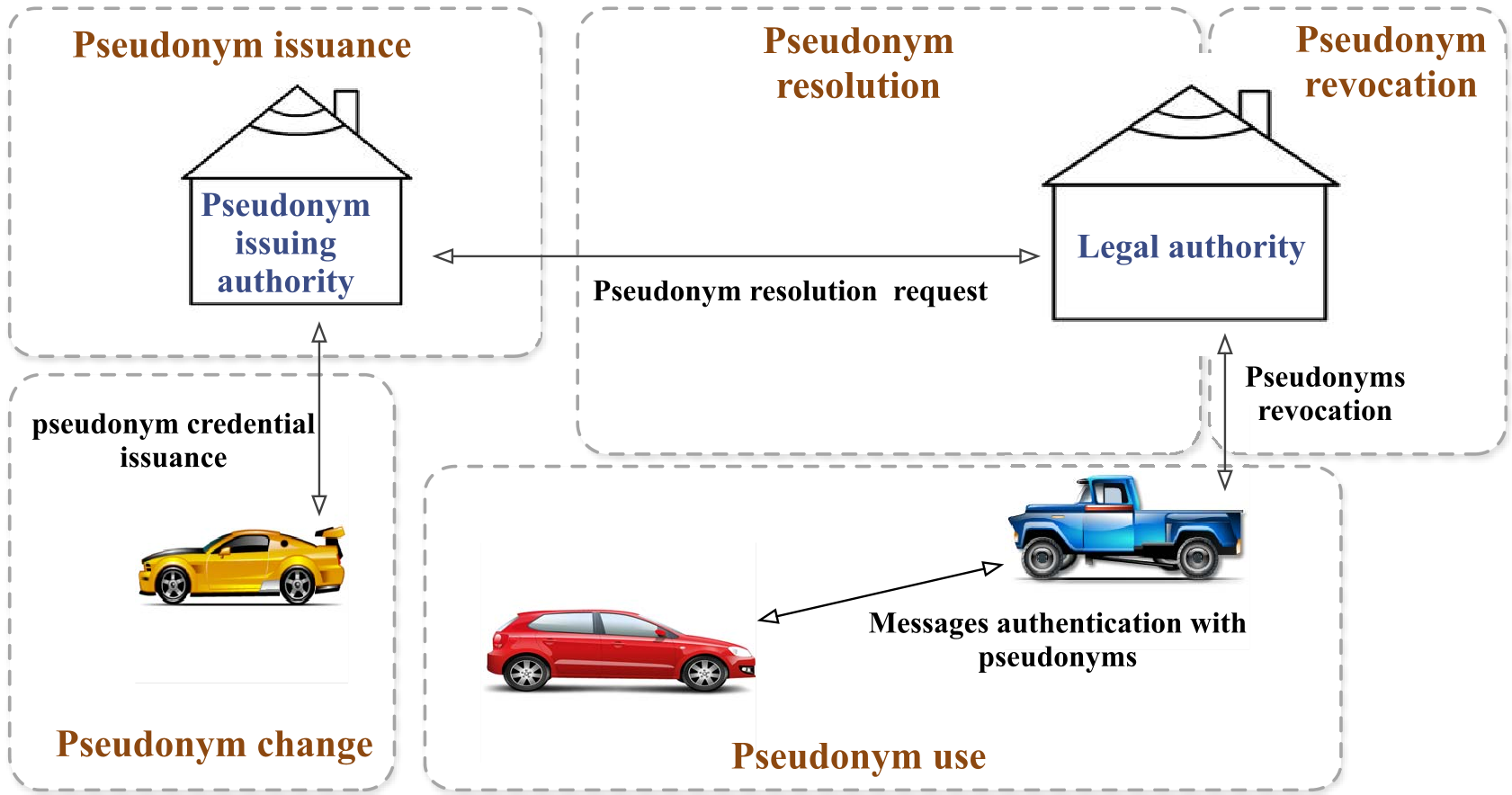
2. Pseudonymity & Mix-Zones
To prevent tracking, vehicles must change their "digital license plates" (pseudonyms). However, doing this in isolation is useless. The paper highlights Mix-Zones—physical areas like intersections where multiple vehicles change pseudonyms simultaneously, creating a "confusion" effect for eavesdroppers.
3. The Game of Privacy
In a unique insight, the paper discusses Game Theory as a tool to model the interaction between an attacker and a defender. By calculating the Nash Equilibrium, a system can dynamically adjust its defense strategy (e.g., pseudonym change frequency) based on the perceived risk and cost of the attack.
Experimental Analysis: Trade-offs in Smart Cities
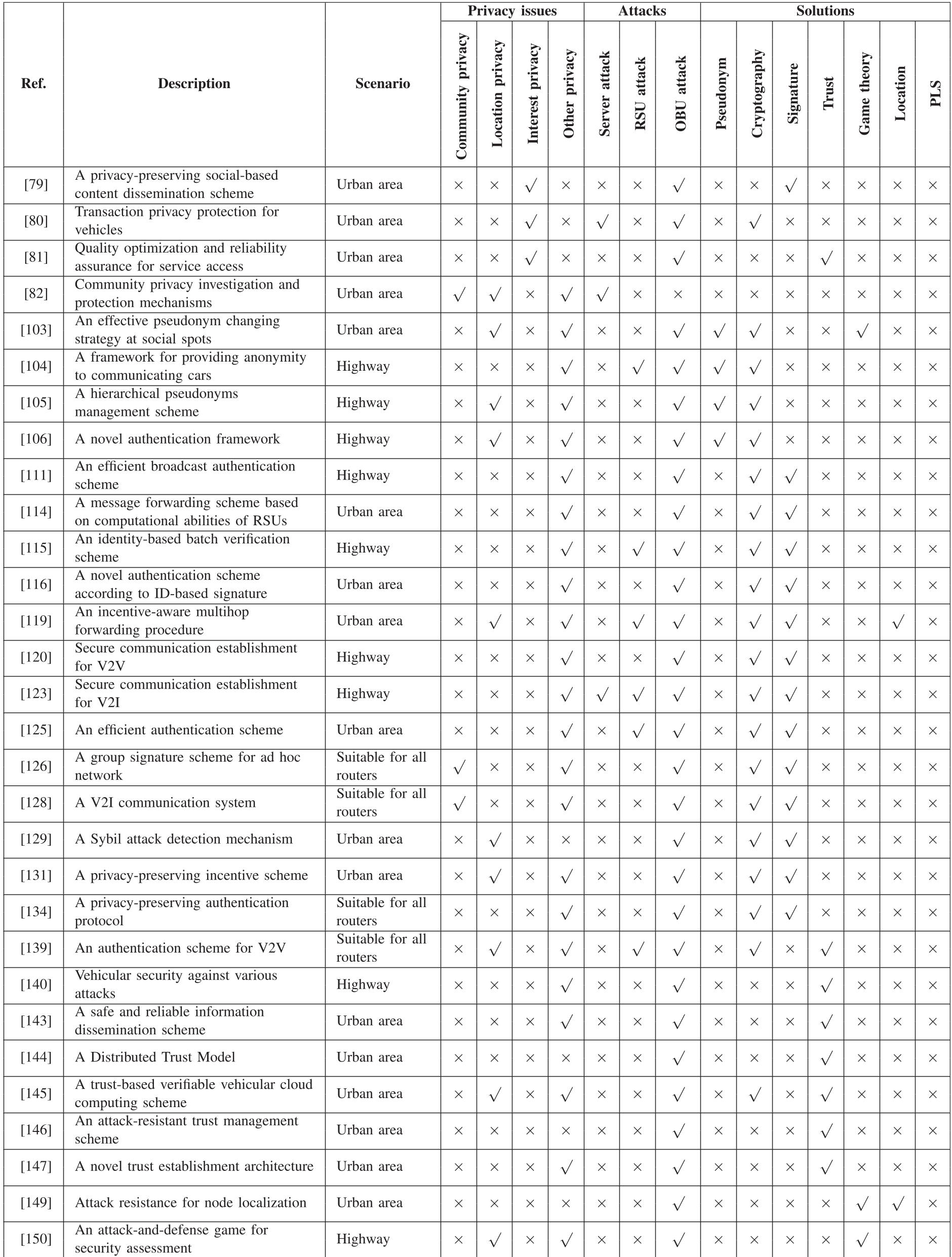
The survey provides a massive side-by-side comparison of different protocols. The conclusion is clear: Latency is the enemy. While heavy encryption (Asymmetric schemes) provides the best security, the high mobility (Short Contact Duration) in highway scenarios often necessitates faster, symmetric-key, or location-cloaking approaches.
Critical Insight & Future Outlook
The most striking takeaway is the potential of Physical Layer Security (PLS). By using the unique "noise" and fading characteristics of the wireless channel as a shared secret, we can generate encryption keys without ever transmitting them over the air.
Challenges Ahead:
- Big Data Privacy: How to perform data mining on "Social Wheels" without compromising individual privacy?
- Autonomous Driving: Ensuring location proofs are spoof-proof while keeping the passenger's history private.
- Cross-Layer Design: The next generation of VSNs must integrate Physical Layer randomness with Application Layer trust scores.
Conclusion
This survey serves as a fundamental coordinate system for researchers. As we move closer to a world of fully autonomous, socially aware vehicles, the solutions discussed here—particularly the fusion of trust models and lightweight signatures—will be the bedrock of a secure Intelligent Transportation System.