
PAD Protocol: Bridging the Gap Between Data Reach and Location Privacy in Mobile Networks
PAD: Privacy-preserving data dissemination in mobile social networks
The paper introduces PAD (Privacy-preserving Data Dissemination), a protocol designed for Mobile Social Networks (MSNs) that identifies high-utility relay users without compromising their location privacy. By leveraging the Paillier cryptosystem's homomorphic properties, it achieves a higher data delivery ratio compared to random selection methods.
TL;DR
The PAD (Privacy-preserving Data Dissemination) protocol solves a classic tension in Mobile Social Networks (MSNs): the need to find highly active "relay" users to spread data versus the necessity of protecting those users' private location histories. By using Paillier Homomorphic Encryption, PAD allows a source node to calculate how "active" a neighbor is without actually seeing where that neighbor has been.
Problem & Motivation: The Privacy-Performance Paradox
In a typical MSN, a source user (e.g., an advertiser) wants to spread information to as many physical locations as possible. Selecting random users as relays is private but inefficient. Selecting the "best" users—those who travel to the most locations—requires these users to disclose their Locations of Interest (LoI), which is a massive privacy breach involving sensitive personal movements.
Prior works often struggled with:
- Low Efficiency: Randomly selected relays might stay in one spot.
- Privacy Leakage: Methods requiring raw trajectory data are rejected by privacy-conscious users.
- Incentive Issues: The cost of hiring relays necessitates picking only the most "active" ones.
Methodology: High-Utility Relays via Homomorphic Math
The core of PAD lies in its ability to calculate a user's Activeness score mathematically while the data remains encrypted.
1. Defining Activeness
A user's potential as a relay is defined by how many new locations they can cover that the source hasn't already covered. This is the union of their Location of Interest (LoI) sets.
2. The Paillier Mechanism
The source node encrypts its own location coverage requirements using the Paillier cryptosystem. The homomorphic property allows neighbors to multiply these ciphertexts in a way that, when decrypted by the source, reveals only the sum of overlapping/unique locations (the Activeness score), but not the specific locations themselves.
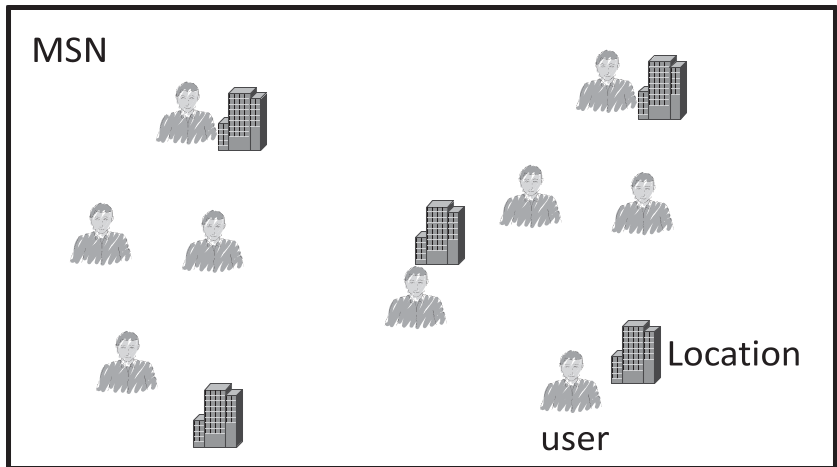 Fig 1: The MSN model where mobile users travel between stationary locations.
3. The Three-Phase Protocol
- Initialization: Users generate Paillier keys and define their LoI binary vectors.
- User Identification: The source interacts with neighbors to compute in the encrypted domain.
- Data Dissemination: High-activeness users are selected as relays and follow a "minimum-distance" travel principle to deliver data.
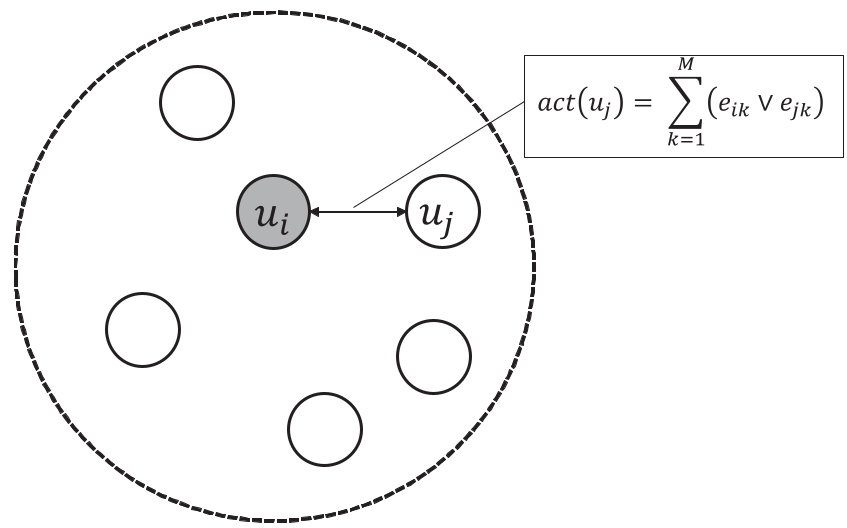 Fig 2: The interaction loop between source and neighbor ensuring zero-knowledge of raw LoI.
Experiments & Results: Efficiency Gains
The authors validated PAD using a custom Java simulator. They compared PAD against GDDM (General Data Dissemination Method), which selects relays randomly.
- Delivery Ratio (DR): PAD consistently outperformed GDDM across various timeframes.
- Scalability: As the number of relay users () increased from 1 to 3, the delivery ratio improved significantly, showing that PAD correctly identifies the most influential nodes.
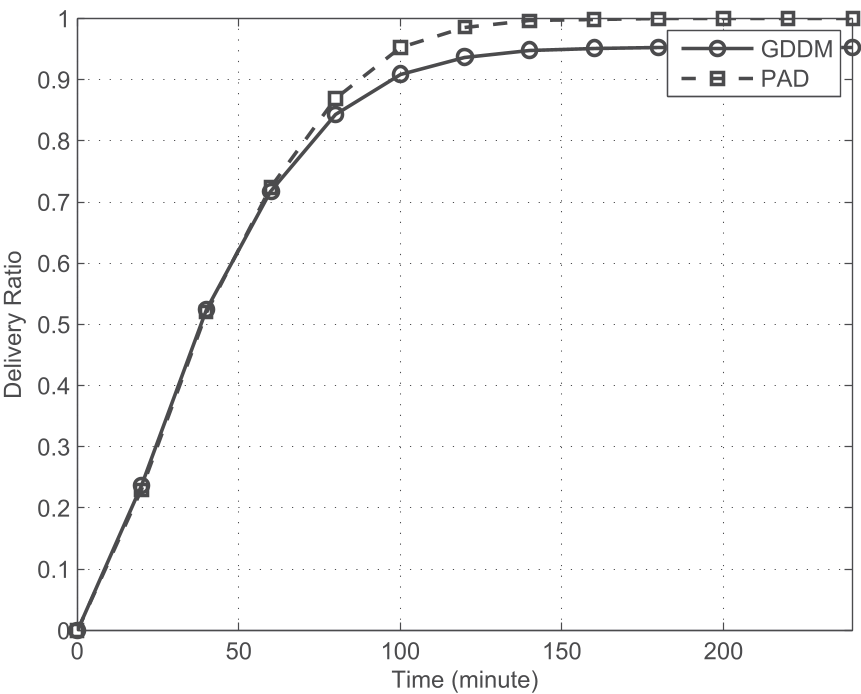 Fig 3: Delivery Ratio (DR) vs. Time. PAD (top lines) consistently stays above random selection (bottom lines).
Critical Analysis & Conclusion
Takeaway
The PAD protocol proves that privacy does not have to come at the cost of utility. By shifting the computation of relay "value" into the encrypted domain, MSNs can enjoy optimized data spreading while keeping user movements confidential.
Limitations & Future Work
While PAD is secure against a semi-honest source user, the computational cost of Paillier encryption on resource-constrained mobile devices could be a bottleneck. The authors' future direction involves optimizing the number of relays to balance the cost of hiring versus the profit of dissemination, a vital step for real-world commercial viability.
Final Insight
This research is a precursor to modern "Privacy-Preserving Proximity Services." It offers a blueprint for how we might one day interact with smart cities—getting relevant local data without ever giving up our personal "map."