
PKcore: Privacy-Preserving Dense Subgraph Discovery in Mobile Social Networks
Privacy-Preserving Dense Subgraph Discovery in Mobile Social Networks
The paper introduces PKcore, a privacy-preserving protocol for discovering optimal k-core subgraphs in Mobile Social Networks (MSNs). It eliminates the need for a central repository by utilizing a distributed approach that combines Yao’s Garbled Circuits with additive homomorphic encryption.
TL;DR
Finding "cohesive groups" in mobile social networks (MSNs) usually requires sharing your entire friend list—a major privacy nightmare. PKcore is a new distributed protocol that allows users to find a k-core (a group where everyone has at least friends) without ever revealing their social links to anyone else, not even the person starting the search. By combining Yao's Garbled Circuits and homomorphic encryption, it achieves optimal results with mobile-friendly performance.
Context: The Privacy Paradox in MSNs
Mobile Social Networks (MSNs) like FireChat or Meetup rely on short-range communication (Bluetooth/WiFi) rather than a central server. While this is great for "off-the-grid" communication, it makes finding dense subgraphs (essential for group activities) incredibly difficult. Current SOTA methods for k-core discovery are centralized, meaning they need a "God's eye view" of the network. In an era where 52% of users hide their friend lists, we need a way to calculate group density without exposing the underlying graph topology.
Methodology: The Core of PKcore
The authors solve this by transforming the standard iterative pruning algorithm for k-cores into a secure multi-party computation (MPC) workflow.
1. The Strategy: Pruning Without Peeking
In a standard k-core algorithm, you repeatedly remove any node with a degree less than . In PKcore, this "is my degree ?" check is performed inside a Yao’s Garbled Circuit.
- The Initiator (D) provides .
- The Participant () provides their current degree.
- The Result: Only the encrypted boolean (is degree ?) is produced.
2. Hybrid Security Architecture
To update degrees without revealing which specific neighbor was pruned, the protocol uses Additive Homomorphic Encryption. This allows a node to sum up the "survival status" of its neighbors while the values are still encrypted.
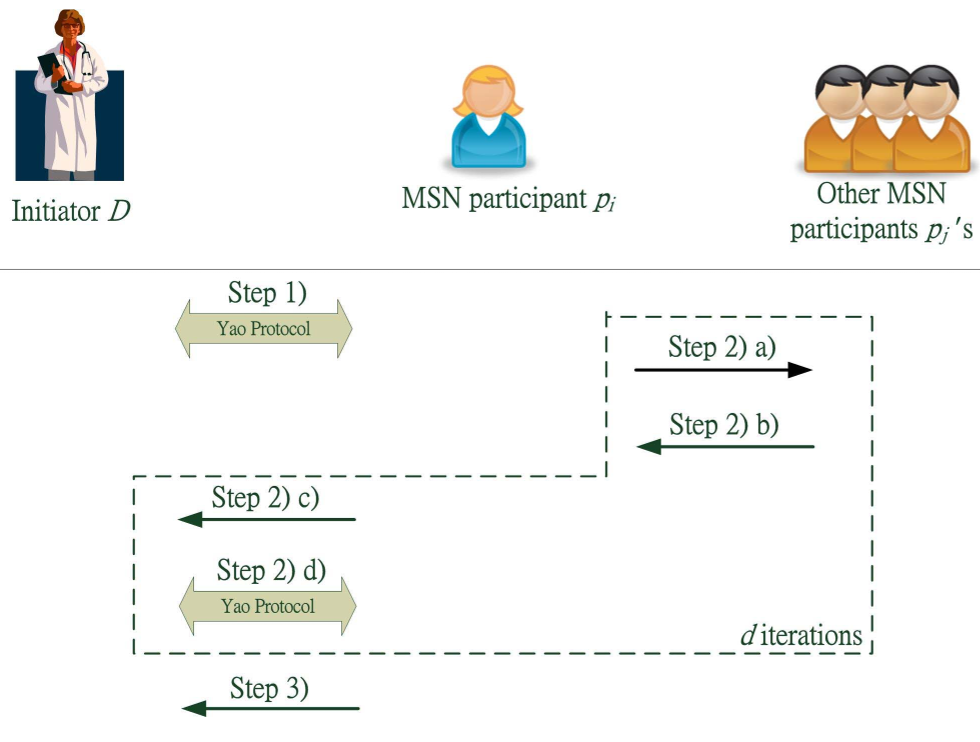 Figure 1: The flow of messages between the Initiator and MSN participants, showcasing the interaction between Yao's protocol and homomorphic updates.
Experiments & Results
The authors implemented the arithmetic operations on a Samsung S4 to prove that "academic" cryptography can run on "real-world" hardware.
- Optimal Correctness: The protocol is proven to return the exact same maximum k-core as a centralized algorithm.
- Performance: Even with the overhead of Garbled Circuits, the runtime remains feasible for mobile devices. For a typical network diameter, computation time stays within a range that won't drain a modern smartphone battery instantly.
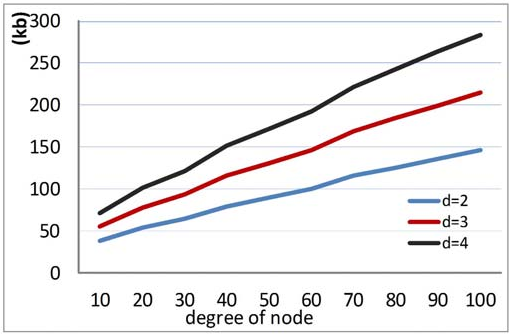 Figure 2: Runtime computation costs show a manageable linear growth as the number of participants () increases.
Critical Insight & Conclusion
The brilliance of PKcore lies in its hybridization. Yao’s protocol is powerful but doesn't scale well to many-to-many communication; homomorphic encryption is great for aggregation but expensive for logic. By using Yao’s for the "logic gate" (the comparison with ) and homomorphic encryption for the "network aggregation," the authors found a "Goldilocks zone" for mobile privacy.
Limitations: The current model assumes semi-honest participants (they follow the rules but try to learn secrets). In high-stakes environments, a "malicious" user could potentially lie about their degree to manipulate the group formation. Future work moving towards "Verifiable Computation" would be the natural next step for this lineage of MSN research.