
$kw$-NMF: Safeguarding Edge Privacy in the Evolving Social Landscape
Privacy Preserving in Dynamic Social Networks
This paper introduces the -NMF (Number of Mutual Friend Anonymization) model, a privacy-preserving framework for dynamic social networks. It focuses on preventing edge identity disclosure across sequential data releases by ensuring each edge belongs to a k-anonymous consistent group over a monitoring window .
TL;DR
As social networks evolve, publishing data snapshots sequentially creates a "temporal side-channel" that adversaries use to track relationship changes. This paper proposes -NMF, a dynamic anonymization model that ensures no relationship can be uniquely identified by its "mutual friend" signature across a window of time steps, maintaining a balance between data privacy and graph utility.
The Dynamic Tracking Dilemma
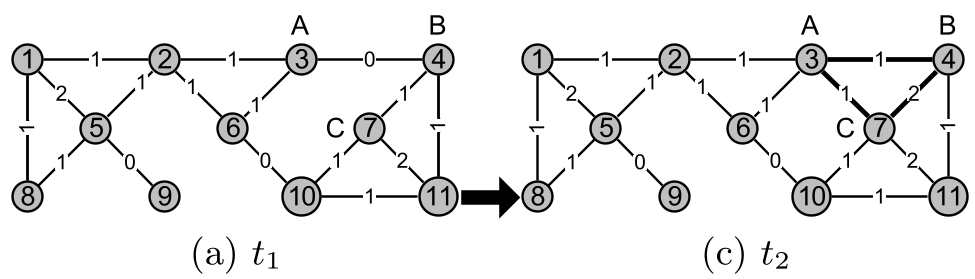
Static anonymization is a solved problem; we can mask degrees or hide neighborhoods. However, real-world social networks are dynamic. Relationships form and dissolve. If an attacker knows that Alice and Bob just became friends, they can look at two sequential releases, identify which edge changed its "mutual friend count," and deanonymize the pair.
The core challenge is that local structural changes propagate. Adding one edge doesn't just change the degree of two nodes; it changes the mutual friend counts of all their neighbors. Existing methods that ignore this temporal correlation leave users vulnerable to "Mutual Friend Attacks" in sequential releases.
Methodology: The -NMF Framework
The researchers transform the problem into an edge weight anonymization task, where the weight is the count of mutual friends.
1. The GS-Table (Group Sequence Table)
Instead of re-processing all historical data for every new release, the authors introduce the GS-Table. This data structure maintains the "history" of mutual friend counts for every edge over a window .
- Incremental Updates: As time progresses, the oldest information () is evicted, and the newest snapshot is integrated.
- Consistent Grouping: Edges are sorted by their temporal sequences, ensuring that edges with similar structural "trajectories" are grouped together.
2. Anonymization via Edge Addition
To satisfy the -anonymity requirement, the algorithm modifies the graph such that for any edge sequence, there are at least other edges with the same sequence.
- Triangle Preservation: When adding fake edges or vertices to increase mutual friend counts, the algorithm ensures it doesn't accidentally change the counts of edges already anonymized.
Experimental Validation
The authors tested their approach on scale-free graphs (Barabási-Albert), which mimic the "rich-get-richer" dynamics of real-world networks like Facebook or LinkedIn.
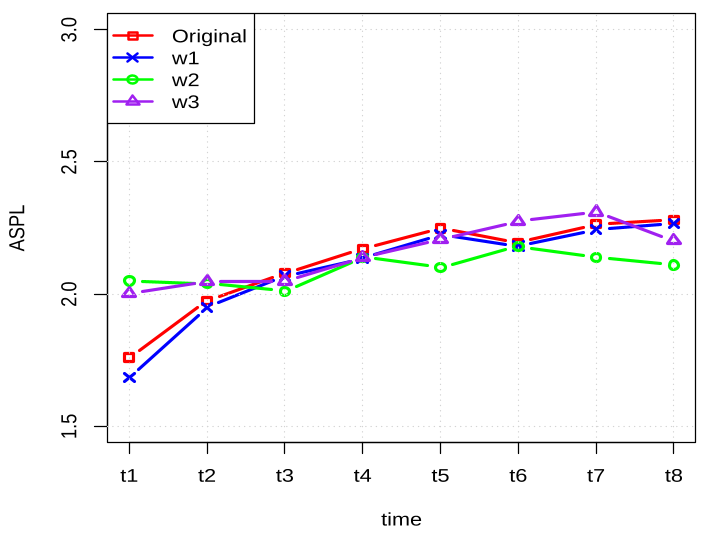
- Utility Metrics: They measured the Average Shortest Path Length (ASPL) and Clustering Coefficients (CC).
- Findings: Even with a large window , the information distortion was surprisingly low. The ASPL stayed relatively stable, proving that the connectivity of the graph—crucial for research on information spread—remained intact.
Critical Insight & Conclusion
The genius of -NMF lies in recognizing that privacy is not a snapshot; it is a sequence. By treating the "mutual friend count" as a dynamic signature, the authors provide a robust defense against adversaries who monitor users over time.
Future Outlook: While adding edges is effective, it increases graph density. Future work could investigate "hybrid" models that combine edge addition with vertex grouping to potentially reduce the number of "fake" relationships required to achieve the same level.
Paper: Privacy Preserving in Dynamic Social Networks Published at: ICIA-16 International Conference on Informatics and Analytics