
PP-ELM: Solving the Accuracy-Privacy Paradox in Secure Cloud Computing
Privacy preserving extreme learning machine using additively homomorphic encryption
This paper introduces PP-ELM, a Privacy-Preserving Extreme Learning Machine framework that leverages Additively Homomorphic Encryption (AHE) to enable secure machine learning on encrypted big data. By utilizing the analytical learning property of ELM, the method achieves state-of-the-art accuracy in secure classification tasks (e.g., 99.7% on the Shuttle dataset) without the performance degradation typically caused by function approximation.
TL;DR
The emergence of PP-ELM (Privacy-Preserving Extreme Learning Machine) marks a significant shift in secure outsourced computation. Unlike traditional neural networks that require heavy iterative communication or "accuracy-killing" approximations, PP-ELM uses Additively Homomorphic Encryption to perform exact analytical learning on encrypted data. It maintains the high accuracy of non-linear classifiers while offloading the heavy computational lifting to the cloud.
Background: Why Secure ML is Usually Slow or Inaccurate
Outsourcing big data analysis to the cloud is a double-edged sword: you get massive compute power, but you risk exposing sensitive personal information. Current Privacy-Preserving Machine Learning (PPML) solutions usually fall into two traps:
- Iterative Complexity: Methods like Backpropagation require constant "ping-pong" communication between the client and server for every training epoch.
- The Approximation Trap: To use Homomorphic Encryption, many models approximate the Sigmoid activation function using simple Taylor polynomials. This makes the math easier but destroys the model's ability to handle complex, non-linear patterns.
The Intuition: ELM's Analytical Secret
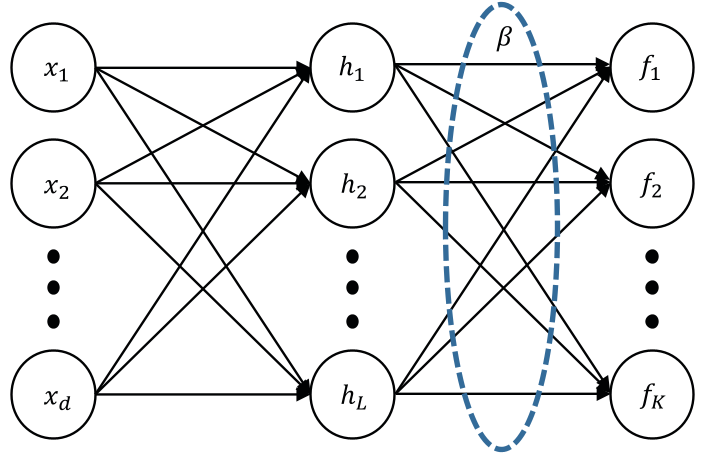
The core "Aha!" moment of this paper lies in the architecture of the Extreme Learning Machine (ELM). In an ELM, the weights between the input and hidden layers are randomly assigned and never changed. Only the output weights () are learned.
Because is calculated using a closed-form solution (the Moore-Penrose generalized inverse), the training process essentially boils down to calculating and .
Methodology: How PP-ELM Works
The authors propose a three-participant model: Data Contributors, an Outsourced Server, and a Data Analyst.
- Local Preprocessing: Data contributors calculate the hidden layer outputs () locally. Since they have the raw data, they can apply the exact Sigmoid function. They then compute the products () and ().
- Encryption & Upload: These products are encrypted using an additively homomorphic scheme and sent to the server.
- Encrypted Aggregation: The server simply sums the encrypted values. Because the encryption is additively homomorphic, the sum of ciphertexts equals the ciphertext of the sum.
- Final Solve: The Data Analyst decrypts the aggregated matrices and solves the linear system to find .
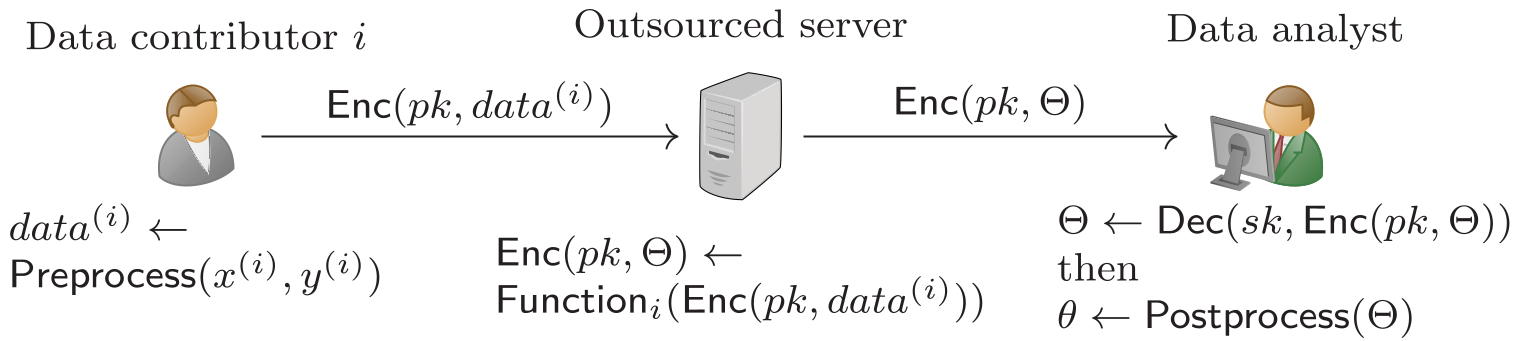
By moving the non-linear activation to the local client before encryption, the server only ever deals with linear additions, bypassing the need for complex "Fully Homomorphic Encryption" (FHE).
Experimental Results: No More Compromises
The performance of PP-ELM is striking when compared to Logistic Regression models that use polynomial approximation (PP-Logistic).
| Dataset | PP-ELM (L=300) | PP-Logistic (Approx) | Logistic (Plaintext) |
|---|---|---|---|
| Shuttle | 99.7% | 87.3% | 93.3% |
| Digits | 96.5% | 88.9% | 92.5% |
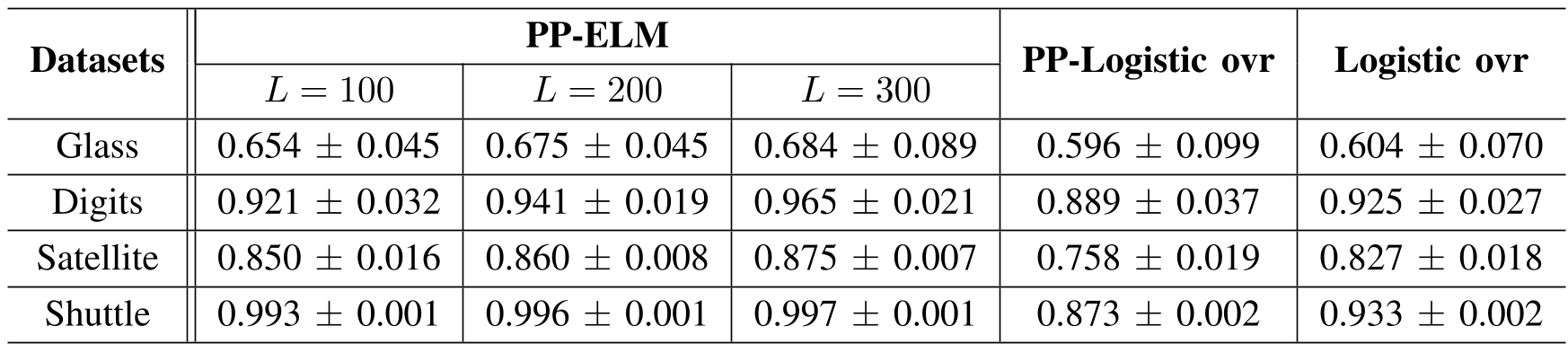
The results show that PP-ELM doesn't just match the performance of plaintext models—it often exceeds them because the underlying ELM is a powerful non-linear learner that doesn't lose its "intelligence" during the encryption process.
Critical Insight: Efficiency vs. Security
The computational cost for the server is . While the encryption/decryption adds some overhead (hundreds of milliseconds), it is a small price to pay for the ability to aggregate data from multiple sources (like different banks or hospitals) without any party ever seeing the raw input.
Limitations: The model currently assumes the Data Analyst is a "trusted" entity. In highly adversarial environments, one might need to combine this with Multi-Party Computation (MPC) to ensure the Analyst cannot reconstruct sensitive patterns from the decrypted matrices.
Conclusion
PP-ELM is a masterclass in "Algorithm-System Co-design." By picking a machine learning algorithm whose mathematical structure naturally aligns with the properties of additive encryption, the authors have created a fast, accurate, and secure pipeline for the next generation of cloud-based AI.