
Fine-Grained Privacy: Reconciling Granular Discovery with Anonymity in MSNs
Privacy-Preserving Fine-Grained Data Retrieval Schemes for Mobile Social Networks
The paper proposes two privacy-preserving fine-grained data retrieval schemes (centralized and decentralized) for Mobile Social Networks (MSNs). It introduces a novel approach using Bloom Filters combined with kNN-based encryption and bilinear pairing to allow users to match specific fine-grained topics and social attributes without revealing private interests to servers or unauthorized peers.
TL;DR
Navigating the trade-off between discovery and privacy is the "holy grail" of Mobile Social Networks (MSNs). This paper introduces a dual-model framework—centralized for infrastructure-heavy scenarios and decentralized for peer-to-peer ad-hoc needs—that allows users to find peers with highly specific interests (topics) under broader categories (subjects). By combining Bloom Filters with kNN-based encryption, the authors achieve efficient, private matching that hides user profiles even from the central server.
The Granularity Gap: Why "Interests" aren't Enough
In the context of MSNs, simply knowing two users like "Sports" isn't helpful if one wants to discuss the "1998 World Cup" while the other only follows "NBA 2024." This is the Granularity Gap.
Current solutions struggle with:
- Scalability: Assigning a unique cryptographic key to every possible sub-topic leads to key-management nightmares.
- Privacy Leakage: Curious servers (Honest-but-Curious threat model) can often glean user preferences just by observing access patterns or matching coarse profiles.
Methodology: The "Subject-Topic" Hierarchy
The core insight of this paper is the separation of broad subjects and fine-grained topics, protected by different layers of encryption.
1. The Centralized Scheme: Outsourcing without Trust
Users outsource their encrypted connection policies and topic lists to a server. The server can perform matching using a mathematical proof without ever decrypting the data.
- Bloom Filters: Instead of encrypting 1,000 separate topics, topics are hashed into a fixed-size Bloom Filter.
- Policy Matching: Using bilinear pairing, the server checks if a requester's attributes (e.g., "Resident of Cookeville" AND "Interested in Soccer") match the data owner's prescribed policy.
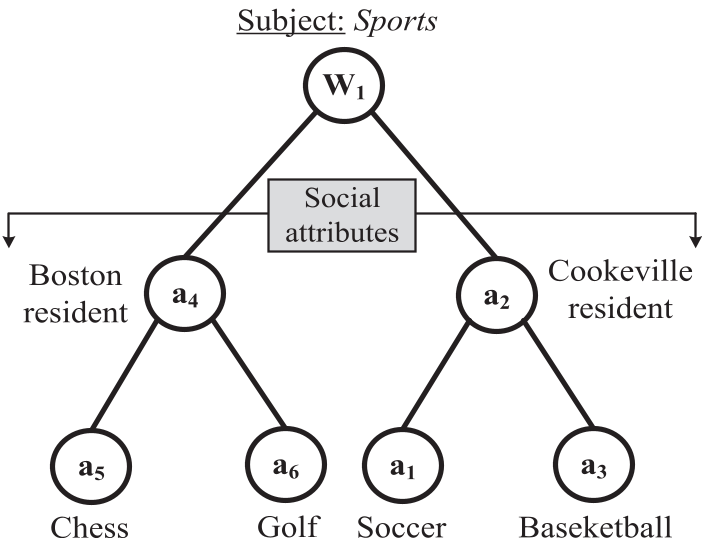 Fig 1: Using the dot product of encrypted Bloom Filters to verify topic existence.
2. The Decentralized Scheme: Transferable Trust
When Internet connectivity is unavailable, the system shifts to a P2P model based on Friends-of-Friends (FoF).
- Privacy-Preserving Forwarding: If a friend is not interested in your subject, they can pass the request to their friends. Crucially, through the proposed cryptographic construction, the intermediate friend cannot see what subject you are searching for.
- Bilinear Pairing: Ensures mutual authenticity between the requester and a potentially unknown friend-of-friend.
Experimental Validation
The authors implemented the system using the MIRACL library. The efficiency gains from Bloom Filters are the standout result.
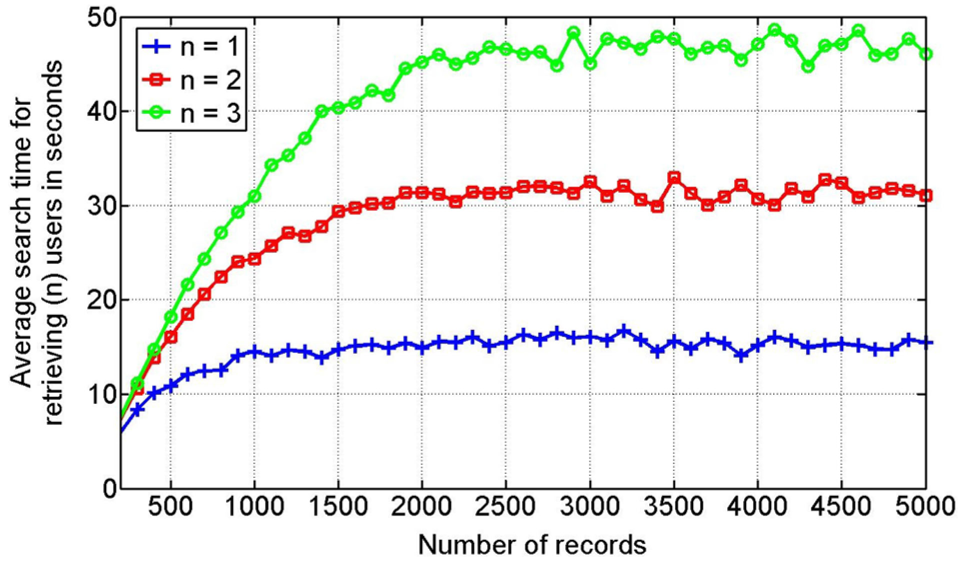 Fig 2: Search time efficiency—the server's search time stabilizes once a sufficient record pool size is reached, ensuring scalability.
Key Results:
- Storage Efficiency: Storing 800 topics in a 2.4 KB Bloom Filter is nearly 50x more efficient than using raw ASCII tags.
- Latency: Matching an access policy takes approximately 37.62 ms, making it viable for real-time mobile interaction.
- Accuracy: While Bloom Filters have false positives, the "n-trial" approach (returning multiple matches) effectively mitigates this, reducing failure probability to near zero with just 3-7 trials.
Critical Insight & Conclusion
The true value of this work lies in its hybrid strategy. By utilizing Evenly Distributed Bloom Filters (EDBF), the authors demonstrate how to manage the "False Positive" explosion that usually occurs when a filter gets too crowded. This allows the system to remain "fine-grained" without the computational cost of traditional Private Information Retrieval (PIR) methods.
While the reliance on a "Trusted Authority (TA)" for initial key distribution remains a bottleneck typical of such architectures, the scheme's ability to provide unlinkability and collusion resistance makes it a robust blueprint for future privacy-first social applications.