
Harmonizing Privacy and Competence: Fine-Grained Task Allocation in Crowdsourcing
Privacy-Preserving Interest-Ability Based Task Allocation in Crowdsourcing
This paper proposes a privacy-preserving interest-ability based task allocation scheme for crowdsourcing. It combines Attribute-Based Encryption (ABE) and Proxy Re-Encryption based Searchable Encryption (PRE-SE) to achieve fine-grained task matching and worker qualification verification without exposing sensitive task tags or worker profiles.
TL;DR
This research addresses the critical trade-off between privacy and efficiency in crowdsourcing. By merging Attribute-Based Encryption (ABE) for ability verification and Proxy Re-Encryption based Searchable Encryption (PRE-SE) for interest matching, the authors enable a system where the server allocates tasks accurately without ever "seeing" what the task is or what the worker is interested in.
The "Curious Server" and the "Greedy Worker"
In current crowdsourcing ecosystems (like Amazon Mechanical Turk or InnoCentive), the central server is an omniscient intermediary. It knows every task detail and every worker's profile. This creates a massive privacy risk if the server is compromised or "honest-but-curious."
Simultaneously, there is a trust gap: workers might claim expertise they don't have to grab high-paying tasks. Prior works either protected privacy but ignored worker competence, or verified competence while sacrificing privacy. This paper bridges that gap.
Methodology: The Dual-Shield Architecture
The core innovation lies in the separation of Interest Matching and Ability Verification.
1. Interest Matching via PRE-SE & LSSS
Instead of searching through plaintexts, the server performs matching on encrypted keywords. The authors use a Linear Secret-Sharing Scheme (LSSS) to allow workers to express complex interests (e.g., "I am interested in (Data Science AND Python) OR Blockchain"). To ensure the server doesn't even know which keyword corresponds to which part of the logic, they remove the mapping functions from the LSSS structure.
2. Ability Verification via CP-ABE
How do you prove you can do a task without the server knowing the task?
- The task content is encrypted via CP-ABE under a specific policy (e.g., "Requires PhD and Cryptography").
- Only a worker with matching attributes can decrypt a secret .
- The worker then uses to sign a challenge from the server using an ElGamal signature.
- The server verifies the signature—proving the worker successfully decrypted the secret (and thus has the skills)—without ever seeing the task content or the worker's specific attributes.
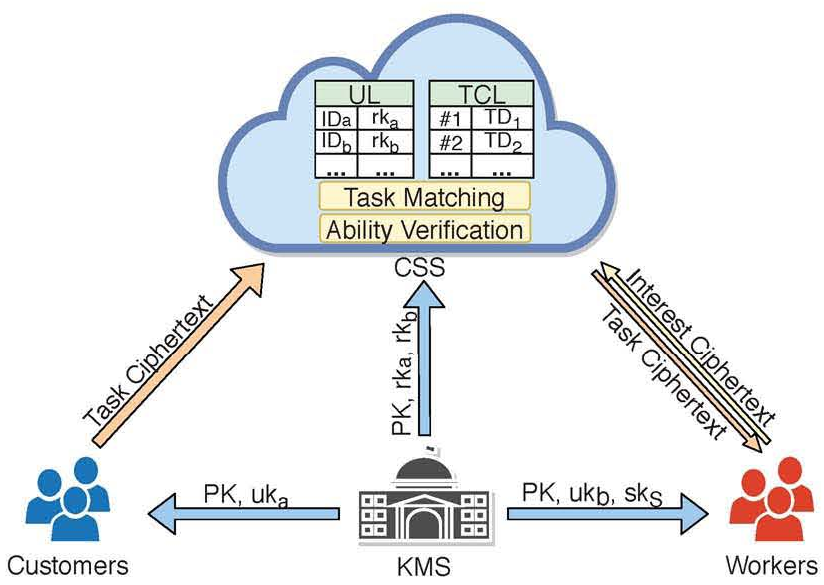 Fig 1: The interaction between Customers, Workers, the Crowdsourcing Server (CSS), and Key Management Server (KMS).
Performance & Practicality
Crucially, high security doesn't come at the cost of crippling latency. The experiments reveal:
- Scalability: Encryption time grows linearly, not exponentially, with the number of keywords/attributes.
- Efficiency: Re-encryption—the heaviest lift for the server—is optimized to sub-20ms levels even for 100 keywords.
- Storage: By using a Trapdoor Component List (TCL), the server avoids redundant storage of identical interests from different workers.
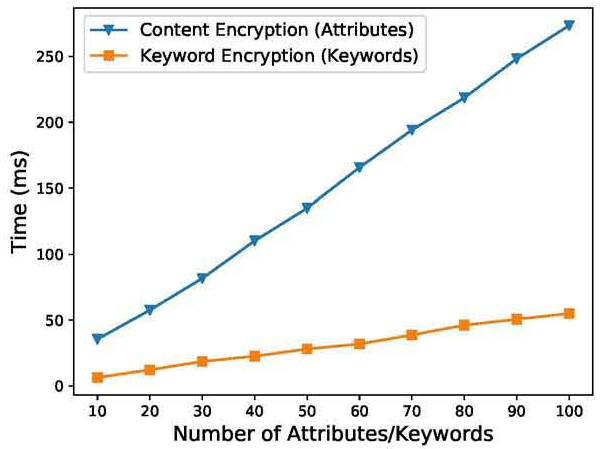 Fig 2: Computation overhead for Customers and Workers across varying task complexities.
Critical Insight: The Future of Blind Allocation
The value of this paper extends beyond crowdsourcing. Its "Matching + Verification" logic is highly relevant to Privacy-Preserving Ad-Tech and Decentralized Finance (DeFi).
However, two limitations remain:
- Revocation Complexity: While the paper suggests attribute revocation methods, actual implementation in a high-churn worker environment remains computationally expensive.
- Search Pattern Privacy: The server can still see when and how often certain encrypted tags match, which could lead to inference attacks over time.
In conclusion, the proposed interest-ability framework moves us one step closer to a digital economy where professional competence and personal privacy are no longer mutually exclusive.